Trick of the Trade: Needlestick hotline 888-448-4911

NeedlstickGlove

You are a fourth-year medical student and super-excited to be doing your first supervised central line procedure on an actual patient. You have done so many central lines on mannequins and simulations. You feel ready. In your excitement, however, you stick yourself with the 22 gauge finder needle after you successfully get a flash-back of the patient’s venous blood.

After handing off the procedure to your senior resident, you go into a mild panic. Your patient is a known HIV patient with an unknown CD4 count and viral load. After taking off your gloves and washing your hands, you report this to the attending.

Should you start post-exposure prophylaxis medications for HIV? You remember that if post-exposure HIV medications are recommended, you should start it immediately and definitely within 2 hours of exposure.

It’s difficult to concentrate when faced with so many questions whirling in your mind.

(more…)

By |2019-01-28T22:38:19-08:00Sep 27, 2011|Infectious Disease, Tricks of the Trade|

Trick of the Trade: Pediatric ear exam

ChildEaraches2

Performing a physical exam on frightened pediatric patients can often be challenging. I am always thrilled to add more child-whisperer techniques to my arsenal of tricks. I have written in the past about:

What’s your trick on performing an otoscope exam of the ears?

(more…)

By |2019-02-19T18:08:03-08:00Sep 20, 2011|ENT, Pediatrics, Tricks of the Trade|

Trick of the Trade: Dix-Hallpike maneuver variation

Hallpike-dix maneuver

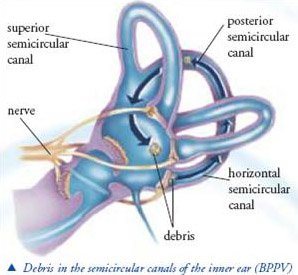
The Dix-Hallpike maneuver is used to help diagnose benign paroxysmal positional vertigo (BPPV).

  • Place the gurney’s head of the bed down flat.
  • Reposition the patient so that s/he is sitting another 12 inches or so closer towards the head of the flat gurney.
  • Rotate patient’s head 45 degrees.
  • Help the patient lie down backwards quickly.
  • The patient’s head should be hanging off of the gurney edge in about 20 degrees extension.
  • Observe for rotational nystagmus after a 5-10 second latency period, which confirms BPPV.

I find 2 things challenging in this maneuver.

  • The patient often does not like to be moved AT ALL while feeling nauseously vertiginous. This even includes trying to reposition the seated patient closer to the head of the bed. This requires them to look behind them to see what where they are going, which sets off more vertigo.
  • In some of our ED rooms and hallways, the head of the gurney bed is often abutting a wall, a portable monitor, or some equipment. It takes a little fancy shuffling to make room for the Dix-Hallpike maneuver.

Trick of the Trade: A modified Dix-Hallpike maneuver

Place blankets or a pillow under the shoulders for the Dix-Hallpike maneuver.

Hallpike-dix maneuver pillow blanket


The key is to maintain about 20-30 degrees of neck extension to align the posterior semicircular canals with the direction of gravity. Placing several blankets under the patients’ shoulders can accomplish this same position without having to scoot the patient close to the gurney edge. I’m sure the patient would appreciate keeping their head movement to a minimum.

By |2020-01-07T23:52:15-08:00Aug 30, 2011|ENT, Neurology, Tricks of the Trade|

Trick of the Trade: Crossed straight leg raise test

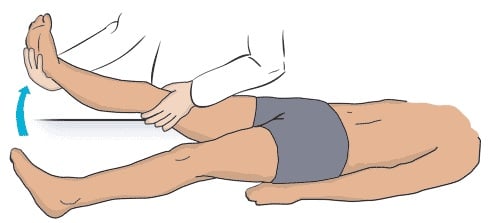
SLRA 35 year old man presents with low back pain which radiates down his right leg to the level of the knee. Is this sciatica?

Low back pain is one of the most common chief complaints that we see in the Emergency Department. In addition to the examination of the back and distal neurovascular function, we also need to test for evidence of a radiculopathy (compression or inflammation of a nerve root typically from a herniated disk). Because most disk herniations occur at the L4-L5 and L5-S1 level, you should test for irritation of the L4-S1 nerve roots. This is the sciatic nerve.

(more…)

By |2016-11-11T18:52:17-08:00Aug 23, 2011|Orthopedic, Tricks of the Trade|
Go to Top