Trick of the Trade: Urine pregnancy test without urine
A 25 year old woman presents to the Emergency Department having syncopized in the waiting room, where she was triaged with the chief complaint of abdominal pain. Ectopic pregnancy immediately bubbles to the top of your differential diagnosis. The patient is too dizzy to walk to the bathroom to give you a urine specimen to check a urine pregnancy test. Plus, she admits that she just urinated in the waiting room bathroom a few minutes ago – so no urine now.
Trick of the Trade
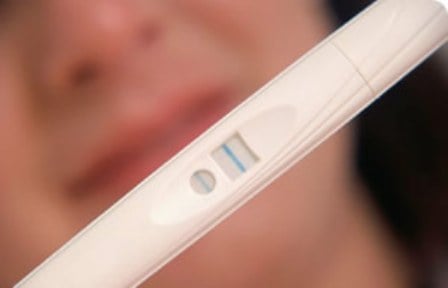
Apply several drops of whole blood (instead of urine) into the pregnancy test cassette. In the photo below, the patient was pregnant with a serum beta-HCG level of 250 mIU/mL whose urine and whole blood qualitative tests were both positive.

Did you know that most urine pregnancy test kits are approved for both urine and serum samples? On a quick Google search, I found that Accutest, Cardinal Health, ICON, OSOM, and Rapid Response all are approved for both. The question is whether this will work for whole blood.
One study 1 in the Journal of Emergency Medicine by Dr. Fromm from Maimonides Medical Center looked at exactly this issue. Whole blood pregnancy test performed extremely well, especially if positive:
- Sensitivity 95.8%
- Specificity 100%
- Negative predictive value 97.9%
- Positive predictive value 100%
In their study, very low beta-HCG values (<159 mIU/mL) occasionally yielded a false negative for whole blood pregnancy tests. The whole blood testing approach missed a total 9 of 425 pregnancies. Interestingly, the urine pregnancy test was also negative in 5 of those 9 and not performed in the other 4.
Bottom Line
Believe a positive test. Confirm all tests with a urine qualitative test or quantitative serum beta-HCG.
Tip
- Be sure to wait at least 5 minutes when using whole blood in the kit. It sometimes takes a while.
- Do not apply additional drops of water or saline to the whole blood sample. This causes unnecessary dilution. Just wait for the blood to osmose across the entire test strip.
- This is trick is ONLY for medical professionals and not the lay public. We are discussing an actual blood draw and not a simple cut on a finger to obtain blood.
Another example courtesy of Dr. Joe Habboushe (New York Hospital–Queens of Cornell University) and Dr. Graham Walker (Stanford) 2 :


S = Sample well; T = Test specific (will show bar if +HCG); C = Control (will always have a bar)
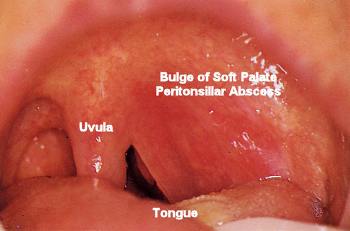 Peritonsillar abscess drainage in the ED continues to be one of my favorite procedures to perform. There are several tricks to increase your chances for a successful aspiration.