DOI: 10.1016/j.annemergmed.2026.05.015 | PubMed: PMID 42429726
Every emergency physician knows these moments. A 10-year-old with autism is escalating in a hallway bed, and nobody can say which de-escalation approach or which medication is safest for him. A 15-year-old is boarding for a third night after a suicide attempt, receiving no active treatment while she waits for a psychiatric bed. A charge nurse asks whether universal suicide screening is worth the workflow disruption. These are routine clinical decisions, and for most of them the pediatric evidence simply does not exist.
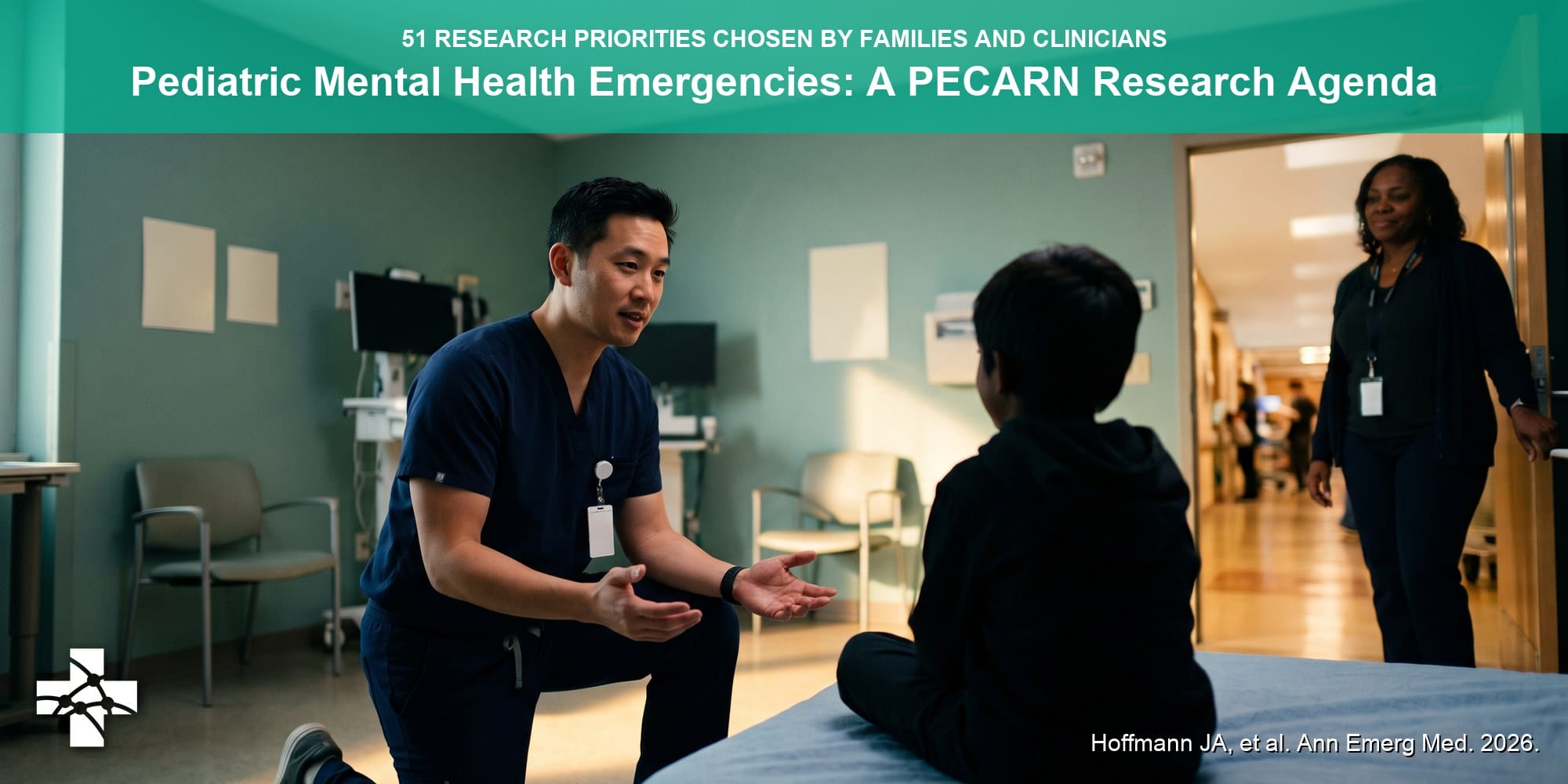
A new consensus statement from the PECARN Mental Health Working Group, A Research Agenda for Acute Pediatric Mental and Behavioral Health Emergencies, published in Annals of Emergency Medicine, maps where those evidence gaps are and which ones matter most [1]. The panel reached consensus on 51 research priorities, 31 of them top tier. Read as a whole, the agenda is an unusually honest inventory of how much of current pediatric behavioral health emergency care runs on extrapolation and local habit.
Background
One in 6 US children has a mental or behavioral health condition, and nearly half receive no treatment from a mental health professional [2]. The ED has become the de facto safety net: visits for self-harm and harm to others have risen substantially over the past decade, boarding times have stretched, and in 2021 the American Academy of Pediatrics, the American Academy of Child and Adolescent Psychiatry, and the Children’s Hospital Association jointly declared a national emergency in child and adolescent mental health [3]. What has not kept pace is the evidence for what emergency clinicians should actually do during these visits.
How the Agenda Was Built
The working group used a modified Delphi process with 23 expert partners: 4 parents and 1 young adult with lived experience of pediatric mental health emergency care, general and pediatric emergency physicians, emergency nurses, child and adolescent psychiatrists with emergency expertise, ED social workers, out-of-hospital and EMS-fellowship-trained clinicians, and a research funder. Across 3 survey rounds, 76 literature-informed candidate priorities were modified, expanded, and rated on need and urgency, research impact, and family centeredness. The prespecified retention criteria required agreement from both the family representative group and the clinician and funder group, so family voices could not be outvoted. The result: 51 consensus priorities sorted into 3 tiers.
Where the Gaps Are
Suicide prevention dominates
Suicide prevention questions account for 42% of the top tier. The panel wants to know which suicide risk screening tool best predicts real outcomes such as return visits, attempts, and deaths, including in neurodivergent children and non-English speakers; what universal screening does to those outcomes; and whether safety planning, with or without structured follow-up calls, actually increases mental health follow-up and reduces future attempts in youth. The contrast with adult evidence is striking. In adults, the multicenter ED-SAFE trial showed that universal screening plus a brief intervention reduced post-discharge suicidal behavior [4]. The pediatric equivalent has never been done. The panel also prioritized a practical lethal-means question: which safety devices, from medication lock boxes to firearm safes, do caregivers actually prefer and use after the ED visit?
Agitation: everything is still an open question
Which de-escalation methods best reduce medication use, restraint use, and staff injuries, and how does that differ by age, developmental stage, culture, language, and trauma history? Which medications are safest and most effective, for which children? What works for children with neurodevelopmental disorders such as autism spectrum disorder, who face a higher risk of pharmacologic and physical restraint? None of these have comparative evidence today, even though documented racial disparities in restraint application make the stakes plain [1].
Boarding and ED care
Top-tier questions include whether brief therapy delivered in the ED during boarding improves symptoms, shortens length of stay, and lowers admission rates, and whether home-based care is a safe and acceptable alternative to hospitalization. The panel also flagged care in rural and low-resource EDs, where most of these children are actually seen.
Before and after the ED
Out-of-hospital priorities center on training first responders in de-escalation and trauma-informed care and on testing novel response models, including mental health co-response teams and alternative destinations. A single-county pilot of direct EMS transport to a psychiatric emergency facility found that roughly 2 in 5 encounters met criteria for direct transport, with only 0.5% requiring secondary ED transfer within 24 hours [5]. On the back end, the agenda targets the high-risk post-discharge window: what actually gets youth to mental health care after they leave, and whether stepped-care models using telehealth reduce return visits and future attempts.
Clinical Implications
Nothing in a research agenda changes tomorrow’s orders, and this post will not pretend otherwise. The value for a practicing clinician is different. First, the agenda names how thin the floor is under common practices: medication choice for acute agitation in children, for example, is largely extrapolated from adult psychiatry. Knowing where evidence is absent should make us slower to treat local protocol as settled science. Second, this document signals where PECARN and federal funders will direct pediatric emergency mental health research over the next 5 to 10 years, which is useful for anyone building a QI program, a research career, or a departmental protocol they would prefer not to rewrite twice. Third, the top-tier questions double as an audit checklist: if your ED cannot say how often it restrains children, whether safety planning happens before discharge, or what its mental health boarding times are, the agenda is a reasonable place to start measuring.
One limitation deserves mention because the authors themselves flag it: no expert partners identified as Black or Hispanic, a notable gap given the documented racial disparities in restraint use and in behavioral health triage that PECARN’s own work has described.
Bottom Line
PECARN’s consensus research agenda distills the pediatric mental and behavioral health emergency evidence gap into 51 prioritized questions, with suicide prevention accounting for 42% of the top tier. It will not change your practice today. It tells you something more uncomfortable and more useful: for most of what we do during pediatric behavioral health visits, from de-escalation to safety planning to boarding care, the evidence base has not been written yet, and this is the field’s official to-do list for writing it.
References
- Hoffmann JA, Foster AA, Krass P, et al. A research agenda for acute pediatric mental and behavioral health emergencies. Ann Emerg Med. Published online July 10, 2026. PMID: 42429726. doi:10.1016/j.annemergmed.2026.05.015
- Bitsko RH, Claussen AH, Lichstein J, et al. Mental health surveillance among children – United States, 2013-2019. MMWR Suppl. 2022;71(2):1-42. PMID: 35202359. doi:10.15585/mmwr.su7102a1
- American Academy of Pediatrics, American Academy of Child and Adolescent Psychiatry, Children’s Hospital Association. AAP-AACAP-CHA declaration of a national emergency in child and adolescent mental health. 2021.
- Miller IW, Camargo CA Jr, Arias SA, et al. Suicide prevention in an emergency department population: the ED-SAFE study. JAMA Psychiatry. 2017;74(6):563-570. PMID: 28456130. doi:10.1001/jamapsychiatry.2017.0678
- Glomb NW, Trivedi T, Grupp-Phelan J, et al. Safety of a prehospital emergency medical services protocol for an alternative destination for pediatric behavioral emergencies in Alameda County. J Am Coll Emerg Physicians Open. 2023;4(2):e12930. PMID: 37051504. doi:10.1002/emp2.12930

Professor and Digital Innovation Lab Director
Department of Emergency Medicine
University of California, San Francisco
@M_Lin
Latest posts by Michelle Lin, MD (see all)
- Pediatric Pneumonia Without Routine Chest X-Rays: How Much Weight Should We Give the Lung Exam? - September 25, 2026
- Sickle Cell Acute Pain Episodes: Lessons Learned from the Prematurely Halted PECARN STArT Trial - August 24, 2026
- What We Still Do Not Know About Pediatric Mental Health Emergencies: PECARN Research Agenda - July 13, 2026