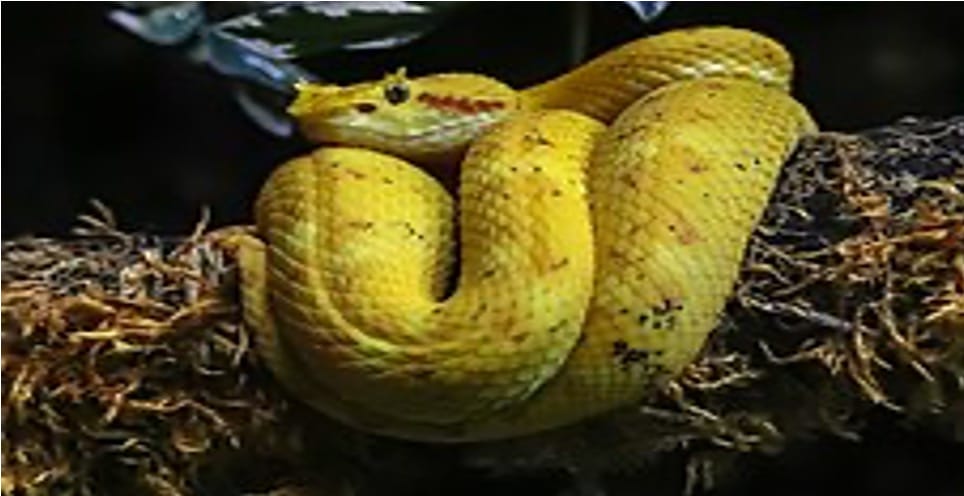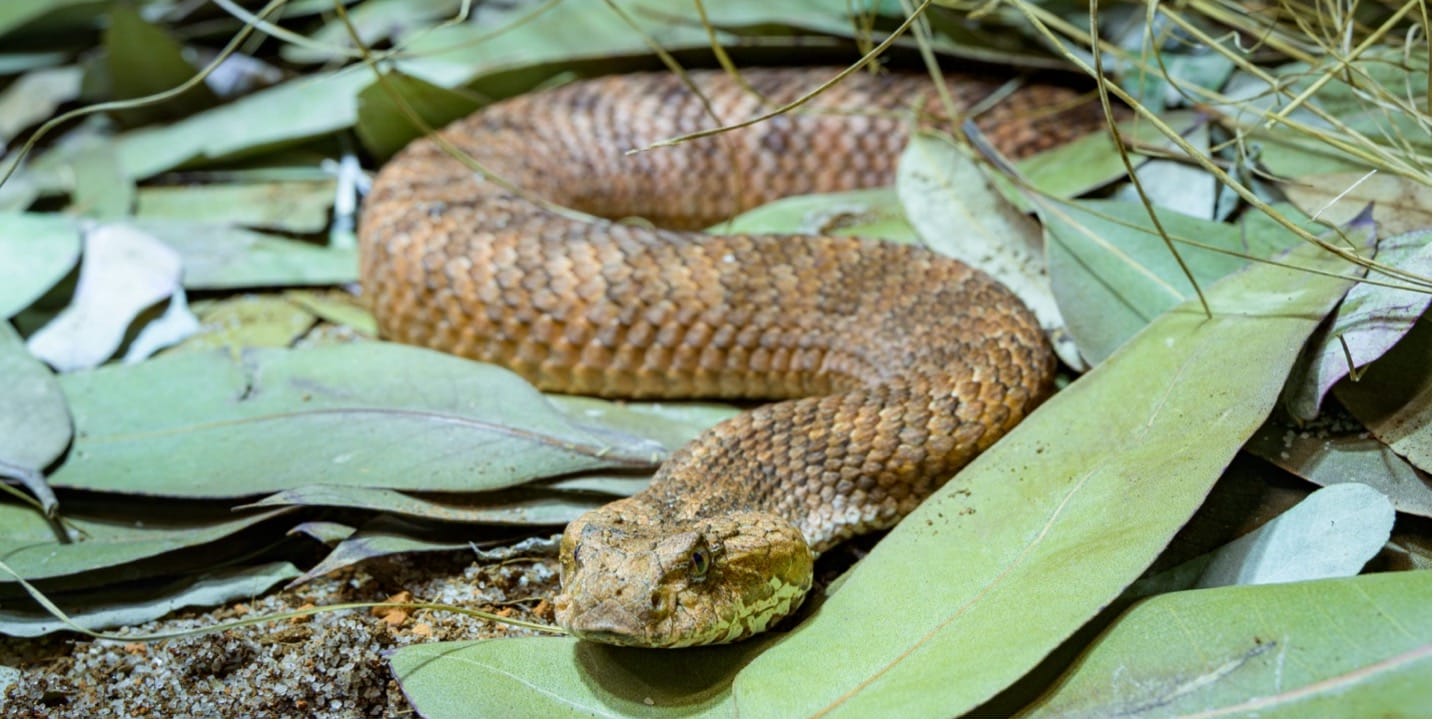
Envenomation from this oceanic snake would most likely lead to which of the following symptoms?
- Acute renal failure
- Blindness
- Descending paralysis
- Localized skin necrosis
[Image courtesy of Petr Hamernik – Zoo Praha, Wikimedia Commons]

The American College of Medical Toxicology hosts this Toxicology Visual Pearls series. The post was peer-reviewed on behalf of ACMT by Drs Spencer Greene, Howard A Greller, and Louise Kao.
References
- Falla MV, Sousa EP, Morais-Zani K, et al. Functional and Proteomic Characterization of Acanthophis Antarcticus Venom: Evidence of Fibrinogenolytic and Serine Peptidase Inhibitory Activities. Toxins (Basel). 2025;17(8):405. PMID: 40864081.
- Fry BG, Wickramaratna JC, Jones A, Alewood PF, Hodgson WC. Species and Regional Variations in the Effectiveness of Antivenom Against the in Vitro Neurotoxicity of Death Adder (Acanthophis) Venoms. Toxicol Appl Pharmacol. 2001;175(2):140-148. PMID: 11543646.
- Tasoulis T, Wang CR, Ellis S, et al. The Venom Proteome of the Ecologically Divergent Australian Elapid, Southern Death Adder Acanthophis Antarcticus. Toxins (Basel). 2025;17(7):352. PMID: 40711163.
- Johnston CI, O’Leary MA, Brown SG, et al. Death Adder Envenoming Causes Neurotoxicity Not Reversed by Antivenom–Australian Snakebite Project (ASP-16). PLoS Negl Trop Dis. 2012;6(9):e1841. PMID: 23029595.
- Blacklow B, Konstantakopoulos N, Hodgson WC, Nicholson GM. Presence of Presynaptic Neurotoxin Complexes in the Venoms of Australo-Papuan Death Adders (Acanthophis Spp.). Toxicon. 2010;55(6):1171-1180. PMID: 20064542.
- Currie BJ. Snakebite in Tropical Australia: A Prospective Study in the “Top End” of the Northern Territory. Med J Aust. 2004;181(11-12):693-697. PMID: 15588215.
- Seifert SA, Armitage JO, Sanchez EE. Snake Envenomation. N Engl J Med. 2022;386(1):68-78. PMID: 34986287.
- Lieu K, Livshits Z, LeSaint KT. Venomous Snakes and Snakebites. JAMA. 2025;334(16):1494. PMID: 40875216.
- Blacklow B, Escoubas P, Nicholson GM. Characterisation of the Heterotrimeric Presynaptic Phospholipase A(2) Neurotoxin Complex From the Venom of the Common Death Adder (Acanthophis Antarcticus). Biochem Pharmacol. 2010;80(2):277-287. PMID: 20361942.
- Isbister GK, Brown SG, Page CB, et al. Snakebite in Australia: A Practical Approach to Diagnosis and Treatment. Med J Aust. 2013;199(11):763-768. PMID: 24329653.
- Lalloo DG, Trevett AJ, Black J, et al. Neurotoxicity, Anticoagulant Activity and Evidence of Rhabdomyolysis in Patients Bitten by Death Adders (Acanthophis Sp.) in Southern Papua New Guinea. QJM. 1996;89(1):25-35. PMID: 8730340.
- Tibballs J. Australian Snake Antivenom Dosing: What Is Scientific and Safe? Anaesth Intensive Care. 2020;48(2):129-133. PMID: 31505950.
- Warrell DA, Williams DJ. Clinical Aspects of Snakebite Envenoming and Its Treatment in Low-Resource Settings. Lancet. 2023;401(10385):1382-1398. doi:10.1016/S0140-6736(23)00002-8. PMID: 36931290.
- Flachsenberger W, Mirtschin P. Anticholinesterases as Antidotes to Envenomation of Rats by the Death Adder (Acanthophis Antarcticus). Toxicon. 1994;32(1):35-39. doi:10.1016/0041-0101(94)90019-1. PMID: 9237335.

Scott Dimeo, MD
Emergency Medicine Resident
Carolinas Medical Center
Carolinas Medical Center
Latest posts by Scott Dimeo, MD (see all)
- ACMT Toxicology Visual Pearl – The Fang and the Furious - June 30, 2026

Erik Fisher, MD
Associate Program Director, Medical Toxicology Fellowship
Atrium Health Carolinas Medical Center and Levine Children's Hospital
Clinical Assistant Professor of Emergency Medicine
Wake Forest School of Medicine
Atrium Health Carolinas Medical Center and Levine Children's Hospital
Clinical Assistant Professor of Emergency Medicine
Wake Forest School of Medicine
Latest posts by Erik Fisher, MD (see all)
- ACMT Toxicology Visual Pearl – The Fang and the Furious - June 30, 2026
- ACMT Toxicology Visual Pearl: Delayed Skin Burn - May 5, 2026
- ACMT Toxicology Visual Pearl: Sleeping with the Fishes - February 24, 2026