The patient is an 82-year-old female who presents to the Emergency Department after an unwitnessed fall from standing approximately 2 hours prior to arrival. The patient states that she thinks she lost her balance and fell, striking her face. She denies loss of consciousness or any antecedent dizziness or presyncopal symptoms, but has limited recollection of the event. At presentation, she reports pain to the left side of the face, a laceration to the left side of her face, and decreased vision in her left eye. She has no other complaints at this time and denies any other injuries.
Vitals: BP 184/86 HR 83 R 17 T 98.4 O2sat 85% room air
General: Awake, alert, conversational, and in mild distress from pain.
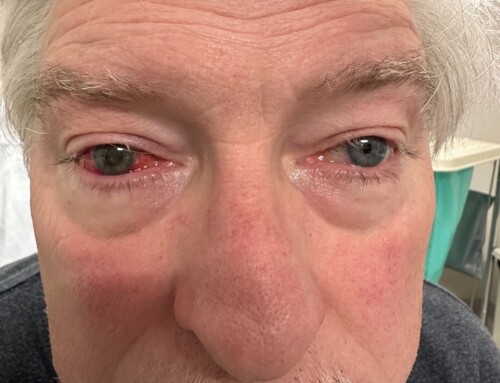
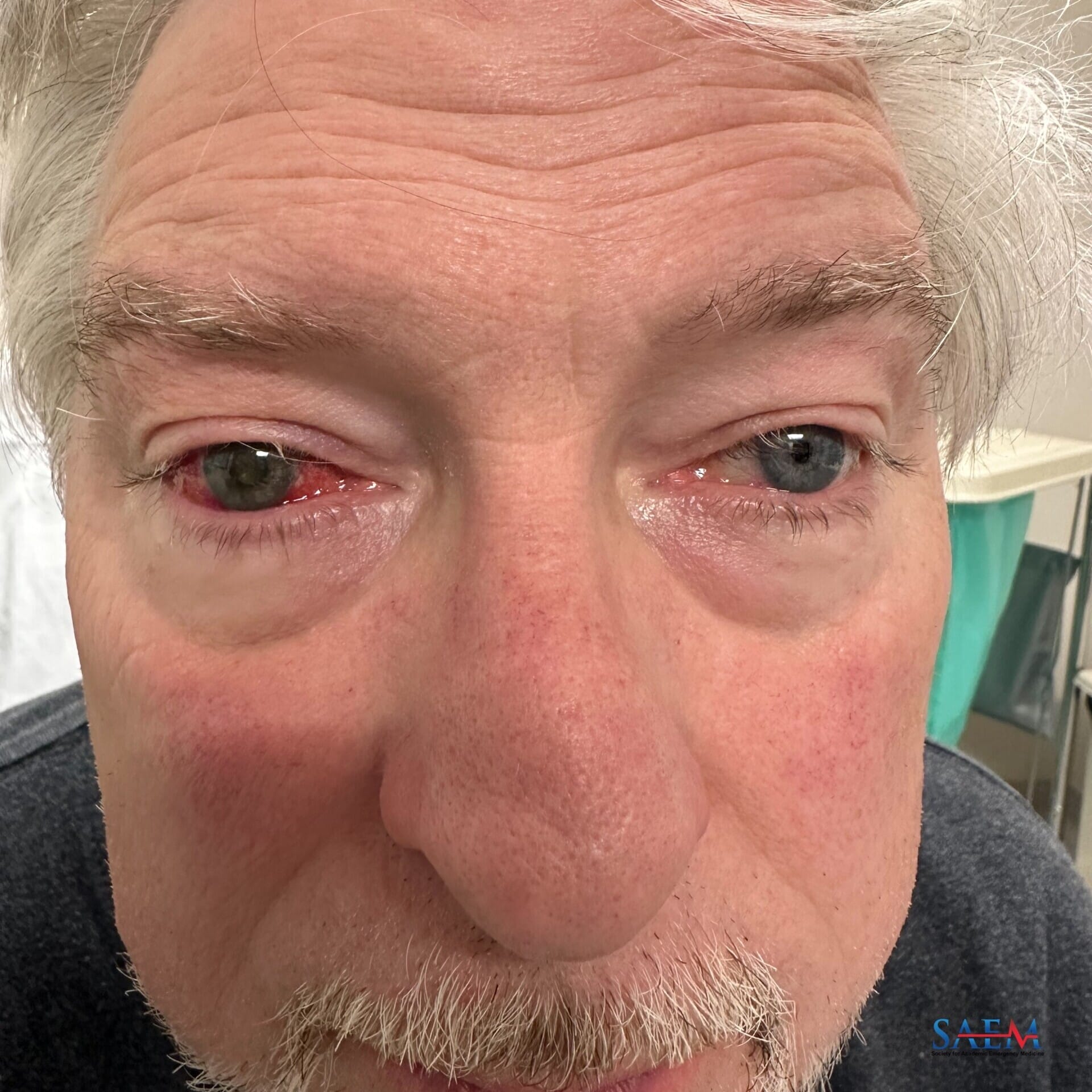
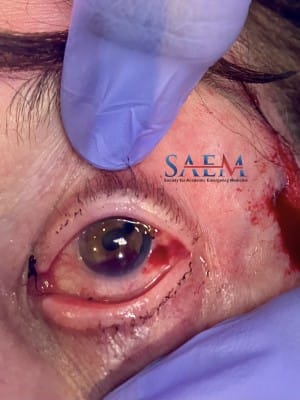
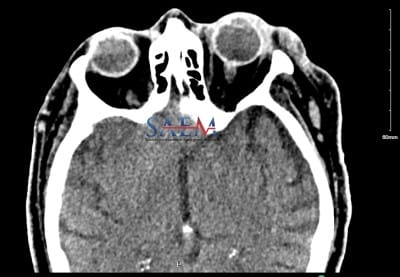
HEENT: 2cm laceration over the left temple. Eye exam physical findings as shown in the image provided. Visual acuity 20/30 OD, 20/100 OS. Visual fields intact. Extraocular movement intact. Right pupil reactive to light. Left pupil non-reactive to light. Tympanic membranes clear. Examination otherwise unremarkable.
This patient has a hyphema, uveal prolapse, iridodialysis, teardrop pupil, and subconjunctival hemorrhage.
This patient has a ruptured globe.
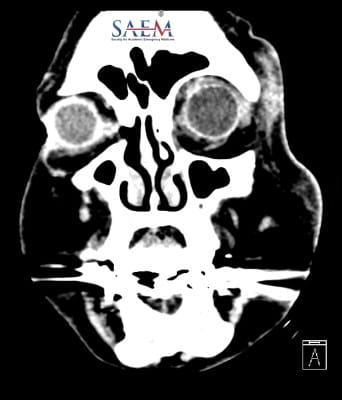
This patient has a ruptured globe with multiple significant traumatic eye findings on examination. The clinical image shows a globe rupture with the iris prolapsing through a corneal defect at the 2 o’clock position, an irregularly shaped (teardrop) pupil, a hyphema, iridodialysis (separation of the iris from the ciliary body), and a subconjunctival hemorrhage. CT is specific for diagnosing a globe rupture, but a negative CT scan does not definitively rule out a globe rupture. Management of globe rupture includes emergent ophthalmologic consultation, firm ocular shield, antibiotics, and tetanus prophylaxis if indicated. The initial ED management of a globe rupture should focus on preventing further expulsion of additional intraocular material. Anti-emetics should be given to prevent vomiting, which may cause a sudden rise in intraocular pressures and expulsion of intraocular contents.
Take-Home Points
- Do not put any pressure on the eye in cases of suspected globe injury. Commercial firm ocular shields are available, but the bottom of a Styrofoam or Dixie cup can be used if such a shield is unavailable.
- Emergency Department treatment is aimed at expediting emergent ophthalmology consultation and definitive management while minimizing further damage to the eye.
- Romaniuk VM. Ocular trauma and other catastrophes. Emerg Med Clin North Am. 2013; 31(2): 399-411. PMID: 23601479. DOI: 10.1016/j.emc.2013.02.003.
- Mohseni M, Blair K, Gurnani B, Bragg BN. Blunt eye trauma. In: StatPearls [Internet]. Treasure Island (FL): StatPearls Publishing; 2023. PMID: 29261988.

Laryssa Patti, MD
Emergency Medicine Clerkship Director
Department of Emergency Medicine
Rutgers - Robert Wood Johnson Medical School
Latest posts by Laryssa Patti, MD (see all)
- SAEM Clinical Images Series: Ocular Trauma Following Ground Level Fall - December 15, 2025
- How I Work Smarter: Laryssa Patti, MD - May 19, 2021
- Banishing Busy: Part 3 - July 17, 2020

Mary Rometti, MD
Emergency Medicine
RWJBarnabas Health - Community Medical Center
Latest posts by Mary Rometti, MD (see all)
- SAEM Clinical Images Series: Ocular Trauma Following Ground Level Fall - December 15, 2025