Trick of the trade: Irrigating scalp lacerations
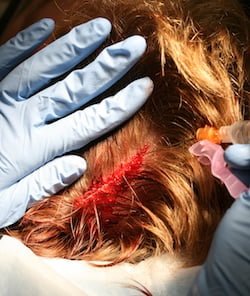
Laceration_Scalp1smThanks to my new-found Emergency Medicine friend in Turkey, Dr. John Fowler has some useful tips about scalp lacerations.

Often patients with scalp lacerations have clotted blood in their hair. While we can irrigate the wound itself (and unavoidably soaking the patient in cold irrigation fluid), a lot of blood remains stuck in their hair. It would be nice if we could completely wash out the blood. This would further allows us to detect occult scalp lacerations.

(more…)

By |2019-02-19T18:48:05-08:00Jan 27, 2010|Tricks of the Trade|

Trick of the Trade: Modified hair apposition technique

modified hair apposition technique

I got a nice email from Dr. John Fowler from Turkey who recently published a modified version of the Hair Apposition Technique (HAT) trick in the American Journal of Emergency Medicine in 2009.

Read more about the traditional HAT trick.

The HAT trick allows for scalp laceration closure by using scalp hair and tissue adhesive glue. Contraindications to this technique for wound closure include hair strands less than 3 cm, because it is difficult to manually manipulate short hair.

(more…)

By |2019-11-29T19:03:44-08:00Jan 20, 2010|Trauma, Tricks of the Trade|

Trick of the Trade: Finger nailbed laceration repair

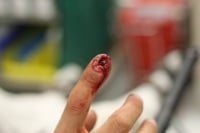
LacFingernailsmOver the years, I have been frustrated by how inelegant finger nailbed closure is. Nailbed lacerations are often sustained by a major crush injury, resulting in a stellate and irregular laceration pattern. This typically also requires the crushed fingernail to be removed. Cosmesis is never ideal because pieces of the nailbed are often missing, as seen in the photo above.

Occasionally, nailbed lacerations are caused by a cutting rather than a crush mechanism. In these cases, I use a different technique. I leave the fingernail on. In fact, I use the fingernail to help reapproximate the nailbed edges.

(more…)

By |2016-11-11T19:01:44-08:00Jan 6, 2010|Orthopedic, Tricks of the Trade|

Trick of the Trade: Laryngoscope lifting strength

IntubationYou are about to endotracheally intubate a patient. As you struggle to elevate the laryngoscope more anteriorly, has your left hand ever trembled while trying to see the vocal cords? Before you say, “I think the cords are too anterior, hand me the [insert your favorite backup airway adjunct]“, let’s focus on some basics.

How can you gain significantly more laryngoscope lift strength? You can do more left arm bicep/tricep exercises, or…

(more…)

By |2016-11-11T19:01:46-08:00Dec 16, 2009|Tricks of the Trade|

Trick of the Trade: Subclavian line gone north

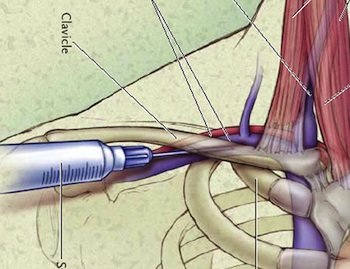
SubclavianNEJManatIn patients requiring central venous access, which vein do you prefer? In descending order, I prefer subclavians, internal jugulars (IJ), and then femorals.

There is increasing evidence that subclavian central venous lines are superior to femoral lines (JAMA 2001) with respect to iatrogenic infection and thrombosis rates. In 9% of subclavian lines, however, the line tip ends up in the ipsilateral IJ, instead of the superior vena cava (SVC) – see chest xray below. These lines are unusable in the long term because of the risk of cathether thrombosis in this low-flow area. The line must must be rewired.

(more…)

By |2016-11-11T19:01:49-08:00Dec 2, 2009|Tricks of the Trade|

Trick of the trade: Straightening the guidewire

Screen Shot 2012-10-31 at 9.05.43 AM

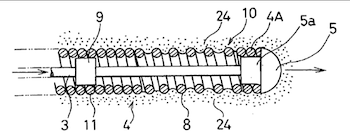
Did you know that a medical guidewire consists of a flexible central “ribbon wire” externally wrapped with a coil-spring wire?

J-shaped guidewires are commonly used in many medical procedures, such as central lines, arterial lines, and pigtails for pneumothoraces. Knowing more about the guidewire makes it possible to carry out a unique Trick of the Trade. For example, let’s say that the plastic introducer is missing or unusable. Using one hand to stabilize the needle in the patient, how do you use your other hand to re-insert a curved guidewire tip into the hub of a needle?

(more…)

By |2019-01-28T23:53:30-08:00Oct 14, 2009|Tricks of the Trade|
Go to Top