Trick of the Trade: Modified HAT trick revisited

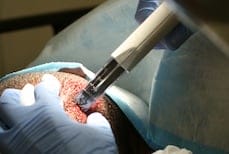
I finally tried the Modified HAT (Hair Apposition Technique) trick for the closure of scalp lacerations. I have used the traditional HAT trick multiple times but not the modified technique.

What’s the difference?

Instead of using your fingers, the modified approach involves the use of two instrument clamps to help twist and pull the hair strands taut. It turns out that this makes a huge difference, especially for short hairs. The clamps allow you to grab the hair strands so much more securely, before instilling a tissue adhesive at the twisting points.

The nice added benefit was that my chubby fingers were now out of the procedural field. This allowed my assistant to more easily see and reach the hair twisting points with the Dermabond applicator.

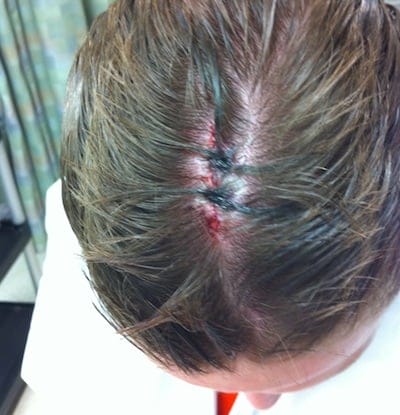
Check out the finished product of this 2.5 cm laceration on the scalp vertex.

Back Camera

Bottom line

The simple addition of two instrument clamps provides significantly superior control, stronger tensile strength, and better exposure when twisting hair strands together. Try it.

By |2019-11-20T18:11:20-08:00Aug 18, 2010|Tricks of the Trade|

Paucis Verbis card: Rapid Sequence Intubation

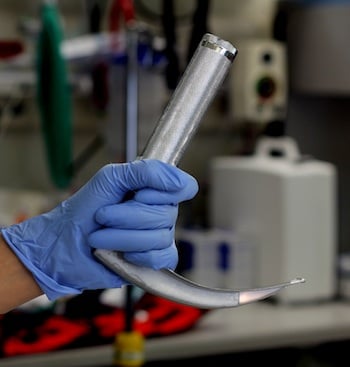
Laryngoscope rapid sequence intubation

The key to success in performing procedures is preparation. This is especially true for endotracheal intubations in the Emergency Department where things are chaotic. Strategic planning and anticipation of obstacles during rapid sequence intubation (RSI) are key principles to avoiding complications.

PV Card: Rapid Sequence Intubation


Go to ALiEM (PV) Cards for more resources.

By |2021-10-18T10:19:45-07:00Jul 16, 2010|ALiEM Cards, Tox & Medications|

Paucis Verbis card: Ascites assessment with paracentesis

Paracentesis ascites

A paracentesis procedure is often performed in the Emergency Department to rule a patient out for spontaneous bacterial peritonitis (SBP).

  • Do you check coagulation studies before performing the procedure?
  • How comfortable do you feel that the patient has SBP with an ascites WBC > 500 cells/microliter or ascites PMN > 250 cells/microliter?

This installment of the Paucis Verbis (In a Few Words) e-card series provides an evidence-based review of the literature on topics related to the paracentesis procedure. Especially helpful is the pooled data of likelihood ratios. Like most everything in medicine, a lab test should be used in conjunction with your pretest probability in clinical decision making, and LR’s help with with this.

PV Card: Ascites and Paracentesis


Adapted from [1]
Go to ALiEM (PV) Cards for more resources.

Reference

  1. Wilkerson RG, Sinert R. The Use of Paracentesis in the Assessment of the Patient With Ascites. Annals of Emergency Medicine. 2009;54(3):465-468. doi: 10.1016/j.annemergmed.2008.09.005
By |2021-10-18T10:26:22-07:00Jun 25, 2010|ALiEM Cards, Gastrointestinal|

Trick of the Trade: Double staple gun

ScalpLacStapleHow do you approach the repair of scalp lacerations in a child? What factors are you considering?

  • Is the wound suspicious for child abuse?
  • Procedural sedation versus local anesthesia of the wound
  • Staples versus hair apposition technique (HAT trick) for wound closure

This trick of the trade pearl addresses the stapling technique for scalp laceration repair. Perhaps the child’s hair is too short for the HAT trick.

(more…)

By |2019-02-19T18:33:04-08:00Jun 16, 2010|Tricks of the Trade|
Go to Top