Great teaching video: Corneal FB removal

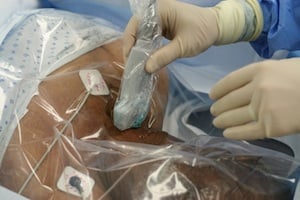
FBCorneasmPatients often come into the ED for eye pain. One of my favorite procedures is removal of a small foreign body embedded in the cornea. There is a great instructional video on removing such foreign bodies and the use of a ophthalmic burr on removing rust rings.

The video recommends using either a 30-gauge or 18-gauge needle. I prefer the less innocuous-looking 29-gauge insulin/TB needle. Can you imagine someone coming towards your eye with a large 18-gauge needle?!
(more…)

By |2019-01-28T23:44:07-08:00Mar 30, 2010|Ophthalmology|

Trick of the trade: Ear foreign body extraction

BeadsA 6-year old boy has placed a hard bead in his ear and presents to the ED for care. How do you remove this foreign body as painlessly as possible? You can just barely see the edge of the bead by just looking at the external ear.

By experience, you know that mini-Alligator clips and forceps will not be able to sufficiently grab the edges of the bead. Additionally it may push the bead in even further.

(more…)

By |2019-02-19T18:08:04-08:00Mar 24, 2010|ENT, Tricks of the Trade|

Trick of the trade: Irrigation scalp wound photos

I mentioned from an earlier post about building a “head basin” for collecting irrigation fluid prior to wound closure. This basin prevents a deluge of fluid from soaking the gurney sheets and patient.

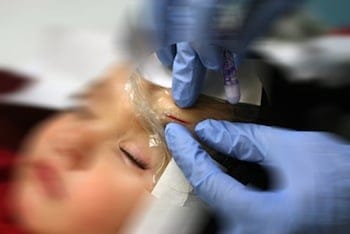
I finally managed to capture this trick in action, while a student was irrigating an eyebrow laceration.

Pearl

When cutting out a semi-circular or rectangular hole in the basin, be sure that there remains a 2-4 inch lip at the bottom to ensure that fluid can collect in the basin.

By |2019-02-19T18:53:55-08:00Mar 3, 2010|Tricks of the Trade|

Article review: Glidescope success in difficult airway simulation

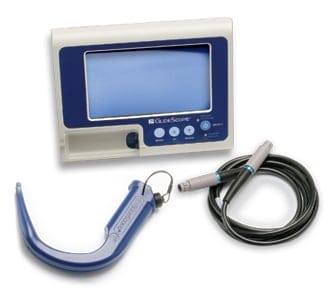
GlideScopeSince our department got a Glidescope, it has rapidly become a go-to difficult airway adjunct when intubating patients in the ED. Note: I have no financial ties to Glidescope.

This education article Sim Healthcare is a head-to-head comparison between video laryngoscopy (VL) versus direct laryngoscopy (DL) in a difficult airway simulation model. In this prospective, convenience sample of EM attendings and residents who were all novice operators of VL, the subjects were asked intubate 3 types of mannequin scenarios using a Macintosh curve laryngoscope for DL and a Glidescope for VL.

(more…)

By |2016-11-11T19:01:37-08:00Feb 8, 2010|Education Articles, Medical Education|

Trick of the Trade: Preventing tissue adhesive seepage

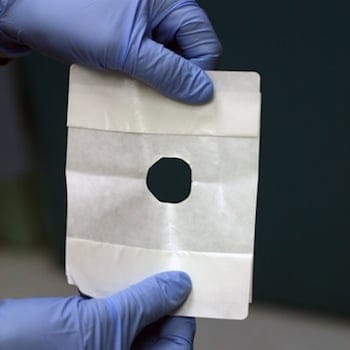
Dermabond Tape

As great as tissue adhesives are in wound closure, they come with some risk. For instance, liquid adhesives, such as Dermabond, can “run” and contact undesired areas such as eyelid margins. Careful application of tissue adhesives is critical.

How can you minimize the amount of seepage of tissue adhesive to undesired areas?

Trick of the Trade

Create an impermeable tape barrier

I already mentioned this in an earlier post in July, but I now have more experience with this technique. Here are some recent photos of this trick in action.

  • Cut out a circle from a transparent tape adhesive. In this case, I used a transparent Tegaderm which can be found with peripheral or central line IV kits.
  • Adhere the tape to the patient’s skin primarily along the circular edge to prevent glue seepage under the tape. You don’t need to stick the ENTIRE transparent tape to the patient, unless you want to pull off some eyebrow and eyelid lashes!
  • Apply the tissue adhesive glue over the wound while ensuring that the wound edges are closely approximated. Excess glue will run off onto the tape. You only need to wait a few seconds after glue application before peeling the tape off.
DermabondTapeTrick5blursm
DermabondTapeTrick10blursm

This idea was contributed by Dr. Hagop Afarian (UCSF-Fresno).

Thanks also to my Visual Aid Project photographer, Lourdes Adame, who photographed and consented the patient’s father for these photos. Her speaking fluent Spanish made them feel at ease and understand that we were photographing for educational purposes.

By |2019-02-04T03:35:20-08:00Feb 3, 2010|Tricks of the Trade|
Go to Top