


EM-IM Residency Training: Is 5 Years Worth It?
As a new member of the ALiEM team, I am joining Dr. Salim Rezaie as the second member to be board certified in both Emergency Medicine and Internal Medicine. Since 2006, I have been asked numerous times, “Why EM/IM?” My answer is simple: I like both. But five years of residency and not be a surgeon? What can you do with this type of training? [+]
Why do we lecture?
The video lecture below is from Rhona Sharpe (@rjsharpe), the Head of the Oxford Center and Learning Development and Deputy Director of the Directorate of Human Resources at Oxford Brooks University. It is taken from First Step into Learning and Teaching in Higher Education (#fslt12) — a MOOC which took place last year. [+]
Maximizing Conferences through Twitter
Conferences are necessary. It’s how we network, exchange research ideas, and share advances in emergency medicine. The reality is that we cannot attend every conference out there because of time, money, and schedule conflicts. But thanks to Twitter, it is no longer necessary to be physically present to reap the benefits of a conference. This post lists information on how to get involved and stay involved with the Twitter conversation and learn from our great conferences without breaking your bank or schedule. [+]

How Social Media is Making an Impact in Medicine
Whether you realize it or not, the use of social media (i.e. Facebook, twitter, and blogs) has found its way into the world of medical students, residents, physicians, and medical educators all around the world. The use of these resources has several advantages versus in-person/print educational tool: Overcomes physical or temporal barriers Provides searchable content Encourages interactivity [+]
Review: Emergency Medicine: Avoiding The Pitfalls and Improving The Outcomes
A pitfall is defined as “an unapparent source of trouble or danger; a hidden hazard” by thefreedictionary.com. In the book Emergency Medicine: Avoiding the Pitafalls and Improving the Outcomes edited by Dr. Amal Mattu along with Dr. Deepi Goyal, you can find many pitfalls that should be considered when managing patients in the emergency department. The book, relatively affordable ($57) when it comes to print hard-bound textbooks, consists of 13 quick-read chapters of common chief complaints in emergency medicine. Some of the authors in this book include: Drs. Peter DeBlieux, Jairo Quintanilla, Robert Rogers, Michael Winters, and others. [+]

Patwari Academy video: Discharge instructions
Read more about the writing of appropriate ED discharge instructions. Clear communication of your thoughts and recommendations are a crucial part of patient care despite their no longer being in the ED. Learn about the pearls and pitfalls in writing instructions in this short 7.5 minute video. 1 [+]
SAEM/CORD slides: Social Media for Emergency Educators
As requested by an audience member at today’s talk at SAEM, Drs. Rob Cooney, Mike Bond, and I are sharing our slides and handout on Social Media for Emergency Medicine Educators with you here. [+]

Director of [+]
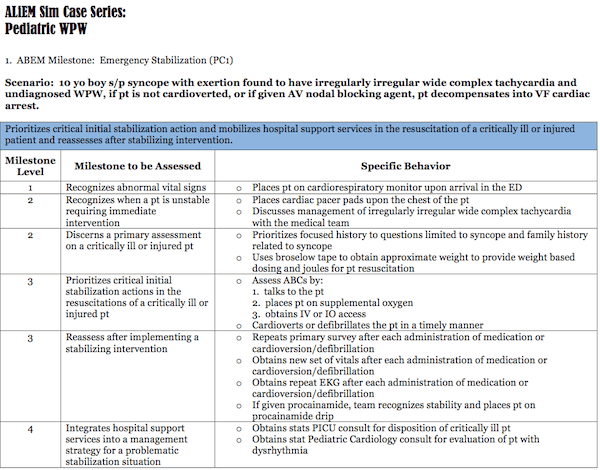
ALiEM Sim Case Series: Pediatric WPW
Case Writer: Nikita Joshi, MD Keywords Pediatrics, Syncope, Wolff Parkinson White (WPW), PALS Educational Objectives Medical Discuss a broad differential diagnosis for pediatric syncopeIdentify critical findings in pediatric EKGManage WPW tachycardia Communication Obtain a focused history in a pt with WPW focusing upon family historyCommunicate as an interdisciplinary team Case Synopsis 10 yo boy BIBEMS s/p syncope. Pt was playing on the football field, running down field when he suddenly collapsed. Bystanders quickly went to the boy and within 1 minute the pt had regained consciousness without any intervention. When EMS arrived on the scene, the boy was sitting with [+]
Improving Consultation Communication Skills
Talking to colleagues is an essential skill especially as we advocate for our patients. We should not only know what’s going on with our patients, but also how to communicate our thoughts effectively and succinctly with our colleagues. In a great article by Dr. Chad Kessler et al 1 just published Academic Medicine, the authors state that although “communication skills may not develop naturally, [they] can be taught and fostered through evidence-based educational models.” [+]
Deception and Simulation
Have you ever created a simulation case with hidden objectives that the learners were not aware of? Would you ever purposefully try to trick or deceive learners in a simulation case? Simulation can be used to reinforce clinical and procedural knowledge. It can teach important teamwork skills. It can also be used to learn about ourselves in morally and ethically challenging situations. [+]
Director of Growth, Strategic Alliance Initiative, Center for Innovation and Digital Health
Massachusetts General Hospital;
Chief Scientific Officer, Conductscience.com
Latest posts by Shuhan He, MD (see all)
- The Discharge Severity Index: Early Research on ED Readmission Risk Assessment - August 14, 2025
- Suboxone and the Emergency Physician: Get Waivered Training - August 12, 2022
- A Tale of Two Epidemics: COVID-19 and the Opioid Crisis - April 23, 2020