ACMT Toxicology

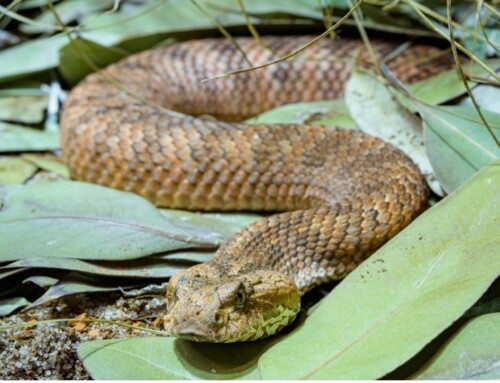
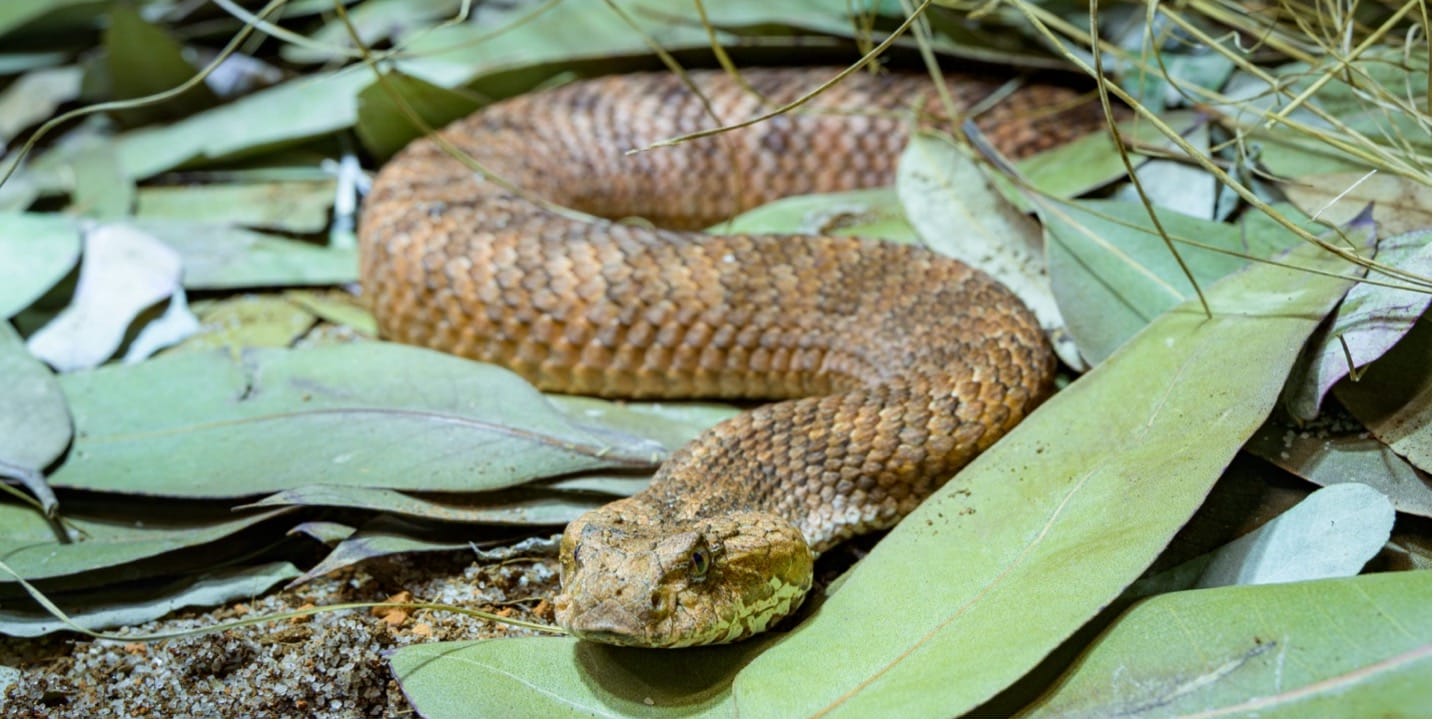
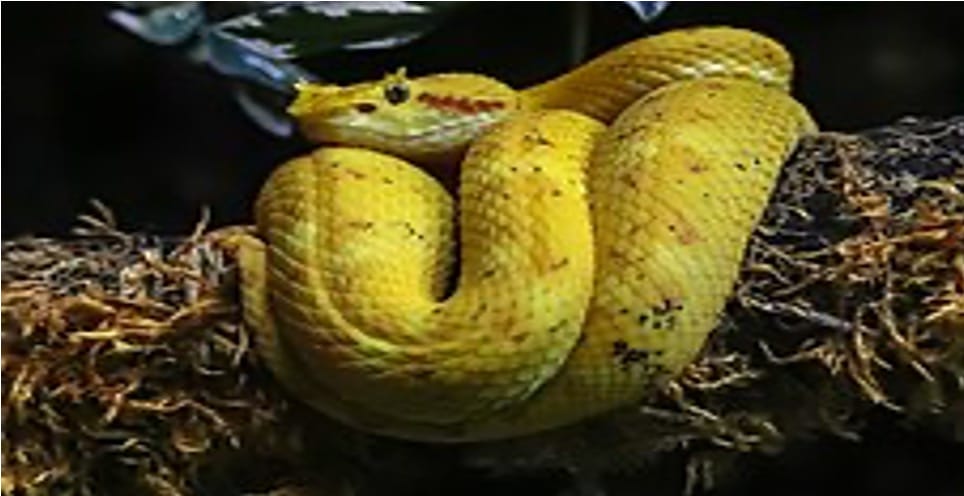
The venom of the pictured creature causes tissue inflammation and necrosis through which of the following mechanisms:

  1. Alpha-bungarotoxin
  2. Alpha-latrotoxin
  3. Domoic acid
  4. Phospholipase A2

[Image by Vauxford via Wikimedia Commons]

4. Phospholipase A2

Background [1-3]

Bothriechis schlegelii is a venomous snake in the Viperidae family native to the rainforests of Central and South America. Like many of its subfamily, Crotalidae, it shares a triangular-shaped head, elliptical pupils, and retractable fangs associated with venom-producing glands.  The presence of pit-like depressions adjacent to the nostrils serves as a heat-sensing organ for the detection of prey. Snakes that share these “pits” are often grouped together as “pit vipers.” Bothriechis schlegelii is colloquially referred to as the “eyelash pit viper” due to its distinctive supraocular scales that resemble eyelashes (see photo). These scales protect the snake’s eyes from sunlight, rain, and debris, enhancing its ability to hunt in adverse conditions.

Its striking features, vibrant coloration, manageable size (averaging 2-3 feet in length), and generally calm temperament may give the impression of being a desirable household pet. Of the 77 species of exotic snake envenomations represented in the National Poison Data System (NPDS) dataset from 1995-2004, 24.7% were native to Latin America (encompassing Central and South America). Over 50% of cases sought hospital evaluation; 28.7% of which were admitted to the Intensive Care Unit, and 26% were treated with antivenom. The eyelash pit viper contributes to US non-native snakebite envenomations reported to the North American Snake Bite Registry. (4)

What is the mechanism of action of the Eyelash Pit Viper’s venom? [5-11]

Eyelash pit viper venom contains numerous components that are cytotoxic and coagulopathic:

  • Snake Venom Metalloproteinases (SVMPs): Responsible for the destruction of vascular endothelium, leading to hemorrhage and tissue necrosis
  • Phospholipase A2 (PLA2): Causes coagulopathy from phospholipid sequestration and tissue damage, and myotoxicity from destruction of cell membranes
  • C-type Lectin-Like Proteins (“SNAke C-type LECtinS” or snaclecs): In the early phase, snaclecs bind to glycoprotein 1b platelet receptors and von Willebrand factor, causing microvascular thrombosis followed by inhibition of thrombin and clotting factor inactivation, resulting in late phase hypocoagulability.
  • Serine Proteases: Induce edema, fibrinolysis, platelet aggregation, and coagulopathy by binding to plasma proteins such as fibrinogen.

What is the initial management for pit viper envenomation? [12-15]

  • Close monitoring of local swelling and progression
    • Hourly measurements of the affected area
  • Close monitoring for the development of systemic symptoms such as hypotension, dyspnea, vomiting, and diarrhea
  • Elevation of extremities to at least 45 degrees and in full extension
  • Removal of constriction points, such as jewelry
  • Update tetanus if needed
  • Laboratory evaluation for coagulopathy, including CBC with platelets, PT/INR, and fibrinogen
  • For exotic snake species, antivenom can be located via the AntiVenom Index (Antivenom Index) accessible through your local poison control center or Association of Zoos and Aquariums (AZA) member institutions.
  • Some exotic snake owners may stock their own personal antivenom after completing an FDA BB-IND. They may bring this supply for pharmacy verification upon presentation.
  • North American Pit Vipers can be treated with Crotalidae polyvalent immune Fab (CroFab) and Crotalidae immune F(ab’)2 (ANAVIP), and these have also been used successfully for non-native pit vipers.
    • CroFab (Crotalidae polyvalent immune Fab): A polyvalent, ovine-derived antivenom that is derived from Eastern diamondback rattlesnake (Crotalus adamanteus), Western diamondback rattlesnake (Crotalus atrox), cottonmouth (Agkistrodon piscivorus), and Mojave rattlesnake (Crotalus scutulatus).
      • Acute and delayed hypersensitivity reactions reported
      • Papaya allergy is a relative contraindication due to papain use in production
    • ANAVIP (Crotalidae immune F(ab’)2): A polyvalent, equine-derived antivenom derived from Fer-de-lance (Bothrops asper) and the Central American rattlesnake (Crotalus simus).
      • Acute and delayed hypersensitivity reactions reported
      • Longer half-life relative to CroFab, which may prevent rebound coagulopathy
    • Indications for antivenom:
      • Progression of swelling
      • Significant coagulopathy or thrombocytopenia
      • Hemodynamic compromise
    • Timely administration of antivenom will not reverse the observed clinical features but may mitigate the progression of symptoms.
    • Consultation with a medical toxicologist is recommended, as they can assist with antivenom acquisition and guide the appropriate use of antivenom.

Bedside Pearls

  • Eyelash pit viper and other non-native, exotic snakes are increasingly implicated in U.S. envenomations.
  • The venom causes coagulopathy, tissue damage, and, in some cases, systemic effects such as hypotension
  • The Antivenom Index (Antivenom Index) is an important resource for obtaining exotic antivenoms, if required.
  • Despite being labeled for North American pit vipers, Crotalidae polyvalent immune Fab (CroFab) and Crotalidae immune F(ab’)₂ (ANAVIP) have been successfully used in non-native pit viper envenomation.

References

  1. Smithsonian’s National Zoo. Eyelash palm pitviper | Smithsonian’s National Zoo and Conservation Biology Institute Accessed April 13, 2026.
  2. Seifert SA, Oakes JA, Boyer LV. Toxic Exposure Surveillance System (TESS)based characterization of U.S. nonnative venomous snake exposures, 1995–2004. Clin Toxicol. 2007;45(5):571578. PMID: 17558631.
  3. Warrick BJ, Boyer LV, Seifert SA. Nonnative (exotic) snake envenomations in the U.S., 20052011. Toxins (Basel). 2014;6(10):28992911. PMID: 25268980.
  4. Basse J, Ruha AM, Baumgartner K, et al. ToxIC Snakebite Study Group. Clinical Presentations, Treatments, and Outcomes of Non-native Snake Envenomations in the United States Reported in the North American Snakebite Registry. J Med Toxicol. 2023 Jan;19(1):16-25. PMID 36175787.
  5. Gutiérrez JM, Rucavado A. Snake venom metalloproteinases: their role in the pathogenesis of local tissue damage. Biochimie. 2000;82(910):841850. PMID: 11086214.
  6. Escalante T, Rucavado A, Fox JW, Gutiérrez JM. Key events in microvascular damage induced by snake venom hemorrhagic metalloproteinases. J Proteomics. 2011;74(9):17811794. PMID: 21447411.
  7. Sampat GH, Hiremath K, Dodakallanavar J, et al. Unraveling snake venom phospholipase A2: an overview of its structure, pharmacology, and inhibitors. Pharmacol Rep. 2023;75(6):14541473. PMID: 37926795.
  8. Lu Q, Navdaev A, Clemetson JM, Clemetson KJ. Snake venom Ctype lectins interacting with platelet receptors. Structurefunction relationships and effects on haemostasis. Toxicon. 2005;45(8):10891098. PMID: 15876445.
  9. Morita T. Structures and functions of snake venom CLPs (Ctype lectinlike proteins) with anticoagulant, procoagulant, and plateletmodulating activities. Toxicon. 2005;45(8). PMID: 15922777.
  10. Misson Mindrebo LE, Mindrebo JT, Tran Q, et al. Importance of the cysteinerich domain of snake venom prothrombin activators: insights gained from synthetic neutralizing antibodies. Toxins (Basel). 2024;16(8):361. PMID: 39195771.
  11. Phan P, Deshwal A, McMahon TA, Slikas M, Andrews E, Becker B, Kumar TKS. A Review of Rattlesnake Venoms. Toxins (Basel). 2023 Dec 19;16(1):2. PMID: 38276526.
  12. Pizon AF, Ruha AM. Antivenom for North American Venomous Snakes (Crotaline and Elapid). In: Nelson LS, Lewin S, Goldfrank LR, et al., eds. Goldfrank’s Toxicologic Emergencies. 11th ed. McGraw‑Hill Education; 2019. Accessed via https://accesspharmacy.mhmedical.com/content.aspx?bookid=2569&sectionid=210263859.
  13. Seifert SA, Boyer LV. Recurrence phenomena after immunoglobulin therapy for snake envenomations: part 1. Pharmacokinetics and pharmacodynamics of immunoglobulin antivenoms and related antibodies. Ann Emerg Med. 2001;37(2):189‑195. PMID: 11174238.
  14. S. Food and Drug Administration. Package Insert – CroFab. Accessed March 11, 2025. https://www.fda.gov/media/74683/download.
  15. S. Food and Drug Administration. Package Insert – ANAVIP. Accessed March 11, 2025. https://www.fda.gov/media/92139/download.

Nomerra Koreshi, DO

Nomerra Koreshi, DO

Emergency Medicine Resident
Jefferson Einstein Philadelphia Hospital
Nomerra Koreshi, DO

Latest posts by Nomerra Koreshi, DO (see all)

Christopher Riviello, DO

Christopher Riviello, DO

Medical Toxicology Fellow
Jefferson Einstein Philadelphia Hospital
Christopher Riviello, DO

Latest posts by Christopher Riviello, DO (see all)

David Goldberger

David Goldberger

Program Director, Emergency Medicine
Jefferson Einstein Philadelphia Hospital
David Goldberger

Latest posts by David Goldberger (see all)