


Is Ondansetron for Nausea and Vomiting Prophylaxis Necessary with Opioids?
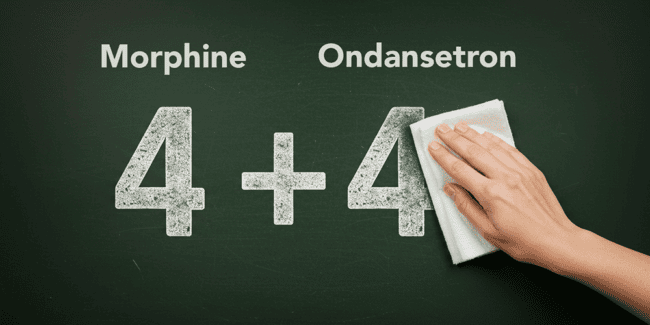
Ondansetron is the most documented medication given in emergency departments (ED) throughout the United States [1]. We have all heard someone ask, “Can I get an order for 4 and 4 for this patient?” in reference to 4 mg of IV morphine and 4 mg of IV ondansetron. It has become common practice in many institutions to provide a prophylactic antiemetic prior to administering an IV opioid.
Logic for giving ondansetron with opioid
This dual therapy seems to make initial sense because all opioids carry a FDA warning that nausea may occur [2]. So why not administer an antiemetic to prevent it? Opioids cause nausea and vomiting due to its interaction on the chemoreceptor trigger zone (CTZ), increased vestibular sensitivity, and hindered gastric emptying [3]. The logic is to provide these patients with a 5-HT3 antagonist (i.e., ondansetron) to inhibit the opioid from exerting emetogenic properties on 5-HT3 receptors in the CTZ and prevent nausea and/or vomiting.
How common is nausea and vomiting associated with IV opioids?
Multiple studies illustrate that morphine-induced nausea and vomiting is low, ranging from 2.0–20.2% in ED patients [4-9]. When discussing with ED nurses, nausea and vomiting are anecdotally associated with how quickly the IV opioid is administered and generally occurs within 5 minutes of administration.
So we should give IV ondansetron to prevent this, right? A common misconception with IV ondansetron is its onset of action. In fact, it can take anywhere between 27-34 minutes before there is a 50% decrease in nausea severity following the administration of ondansetron [10, 11]. This begs the question, does it really make sense to provide prophylactic antiemetics with IV opioids?
Literature Review
| Study | Intervention | Outcome | Conclusion |
|---|---|---|---|
| Bradshaw et al. [5]
RCT- double blinded Performed in United Kingdom |
IV morphine + placebo (n=136)
IV morphine + metoclopramide 10 mg (n=123) |
N/V between the 2 groups was not statistically significant (p=0.3).
Overall incidence of N/V was low in both treatment groups (3.7% in placebo and 1.6% metoclopramide) |
Pre-treating patients with metoclopramide was not necessary.
Overall N/V associated with IV morphine was very low and recommended using antiemetics for patients who develop N/V. |
| Bhowmik et al. [8]
RCT, double blinded Performed in India |
IV morphine + placebo (n=53)
IV morphine + promethazine (n=54) IV morphine + ramosetron (n=54) IV morphine + metoclopramide (n=54) |
Overall incidence of N/V was low in all treatment groups (9.4% ramosetron, 18.5% metoclopramide, 10.2% in promethazine and 6.2% in placebo)
Rate of N/V was not statistically significant between any of the groups. |
Patients should receive antiemetic therapy only if experience N/V and not as a prophylactic agent with IV opioids.
Patients that received (morphine + placebo) had less N/V compared to other treatment groups; however, NOT statistically significant. |
| Sussan et al. [9]
Randomized, double- masked multicenter trial Performed in 9 countries |
Investigated 2,574 patients that received IV opioids and randomized 520 patients that developed N/V associated with IV opioids.
Group 1: placebo (n=94) Group 2: ondansetron 8 mg (n=214) Group 3: ondansetron 16 mg (n=211) |
Resolution of N/V was statistically more significant (p < 0.001) when comparing ondansetron therapy with placebo.
Group 1: 45.7% N/V resolved Group 2: 62.3% N/V resolved Group 3: 68.7% N/V resolved |
The best practice seems to treat patients’ N/V after development in patients that receive IV opioids.
Trial determined the prevalence of N/V is minimal and exposing patients to medication they do not need puts them at risk for additional adverse drug reactions. |
Each of the 3 trials concluded that there was no statistical significance in outcomes when adding prophylactic antiemetics with IV opioids. After these institutions analyzed their findings, the investigators at their respective institutions made it common practice for patients to only receive antiemetics AFTER a patient developed nausea or vomiting.
Prophylactic ondansetron practice
So why is ondansetron still commonly used to pre-treat patients that receive IV opioids in the ED?
The limited literature primarily focused on these anti-emetic agents: metoclopramide, promethazine, and ramosetron (5-HT3 antagonist). Literature related to specifically ondansetron is minimal.
Two randomized, placebo-controlled studies comparing ondansetron, metoclopramide, and saline in ED patients complaining of nausea showed no clinically important difference in the reduction of nausea between treatments and placebo [12, 13]. Yet in the ED, we still order ondansetron more than any other medication.
Some nerd (me!) put together a prospective multiple-site study (n=133) at 2 academic medical institutions where patients were administered IV opioids, with or without IV ondansetron [14]. Patients were observed for nausea and vomiting at baseline, 5 minutes, and 30 minutes after opioid administration, and then for a total of 2 hours. The results showed that 17.3% of patients developed nausea, with no significant difference in the rate of nausea, emesis, or the need for rescue antiemetics between the group receiving ondansetron and the group receiving opioids alone.
Of note, ondansetron is not FDA approved for the treatment or prophylaxis of acute nausea and/or vomiting (N/V) outside of chemotherapy, radiation, and postoperative use. It also, not surprisingly, has side effects!
Take Home Point
- Concurrent treatment with anti-emetics (including ondansetron) is unnecessary, increases costs, and adds potential for adverse drug reactions.
- The next time the request for “4 + 4” comes through, consider holding off on the unnecessary ondansetron with your IV opioid order.
- You can use this isopropyl alchohol vapor inhalation trick of the trade for those 2-20% of patients that do develop nausea.
References
- National Hospital Ambulatory Medical Care Survey: 2011 Emergency Department Summary. Accessed 19 Dec 2024.
- Red Book: pharmacy’s fundamental reference. Montvale, NJ: Thompson Healthcare Inc.; 2010
- Smith H, Smith J, Seidner P. Opioid-induced nausea and vomiting. Annals of Palliative Medicine 2012;1(2):121-129
- Paoloni R, Talbot-Stern J. Low incidence of nausea and vomiting with intravenous opioid analgesia in the ED. Am J Emerg Med 2002;20:604-608.
- Bradshaw M, A Sen. Use of prophylactic antiemetic with morphine in acute pain: randomized controlled trial. Emerg Med J 2006; 23:210-212.
- Talbot-Stern J, Paoloni R. Prophylactic metoclopramide is unnecessary with intravenous analgesia in the ED. Am J Emerg Med 2000;18(6):653-7.
- Lambie B, Chambers J, Herbison P. The role of prophylactic anti-emetic therapy in emergency department patients receiving intravenous morphine for musculoskeletal trauma. Emer Med 1990; 11(4): 240-243.
- Bhowmik A, Dasgupta I, Barua S, et al. Evaluation of the need of prophylactic antiemetic with injection morphine in treating acute musculoskeletal pain in the Indian population. IJAR 2014;2:53-58.
- Sussan G, Shurman J, Creed M, et al. Intravenous ondansetron for the control of opioid-induced nausea and vomiting. Clinical Therapeutic. 1999; 21:1216-1227.
- Cotton J, Rowell L, Hood R, et al. A comparative analysis of isopropyl alcohol and ondansetron in the treatment of postoperative nausea and vomiting from the hospital setting to the home. AANA J. 2007; 75(1):21-6.
- Winston A, Rinehart R, Riley G, et al. Comparison of inhaled isopropyl alcohol and intravenous ondansetron for treatment of postoperative nausea. AANA J. 2003; 71(2):127-32.
- Barrett TW, DiPersio DM, Jenkins CA, et al. A randomized, placebo-controlled trial of ondansetron, metoclopramide, and promethazine in adults. Am J Emerg Med. 2011 Mar;29(3):247-55.
- Egerton-Warburton D, Meek R, Mee MJ, et al. Antiemetic use for nausea and vomiting in adult emergency department patients: randomized controlled trial comparing ondansetron, metoclopramide, and placebo. Ann Emerg Med. 2014 Nov;64(5):526-532.
- Culver MA, Richards EC, Jarrell DH, et al. Use of Prophylactic Ondansetron With Intravenous Opioids in Emergency Department Patients: A Prospective Observational Pilot Study. J Emerg Med. 2017;53(5):629-634. PMID 28987314. DOI

 Medical providers commonly encounter patients in the emergency department who state they are anticoagulated with warfarin, but they have no idea what dose they are taking. “I know that I take two pills of warfarin daily.” Dosing becomes critically important especially when continuing their medication as an inpatient, refilling their medications, or adjusting their outpatient dose because of an inappropriately high or low INR level. How can you determine the patient’s warfarin dose?
 The genus
 Your triage nurse complains of numerous patients in the waiting room complaining of nausea, retching, and emesis. They ask you “why can’t we have an antiemetic on hand in triage?” Turns out they might have had an effective antiemetic on hand, or rather in their scrub pocket the entire time. They just didn’t know about it yet.