


High Sensitivity Troponin Testing
 Troponin testing is an important component of the diagnostic workup and management of acute coronary syndromes (ACS). The increasing sensitivity of troponin assays has lowered the number of potentially missed ACS diagnoses, but this has also created a diagnostic challenge due to a decrease in the specificity of the test. From 1995 to 2007, the limit of troponin detection fell from 0.5 ng/mL to 0.006 ng/mL (see below graph). Robert Jesse summed up this frustration with the following quote:
When troponin was a lousy assay it was a great test, but now that it’s becoming a great assay, it’s getting to be a lousy test.
 Recently, I have been asked by several students at my home institution (UTHSC at San Antonio) to help them understand bundle branch blocks. This is different than some of my usual posts because it is meant to be more educational than evidence based. So here we go. The normal conduction system of the healthy heart is shown to the right. If there is a delay or block in the left or right bundle, depolarization will take longer to occur. Therefore we get a widened QRS (>0.12 sec or >3 small boxes).
 More than one third of patients will have chest pain associated with SVT causing providers to order troponins and other cardiac enzymes. Elevated troponins are not pathognomonic for CAD/ACS and could represent other etiologies such as sepsis, subarachnoid hemorrhage, and pulmonary embolism. Also, subsequent coronary angiography is not necessary for risk stratification in all cases. SVT causes a rapid heart rate, which is well documented as a cause for modest troponin elevation secondary to cardiac stretch, poor diastolic perfusion, and/or coronary artery vasospasm.
 Posterior myocardial infarction (MI) represents 3.3 – 21% of all acute MIs and can be difficult to diagnose by the standard precordial leads. Typically, leads V7 – V9 are needed to diagnose this entity. Luckily, leads V1 – V3, directly face the posterior wall of the left ventricle and are the “mirror image” of the posterior wall of the left ventricle.
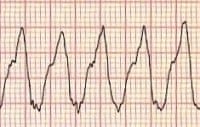
 Differentiating between SVT with aberrancy and VT can be very difficult. It is crucial to be able to make this distinction as therapeutic decisions are anchored to this differentiation. Brugada et al prospectively analyzed 384 patients with VT and 170 patients with SVT with aberrant conduction to see if it was possible to come up with a simple criteria to help differentiate between the two with high sensitivity and specificity.