


Paucis Verbis card: Subarachnoid hemorrhage high-risk characteristics
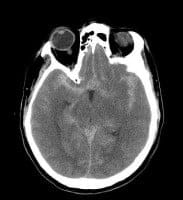 In Wednesday’s post about the Colorado Compendium, Graham mentioned a new 2010 BMJ article on the high-risk signs suggestive of subarachnoid hemorrhage by the gurus in clinical prediction rules in Canada.
We excessively work-up patients for a subarachnoid hemorrhage with a nonspecific headache and no neurologic deficitis. This is because it’s difficult to predict who is high, medium, and low risk for such a bleed. So we throw a wider net so that we don’t miss such a devastating diagnosis. This usually means a CT and LP for many patients with a headache.
In this 5-year multicenter study, the investigators identified clinical decision rules to help identify the higher-risk groups for a subarachnoid hemorrhage. They derived 3 models, based on recursive partitioning. Each has a negative predictive value of 100%.
Before thinking about seeing if your headache patient has any of these high-risk features, pay special attention to see if s/he would have met the inclusion and exclusion criteria of this study.
Inclusion criteria:
- Neurologically intact adults (age ≥ 16 years) with a non-traumatic headache peaking within an hour.
Exclusion criteria:
- History of ≥3 recurrent HA’s of same character/intensity
- Referred from another hospital with confirmed SAH
- Returned for reassessment of same HA which was already evaluated for SAH
- Papilledema
- New focal neurologic deficits
- Previous dx of cerebral aneurysm or SAH
- Previous dx of brain neoplasm
- Known hydrocephalus
Although none of the models are validated as of yet, the cumulative list of clinical characteristics from these 3 models may be able to help you understand who may be at higher risk:
- Age ≥ 40 years
- Witnessed loss of consciousness
- Neck pain or stiffness
- Onset of HA with exertion
- Arrival by ambulance
- Vomiting
- DBP ≥ 100 mmHg or SBP ≥ 160 mmHg

 With increasing awareness of CT’s irradiation risk, I thought I would review a classic 2001 article from the New England Journal of Medicine. Head CT’s previously were commonly performed prior to all lumbar punctures (LP) to rule-out meningitis. When can you safely go straight to an LP without imaging?
 Patients present with acute strokes to the Emergency Department. Time is of the essence to obtain a rapid neurologic exam, draw labs, get CT imaging, and consulting a neurologist especially if the patient presents within 3 hours of onset. To help the neurologist determine whether the patient should get thrombolytics, calculating a NIH Stroke Scale score is useful.w