


2020 ACLS Guidelines on Medications for Management of Specific Arrhythmias
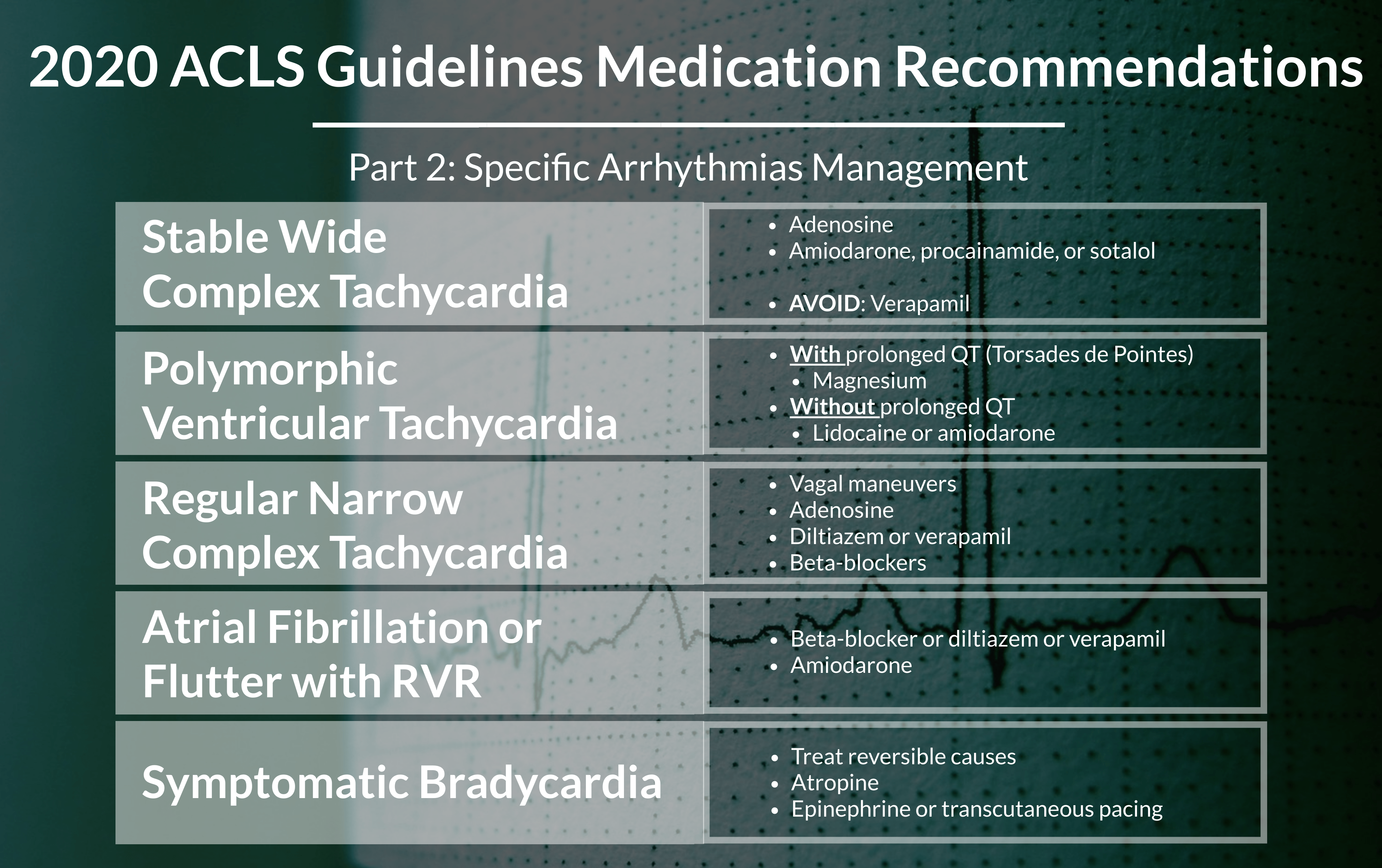
The 2020 ACLS guidelines provide recommendations on the medication-specific management for arrhythmias including wide-complex tachycardia, regular narrow-complex tachycardia, atrial fibrillation/flutter, and bradycardia [1]. There are also our 2020 ACLS guideline summaries on vasopressor and non-vasopressor medications used during cardiac arrest and toxicology-related conditions.
Wide-complex tachycardia (WCT)
| Wide-complex tachycardia | Medication(s) | Evidence |
|---|---|---|
| Hemodynamically stable | Adenosine | COR 2b, LOE B-NR |
| Amiodarone, procainamide, or sotalol | COR 2b, LOE B-R | |
| NOTE: Verapamil is harmful | COR 3, LOE B-NR | |
| Polymorphic VT with long QT (torsades de points) | Magnesium | COR 2b, LOE C-LD |
| Polymorphic VT without long QT | Lidocaine or amiodarone | COR 2b, LOE C-LD |
Regular narrow-complex tachycardia
- Vagal maneuvers (COR 1, LOE B-R)
- Adenosine (COR 1, LOE B-R)
- Diltiazem or verapamil (COR 2a, LOE B-R)
- Beta-blockers (COR 2a, LOE C-LD)
Atrial fibrillation/flutter with rapid ventricular rate
- Beta-blocker or diltiazem or verapamil (COR 1, LOE B-NR)
- Amiodarone (COR 2a, LOE B-NR)
Bradycardia
- Treat reversible causes (COE 1, LOE C-EO)
- Atropine if hemodynamic compromise (COR 2a, LOE B-NR)
- Epinephrine or transcutaneous pacing if unresponsive to atropine (COR 2b, LOE C-LD)

Reference
Panchal AR, Bartos JA, Cabañas JG, et al; Adult Basic and Advanced Life Support Writing Group. Part 3: Adult Basic and Advanced Life Support: 2020 American Heart Association Guidelines for Cardiopulmonary Resuscitation and Emergency Cardiovascular Care. Circulation. 2020 Oct 20;142(16_suppl_2):S366-S468. doi: 10.1161/CIR.0000000000000916. Epub 2020 Oct 21. PMID: 33081529.

 Left ventricular assist devices (LVADs) have moved from being a bridge to a heart transplant to destination therapy for patients with severe heart failure. Although their use in the general public has increased, they still provide a challenge to the emergency medicine (EM) physician. This series aims to cover the basics of how the EM physician approaches the care of these patients.
 Left ventricular assist devices (LVADs) have moved from being a bridge to a heart transplant to destination therapy for patients with severe heart failure. Although their use in the general public has increased, they still provide a challenge to the emergency medicine (EM) physician. This series aims to cover the basics of how the EM physician approaches the care of these patients.
 Left ventricular assist devices (LVADs) have moved from being a bridge to a heart transplant to destination therapy for patients with severe heart failure. Although their use in the general public has increased, they still provide a challenge to the emergency medicine (EM) physician. This series aims to cover the basics of how the EM physician approaches the care of these patients.
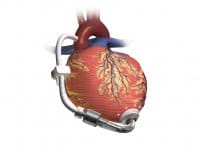 Left ventricular assist devices (LVADs) have moved from being a bridge to a heart transplant to destination therapy for patients with severe heart failure. Although their use in the general public has increased, they still provide a challenge to the emergency medicine (EM) physician This series aims to cover the basics of how the EM physician approaches the care of these patients.