


Diagnosis on Sight: “Stabbing Belly Pain”
A 24-year-old male with a history of microscopic hematuria presented to the emergency department (ED) with left lower quadrant abdominal pain. His pain started about two weeks ago and has been intermittent. He describes the pain as stabbing. He decided to come to the ED today because of the persistent nature of the pain. He denies chest pain, cough, shortness of breath, fevers, nausea, vomiting, diarrhea, constipation, rectal bleeding, dysuria, and increased urinary frequency. His exam revealed a well-appearing male in no acute distress. His abdomen was soft with left lower quadrant tenderness on palpation but no rebound or guarding. A CT Abdomen/Pelvis with IV contrast was obtained with the following images:
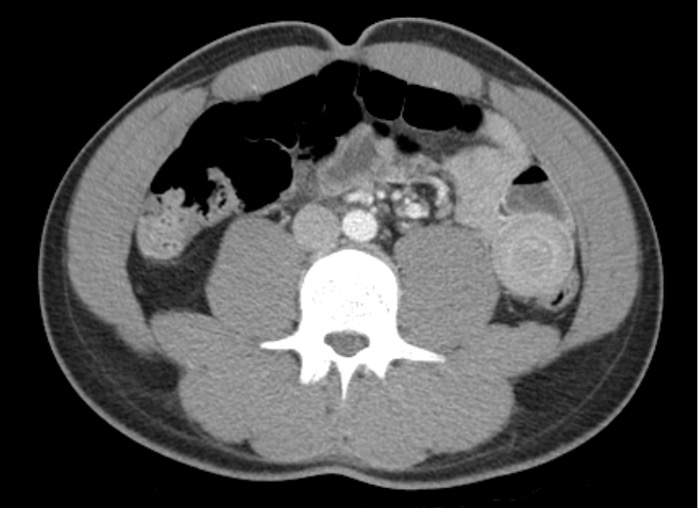
Axial View
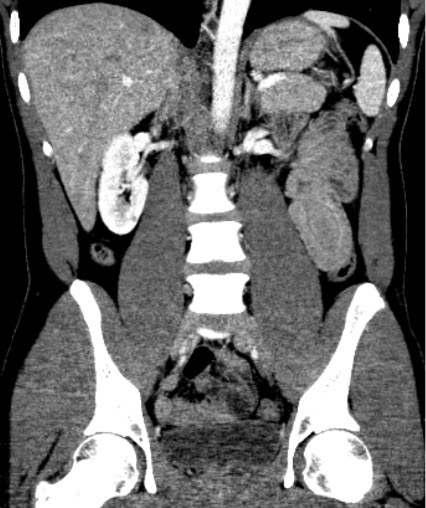
Coronal View
What is the diagnosis?
Intussusception
Explanation:
Intussusception is a telescoping of a proximal segment of the GI tract into the lumen of the adjacent distal segment of the GI tract.
The axial image of the left side of the abdomen shows a dilated small bowel loop with a target-like appearance, typical of intussusception. Coronal imaging shows that the intussusception is approximately 4.5 cm long.
Intestinal intussusception is classically a diagnosis associated with childhood. Adult cases of intussusception are quite rare and only account for about 5% of all cases [1]. Only 1-5% of all cases of bowel obstructions are secondary to adult intussusception [1-2].
Etiologies of adult intussusception include [2]:
- Inflammatory bowel disease
- Adhesions due to past surgeries
- Meckel’s diverticulum
- Benign tumors
- Malignant tumors
- Iatrogenic (e.g., intestinal tubes, feeding tubes, gastric surgery)
- Idiopathic (8-20% of cases)
CT Abdomen/Pelvis is the diagnostic modality of choice [3].
Treatment typically involves surgery with surgical resection. The possibility of a malignant lesion also needs to be assessed.
Case Conclusion:
Surgery was consulted. The patient’s pain was resolved when they saw the patient in the emergency department. Therefore, the surgeon did not believe that the patient needed urgent surgery. However, surgery did recommend a fluoroscopic small bowel series for further evaluation, which ultimately came back unremarkable. Subsequently, the surgeon’s recommendation was to discharge the patient home with a plan for an outpatient colonoscopy to assess for malignancy. The colonoscopy was completed only a few days later which only revealed benign polyps.
Want more visual stimulation? Check out the Diagnosis on Sight archives!
References
- Marinis A, Yiallourou A, Samanides L, Dafnios N, Anastasopoulos G, Vassiliou I, Theodosopoulos T. Intussusception of the bowel in adults: a review. World J Gastroenterol. 2009;15(4):407. PMID 19152443.
- Zubaidi A, Al-Saif F, Silverman R. Adult Intussusception: A Retrospective Review. Dis Colon Rectum. 2006 Oct;49(10):1546-51. PMID 16990978.
- Azar T, Berger DL. Adult intussusception. Ann Surg. 1997;226:134–138. PMID 9296505.


 A 76-year-old female with a history of HTN, TIA, CAD, left CEA, and CKD presented to the emergency department for evaluation of neck bruising and swelling. The patient stated that the night before, she was eating popcorn and choked on a kernel. She states that she coughed to clear her throat and shortly after she developed swelling and bruising to the left side of her neck, which has progressively gotten worse. The patient has a remote history of left carotid endarterectomy and was concerned that her symptoms could be related to the prior surgery. On examination, she had ecchymosis and a hematoma/mass to the left side of her neck without palpable thrill or bruit. A well-healed CEA scar was noted. A CTA of the neck was obtained to determine the source of the ecchymosis/hematoma. What is the diagnosis?

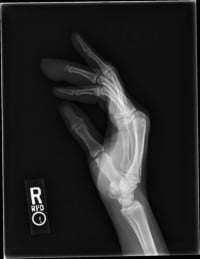 Case: A 32-year-old male with a past medical history of diabetes presents with a 1 month history of finger pain after slamming his finger in a car door. 2 weeks after the initial incident he presented to the emergency department for worsening pain and received x-rays that were negative for acute fracture. Today he presents reporting pain radiating up the hand, arm, and into the shoulder, with associated chills. His labs are significant for hyperglycemia, hyponatremia, and an elevated erythrocyte sedimentation rate and c-reactive protein. His x-ray is seen here (figure 1 image courtesy of Daniel Rogan, MD). What is the diagnosis?
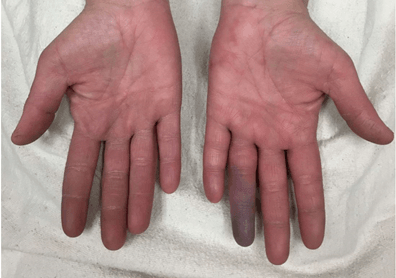 A 37-year-old female presented to the emergency department for evaluation of numbness and discoloration to her left fourth finger, which had started the day before. The patient stated that she was gardening the previous day and afterward she noticed the discoloration and pain. The patient denied taking any medications. She reported recreational methamphetamine and heroin use. She denied any chest pain or difficulty breathing. She denied any history of Raynaud’s phenomenon, venous thromboembolism, or history of trauma. The patient was afebrile with normal vital signs. Physical exam revealed cyanotic discoloration to the left distal fourth finger. Sensation was intact to light touch and strength was 5 out of 5 in the finger. The capillary refill was diminished. Radial and ulnar pulses were 2+ bilaterally. Initially, a warm pack was placed to the patient’s finger with slight improvement, but without resolution of the pain and cyanosis. What is the diagnosis?