ACMT Toxicology Visual Pearls – Necrotic Spider Bite
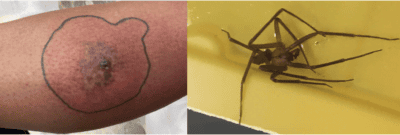
A patient bitten by the pictured creature with the pictured lesion should be screened for which pathology?
- Acute liver failure
- Ascending paralysis
- Hemolysis
- Meningitis
- Myocarditis

A patient bitten by the pictured creature with the pictured lesion should be screened for which pathology?

In the continued fight against COVID-19, a January 22, 2021 press release from the Montreal Heart Institute touted the potential of colchicine, citing results from the COLCORONA trial [1, 2]. We’ve learned to be especially skeptical of any study results reported only via press release before undergoing full peer-review and publication. Nevertheless, the authors claim a non-significant (p=0.08) relative risk reduction of 19% (absolute risk reduction 1.1%) in hospitalizations, mechanical ventilation, and death. Note that the pre-print of the study has still not been peer-reviewed [3]. This study comes on the heels of the much smaller GRECCO-19 study published in June 2020 [4].
Early in 2020, promising results on hydroxychloroquine for treatment of COVID-19 led to a large increase in its use in outpatients and inpatients. It is now known that there is virtually no role for hydroxychloroquine and that this spike in use led to serious toxicity both from therapeutic use and overdose [5, 6]. The same may be anticipated for colchicine. And, if there is a drug that toxicologists fear more than hydroxychloroquine in overdose, it’s colchicine.
This 2010 Clinical Toxicology review article provides further information and education on colchicine toxicity.
Read other articles in the EM Pharm Pearls Series.

The 2020 ACLS guidelines provide recommendations on the medication-specific management recommendations for toxicology [1]. Although the name of the guidelines emphasize they are ‘Advanced,’ these are still relatively basic toxicology recommendations and largely apply to patients in cardiac arrest or refractory shock. There are also our 2020 ACLS guideline summaries on vasopressor and non-vasopressor medications used during cardiac arrest and arrhythmia management.
| Intervention | Beta-adrenergic blocker | Calcium channel blocker | Evidence (COR/LOE) |
|---|---|---|---|
| High-dose insulin | Reasonable | Reasonable | 2a/C-LD |
| Glucagon IV | Reasonable | May be considered | 2a/C-LD and 2b/C-LD |
| Calcium | May be considered | Reasonable | 2b/C-LD and 2a/C-LD |
| ECMO | Might be considered | Might be considered | 2b/C-LD |
Table: Medications and interventions in the management of beta-adrenergic and calcium channel blocker toxicity (COR: class of recommendation, LOE: level of evidence, ECMO: extracorporeal membrane oxygenation)

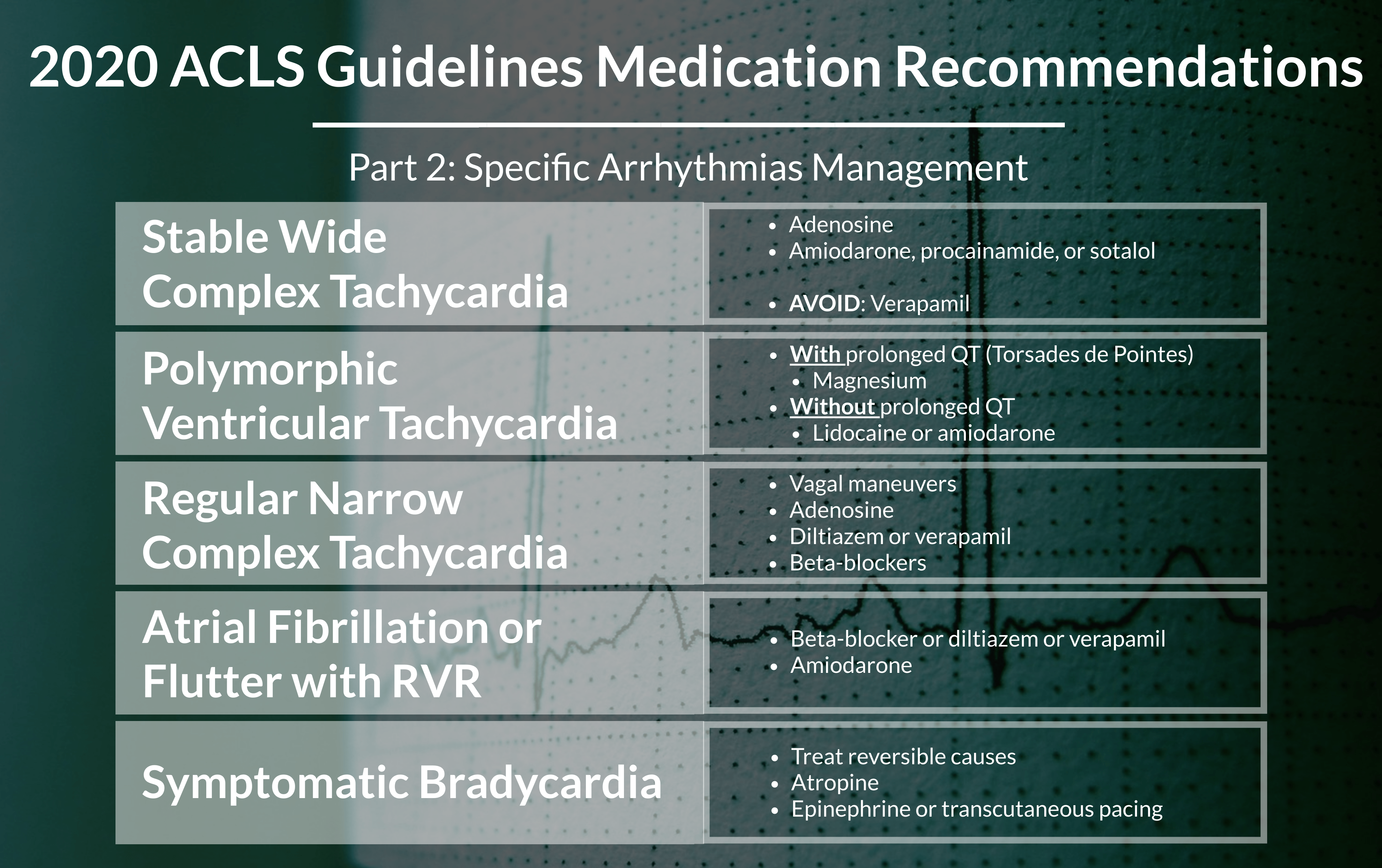
The 2020 ACLS guidelines provide recommendations on the medication-specific management for arrhythmias including wide-complex tachycardia, regular narrow-complex tachycardia, atrial fibrillation/flutter, and bradycardia [1]. There are also our 2020 ACLS guideline summaries on vasopressor and non-vasopressor medications used during cardiac arrest and toxicology-related conditions.
| Wide-complex tachycardia | Medication(s) | Evidence |
|---|---|---|
| Hemodynamically stable | Adenosine | COR 2b, LOE B-NR |
| Amiodarone, procainamide, or sotalol | COR 2b, LOE B-R | |
| NOTE: Verapamil is harmful | COR 3, LOE B-NR | |
| Polymorphic VT with long QT (torsades de points) | Magnesium | COR 2b, LOE C-LD |
| Polymorphic VT without long QT | Lidocaine or amiodarone | COR 2b, LOE C-LD |

The 2020 ACLS Guidelines were published in October 2020 [1]. This first of 3 blog posts will focus on vasopressor and non-vasopressor medications during cardiac arrest. Part 2 will focus on specific arrhythmia management and Part 3 will focus on toxicologic interventions.
There were no major updates for vasopressors and non-vasopressors used during cardiac arrest. The American Heart Association (AHA) published Highlights of the 2020 Guidelines [PDF] as a clear and concise summary. Now that the AHA is releasing focused updates in the 5-year period between guidelines (like this one on lidocaine), fewer major changes likely will be needed when the full guidelines are published.
| Vasopressor | Non-Vasopressor |
|---|---|
|
Epinephrine
|
Amiodarone or lidocaine
|
|
Vasopressin
|
Steroids
|
|
Calcium
|
|
|
Sodium bicarbonate
|
|
|
Magnesium
|
Table: Vasopressors and non-vasopressors used during cardiac arrest (VF: ventricular fibrillation, pVT: pulseless ventricular tachycardia)
Which component of the pictured plant is the cause of gastrointestinal symptoms when ingested? 
A major development in curbing the opioid epidemic is the introduction of the medication buprenorphine to address opioid addiction. Being able to prescribe this medication, however, requires a special DEA-X Waiver in the United States. Dr. Alister Martin, the Founder of the Get Waivered initiative, is working to reduce the barriers for clinicians to obtain the training and paperwork necessary to obtain this waiver. Dr. Michelle Lin talks with Dr. Martin on this podcast about the backstory of the Get Waivered program, the lowered barriers to obtaining training, and some sneak peaks on what is new on the launching pad for his program.
Interesting fact: Medical students can participate in the free DEA-X waiver training now. The certificate of completion has no expiration date and can be submitted, when eligible for this waiver license.
Visit the Get Waivered site to learn of their upcoming online training events and hot off the press news.
Disclosure: ALiEM is proud to be a collaborator with the Get Waivered Initiative. This work was funded by the Foundation for Opioid Response Efforts (FORE). The views and conclusions contained in this document are those of the authors and should not be interpreted as representing the official policies or stance, either expressed or implied, of FORE. FORE is authorized to reproduce and distribute reprints for Foundation purposes notwithstanding any copyright notation hereon.