Cyanide

Improper preparation of this food causes poisoning from which toxic compound?

  1. Atropine
  2. Cicutoxin
  3. Cyanide
  4. Oxalic acid

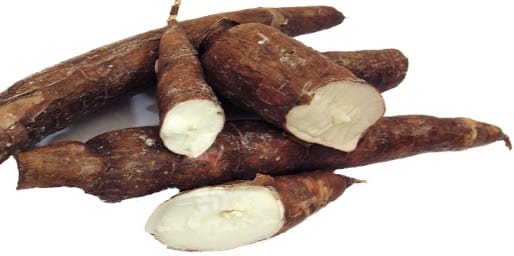
Image from Wikimedia Commons [1]

3. Cyanide

Background

Cassava (Manihot esculenta) is a staple crop for millions of people around the world [2,3]. Cassava is grown and consumed extensively in Africa, Southeast Asia, the Caribbean, and Central and South America. It is also known as yuca, manihot, tapioca, ubi kayu, gbaguda, and various other names depending on geography. Cassava roots are an excellent source of carbohydrates, and the leaves are an excellent supply of micronutrients and protein, except for methionine [3]. However, cassava contains cyanogenic glycosides that can cause acute and chronic poisoning [2-4].

What are the toxins in cassava? [2-4]

  • Cassava contains several cyanogenic glycosides. The two most prevalent are linamarin and lotaustralin.
  • These are converted via linamarase to cyanohydrin, which spontaneously degrades to acetone and hydrogen cyanide.
  • Cassava can be categorized as “sweet” or “bitter” depending on the amount of cyanide they contain.
    • Sweet cassava contains less than 50 micrograms/gram of cyanide.
    • Bitter cassava contains more than 50 micrograms/gram of cyanide.
    • Bitter varieties often have darker leaves and stems and are responsible for most reported cases of cyanide toxicity.

How do you prepare cassava for consumption? [3,5]

  • Removing cyanogenic glycosides from cassava is essential for safe consumption.
  • Increasing the contact time between cyanogenic glycosides and linamarase allows the cyanohydrin and cyanide to dissolve or volatilize, facilitating removal.
  • This can be accomplished by multiple different methods, which can be combined:
    • Sun drying
    • Soaking in water for 24 hours
      • Soaking for 20 hours can remove HCN by 50%
      • Some processes recommend soaking for 2-8 days.
    • Grating roots into a pulp, which is then squeezed dry.
      • This method is utilized to produce cassava flour/tapioca starch.

How does cassava poisoning present? [3-4,6-8]

  • Symptoms are those of cyanide poisoning
  • The onset of symptoms is generally seen between 1 – 12 hours after ingestion.
  • The most common symptoms are abdominal pain, nausea, vomiting, diarrhea, and dizziness.
  • Severe toxicity is characterized by lethargy, coma, and renal failure.
  • Death has been reported.
  • Laboratory testing may show elevated cyanide levels and elevated lactic acid levels [9].

How is cassava poisoning treated? [9,10]

  • Specific treatment is poorly detailed in the literature.
  • Supportive care is key, including IV fluids, anti-emetics, and supplemental oxygen if needed.
  • Standard cyanide treatment is recommended, including sodium thiosulfate, sodium nitrite, or hydroxocobalamin.
  • Please see ACMT Toxicology Visual Pearls: Discolored Skin and Urine for more information on treatment.

What about chronic exposure to cassava? [2.6.11-14]

  • Chronic consumption of bitter cassava has been associated with several different diseases.
    • Diabetes is associated with calcification of the pancreas, although this link is debatable.
    • Stomach cancer, potentially related to carcinogenic nitrosamines induced by thiocyanate.
    • Optic Neuropathy similar to tobacco amblyopia and Leber hereditary optic neuropathy
    • Ataxic neuropathy, including an endemic disease called konzo
  • Konzo is a neurologic disease linked to (bitter) cassava consumption as a primary food source and is characterized by:
    • Rapid onset of symmetrical, irreversible spasticity, deficits in fine motor control, and hyperreflexia
    • Outbreaks have been reported in Democratic Republic of the Congo, Mozambique, Tanzania, Central African Republic, Angola, Cameroon, and Zambia.
    • Unfortunately, this disease is irreversible, and there is no known cure.

Bedside Pearls

  • Cassava is a staple food for millions around the world.
  • Cassava contains cyanogenic glycosides, which can cause acute cyanide toxicity and even death if the cassava is improperly processed/prepared.
  • Treatment for acute cassava poisoning is similar to standard cyanide toxicity treatment.
  • Chronic toxicity can result in ataxic neuropathy or a disease of spastic paresis called konzo.

References

  1. Photo from Renatosjoao. Cassava (2).jpg. Wikimedia Commons. Published May 13, 2016. Accessed October 8, 2024.
  2. Mohidin SRNSP, Moshawih S, Hermansyah A, Asmuni MI, Shafqat N, Ming LC. Cassava (Manihot esculenta Crantz): A Systematic Review for the Pharmacological Activities, Traditional Uses, Nutritional Values, and Phytochemistry. J Evid Based Integr Med. 2023;28:2515690X231206227. PMID:37822215.
  3. Teles FF. Chronic poisoning by hydrogen cyanide in cassava and its prevention in Africa and Latin America. Food Nutr Bull. 2002;23(4):407-412. PMID: 16619750.
  4. Peñas J, de Los Reyes VC, Sucaldito MN, Manalili DL, Hizon H, Magpantay R. A retrospective cohort study on cassava food poisoning, Santa Cruz, Davao del Sur, Philippines, October 2015. Western Pac Surveill Response J. 2018;9(4):7-11. Published 2018 Oct 25. PMID: 30766741.
  5. Padmaja G. Cyanide detoxification in cassava for food and feed uses. Crit Rev Food Sci Nutr. 1995;35(4):299-339. PMID: 7576161.
  6. Alitubeera PH, Eyu P, Kwesiga B, Ario AR, Zhu BP. Outbreak of Cyanide Poisoning Caused by Consumption of Cassava Flour – Kasese District, Uganda, September 2017. MMWR Morb Mortal Wkly Rep. 2019;68(13):308-311. Published 2019 Apr 5. PMID: 30946738.
  7. Ariffin WA, Choo KE, Karnaneedi S. Cassava (ubi kayu) poisoning in children. Med J Malaysia. 1992;47(3):231-234. PMID: 1491651.
  8. Akintonwa A, Tunwashe OL. Fatal cyanide poisoning from cassava-based meal. Hum Exp Toxicol. 1992;11(1):47-49. PMID: 1354460.
  9. Espinoza OB, Perez M, Ramirez MS. Bitter cassava poisoning in eight children: a case report. Vet Hum Toxicol. 1992;34(1):65. PMID: 1621366.
  10. Hall AH, Rumack BH. Clinical toxicology of cyanide. Ann Emerg Med. 1986;15(9):1067-1074. PMID: 3526995.
  11. Freeman AG. Optic neuropathy and chronic cyanide intoxication: a review. J R Soc Med. 1988;81(2):103-106. PMID: 3279198.
  12. Kashala-Abotnes E, Okitundu D, Mumba D, Boivin MJ, Tylleskär T, Tshala-Katumbay D. Konzo: a distinct neurological disease associated with food (cassava) cyanogenic poisoning. Brain Res Bull. 2019;145:87-91. PMID: 29981837.
  13. Kambale KJ, Ali ER, Sadiki NH, et al. Lower sulfurtransferase detoxification rates of cyanide in konzo-A tropical spastic paralysis linked to cassava cyanogenic poisoning. Neurotoxicology. 2017;59:256-262. PMID: 27246648.
  14. Tshala-Katumbay D, Mumba N, Okitundu L, et al. Cassava food toxins, konzo disease, and neurodegeneration in sub-Sahara Africans. Neurology. 2013;80(10):949-951. PMID: 23460617.

John Michael Sherman, MD

John Michael Sherman, MD

Emergency Medicine Resident
Carolinas Medical Center, Charlotte, NC
John Michael Sherman, MD

Latest posts by John Michael Sherman, MD (see all)

Kathryn T. Kopec, DO

Kathryn T. Kopec, DO

Emergency Medicine and Medical Toxicology Faculty
Carolinas Medical Center, Charlotte, NC