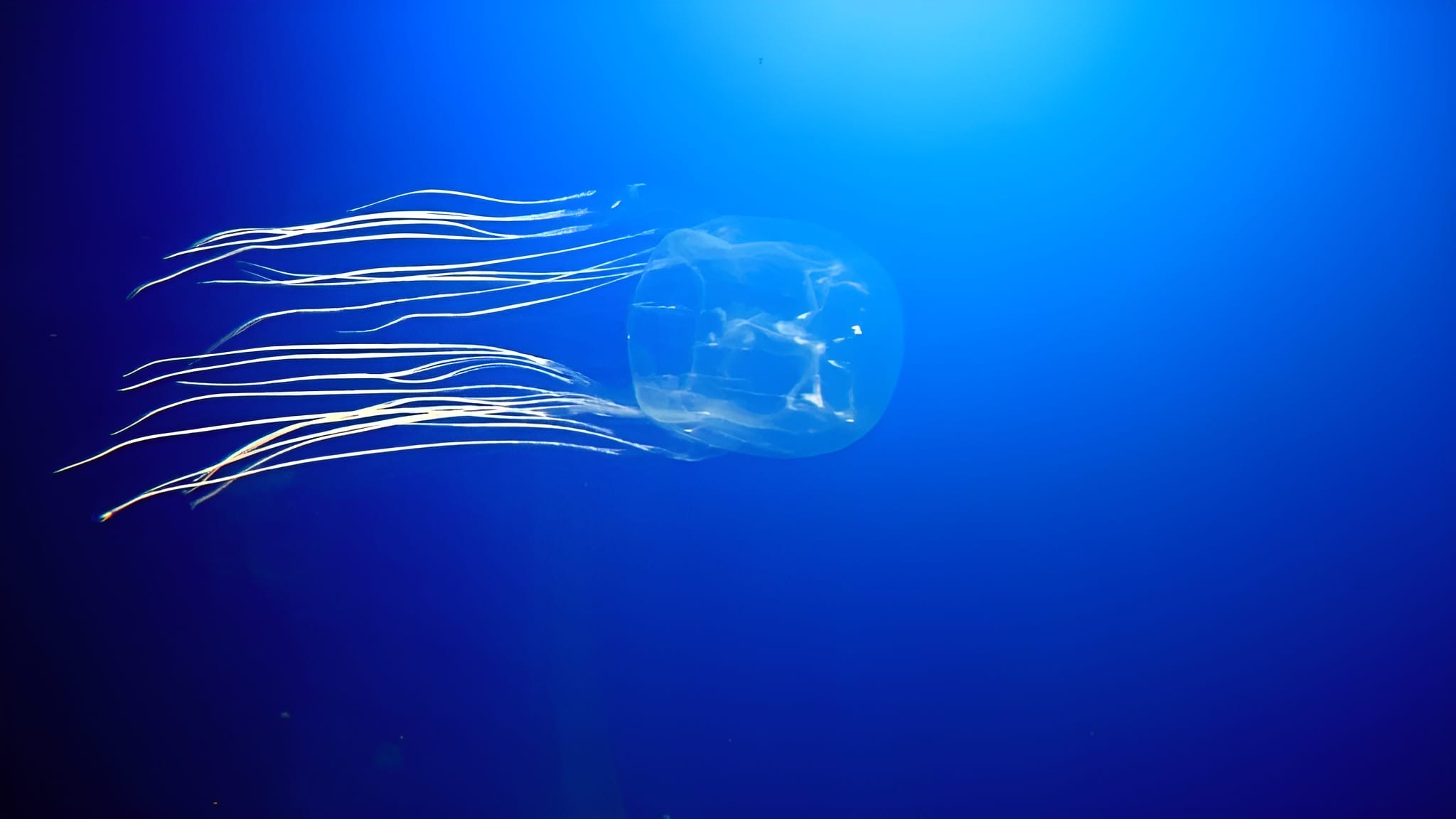
In addition to local pain and dermal injury, stings from this marine animal can result in what systemic symptoms?

  1. Acute liver injury
  2. Hypotension, arrhythmia, and cardiac arrest
  3. Nausea, vomiting, and respiratory arrest
  4. Numbness, tingling, and muscle paralysis

[Image courtesy of Guido Gautsch, Wikimedia Commons]

2. Hypotension, arrhythmias, and cardiac arrest

This image depicts a box jellyfish (Chironex fleckeri), whose venom can cause direct cardiac toxicity resulting in hypotension, arrhythmia, and cardiac arrest.

Background

Chironex fleckeri, commonly known as the Australian Box Jellyfish (AKA the “Sea Wasp”), is a species of Cnidarian of the class Cubozoa. Named for their box-shaped bell, these jellyfish are commonly considered one of the most venomous marine animals, with more than 70 fatalities attributed to their stings [1,2]. Members of this species are native to the coastal waters of northern Australia, with populations extending north to New Guinea, Indonesia, and Southeast Asia. Chironex fleckeri, like all Cubozoa, are effectively translucent and primarily encounter humans in shallow waters off the shores of beaches [2].  With tentacles up to 3 meters in length, stings often occur due to incidental contact. This leads to discharge of nematocysts (Cnidarian stinging organelles), which puncture the epidermis and deliver venom directly into the contacted tissue, which can result in systemic effects [1-3].

What are the venom components?

Venom extraction for analysis is difficult due to Chironex’s small size and fragility. As such, only a few unique venom components have been definitively identified [3,4].

  • Metalloproteases: Degrade the extracellular matrix to facilitate the delivery of other toxic components to the cell membrane [5].
  • Porins: Toxic proteins that form pores in cell membranes. CfTX-A/B and CfTX-1/2 are the major toxic proteins specific to Chironex fleckeri and are suspected to cause hemolytic and cardiotoxic effects, respectively [6].

What is the pathophysiology of envenomation?

  • Primarily studied in animal models and in vitro cell lines.
  • It is suspected that cardiomyocyte porin insertion leads to the rapid onset of direct cardiotoxicity [4,7].
  • Disruptions in cardiac ion concentration gradients lead to biphasic effects on contractility, vasoconstriction, and arterial pressure, ultimately leading to cardiovascular collapse [7,8].
  • ECGs of envenomated mice demonstrated progressive PR prolongation and AV dissociation at sub-lethal doses [4].

What are the clinical effects? [1-3]

  • Most cases are limited to pain and dermal injury.
  • Local: Intense pain with erythematous, edematous plaques in a linear pattern, consistent with tentacle contact.
  • When systemic symptoms do occur, they are often rapid-onset, occurring in seconds to minutes. Effects are believed to be dose-dependent (as measured by length of tentacle contact), and children appear more likely to experience severe, systemic effects.
  • Systemic: Dyspnea, vasospasm, hypotension, arrhythmias, and cardiac arrest.

What is the management of envenomation?

  • Severe, systemic symptoms can occur rapidly. As such, basic and advanced life support are first line for critically ill patients or patients in cardiac arrest [9].
  • Liberally apply vinegar (4-6%% acetic acid) for ~30 seconds to the area of stings [10, 11].
    • Rapidly inactivates unfired nematocysts.
    • If vinegar is not available, use seawater to irrigate the area.
    • Fresh water and alcohol are not recommended, as these have been shown to induce nematocyst discharge [11,12].
  • Remove adhered tentacles.
    • Consider using forceps to prevent excessive pressure-induced nematocyst discharge. If not available, pluck them from the skin with as little applied pressure as possible, avoiding skin contact with tentacles [13].
  • Pain control.
    • Ice and heat are equally effective in controlling pain [14].
    • Typical oral and parenteral analgesics can be utilized if needed.
  • In severe cases, consider antivenom if readily available [15].

A word about antivenom

  • Ovine antivenom (Purified IgG against Chironex fleckeri toxin) has been available since 1970 from CSL limited [16].
  • The suggested indication is management of life-threatening box jellyfish envenomation associated with cardiac and/or respiratory collapse [17].
  • Multiple studies have demonstrated questionable efficacy, and there is no consensus as to the clinical benefit of antivenom in affected patients [2,3].

Bedside Pearls

  • Australian Box Jellyfish (Chironex fleckeri) stings primarily cause local pain and dermal injury but can cause rapid-onset cardiovascular symptoms, including cardiac arrest, especially in children.
  • Acute management of severe envenomation focuses on excellent resuscitation and supportive care.
  • For less severe cases, irrigate stings with vinegar or seawater, remove adhered tentacles, and treat pain.
  • Antivenom is available in endemic regions, though its efficacy is debated.

References

  1. Cegolon L, Heymann WC, Lange JH, Mastrangelo G. Jellyfish stings and their management: a review. Mar Drugs. 2013;11(2):523-550. PMID: 23434796
  2. Currie BJ, Jacups SP. Prospective study of Chironex fleckeri and other box jellyfish stings in the “Top End” of Australia’s Northern Territory. Med J Aust. 2005;183(11-12):631-636. PMID: 16336157
  3. Piontek M, Seymour JE, Wong Y, et al. The pathology of Chironex fleckeri venom and known biological mechanisms. Toxicon X. 2020;6(100026):100026. PMID: 32550582
  4. Yanagihara AA, Shohet RV. Cubozoan venom-induced cardiovascular collapse is caused by hyperkalemia and prevented by zinc gluconate in mice. PLoS One. 2012;7(12):e51368. PMID: 23251508
  5. Jouiaei M, Casewell NR, Yanagihara AA, et al. Firing the sting: chemically induced discharge of cnidae reveals novel proteins and peptides from box jellyfish (Chironex fleckeri) venom. Toxins (Basel). 2015;7(3):936-950. PMID: 25793725
  6. Brinkman DL, Konstantakopoulos N, McInerney BV, et al. Chironex fleckeri (Box Jellyfish) venom proteins: expansion of a cnidarian toxin family that elicits variable cytolytic and cardiovascular effects. J Biol Chem. 2014;289(8):4798-4812. PMID: 24403082
  7. Freeman SE, Turner RJ. Cardiovascular effects of toxins isolated from the cnidarian Chironex fleckeri Southcott. Br J Pharmacol. 1971;41(1):154-166. PMID: 4396129
  8. Hughes RJA, Angus JA, Winkel KD, Wright CE. A pharmacological investigation of the venom extract of the Australian box jellyfish, Chironex fleckeri, in cardiac and vascular tissues. Toxicol Lett. 2012;209(1):11-20. PMID: 22154831
  9. ANZCOR, 2025, Guideline 9.4.5 – Envenomation – Jellyfish Stings, accessed 25 April 2025, https://www.anzcor.org/home/first-aid-for-bites-stings-and-poisoning/guideline-9-4-5-envenomati on-jellyfish-stings/
  10. Hartwick R, Callanan V, Williamson J. Disarming the box-jellyfish: nematocyst inhibition in Chironex fleckeri. Med J Aust. 1980;1(1):15-20. PMID: 6102347
  11. Thaikruea L & Siriariyaporn P. The magnitude of severe box jellyfish cases on Koh Samui and Koh Pha-ngan in the Gulf of Thailand. BMC Res Notes. 2016; PMID: 26888067
  12. Birsa LM, Verity PG, Lee RF. Evaluation of the effects of various chemicals on discharge of and pain caused by jellyfish nematocysts. Comp Biochem Physiol. 2010; PMID: 20116454
  13. Peng X, Liu KT, Chen JB, et al. Jellyfish stings: A review of skin symptoms, pathophysiology, and management. Med Sci Monit. 2024;30:e944265. PMID: 39074073

Samuel Kerans, MD

Samuel Kerans, MD

Emergency Medicine Resident
Carolinas Medical Center
Charlotte, NC
Samuel Kerans, MD

Latest posts by Samuel Kerans, MD (see all)

Kathryn T. Kopec, DO

Kathryn T. Kopec, DO

Emergency Medicine and Medical Toxicology Faculty
Carolinas Medical Center, Charlotte, NC