DOI: 10.1056/NEJMoa2601969 | PubMed: PMID 42028918
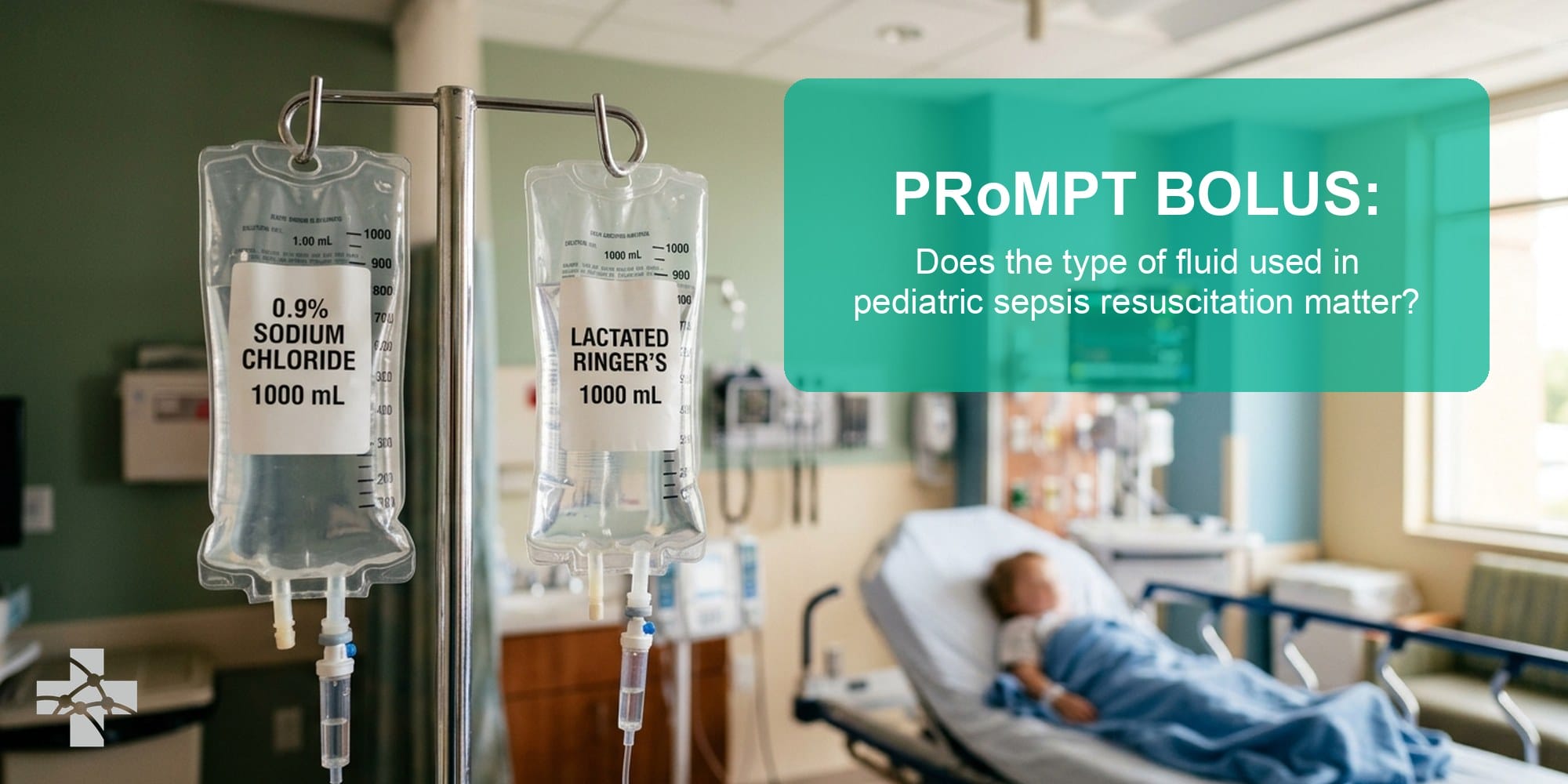
For years, clinicians and researchers have debated a fundamental question in pediatric emergency care: does the type of fluid used in pediatric sepsis resuscitation matter?
The PRoMPT BOLUS trial was designed to answer this question. Conducted across 47 international sites in 5 countries and enrolling more than 9,000 children, this large, pragmatic randomized trial compared 0.9% saline with balanced crystalloids in children treated for suspected septic shock.
The results have just been released. Across a wide range of clinically meaningful outcomes (including kidney injury, mortality, and recovery), there was no difference between fluid types.
Background
Sepsis remains a major global health concern, affecting approximately 50 million people each year, with children accounting for nearly half of these cases. Early fluid resuscitation is a cornerstone of treatment, making the choice of fluid a critical and historically debated decision.
Two primary types of crystalloid fluids are used in practice:
- 0.9% saline, which contains a higher-than-physiologic chloride concentration
- Balanced fluids (such as lactated Ringer’s, Hartmann’s solution and PlasmaLyte), which more closely resemble plasma electrolyte composition
Prior research raised concerns that saline could contribute to metabolic acidosis and kidney injury, while balanced fluids were associated with improved outcomes in some adult and smaller pediatric studies. However, the pediatric literature remained inconsistent, with observational studies reaching conflicting conclusions. As a result, guidelines offered only weak recommendations favoring balanced fluids and called for more definitive trials.
PRoMPT BOLUS was designed to fill this gap.
Study Design
This trial used a pragmatic, randomized design (NS vs. balanced fluids), intentionally embedded into routine clinical care. Pragmatic trials evaluate clinical interventions within typical practice, rather than highly controlled clinical settings. By incorporating fluid randomization without modifying additional aspects of clinical practice, this approach allowed investigators to study fluid choice in real-world conditions across diverse healthcare systems. PRoMPT BOLUS was a collaborative effort across multiple networks including PECARN (Pediatric Emergency Care Applied Research Network), PERC (Pediatric Emergency Research Canada), and PREDICT (Paediatric Research in Emergency Departments International Collaborative).
Children ages 2 months to <18 years were eligible if clinicians suspected sepsis and were planning to treat with more than one fluid bolus for abnormal perfusion consistent with septic shock. They were randomized to receive either balanced fluids or 0.9% saline, with clinicians otherwise managing care as they normally would.
The primary outcome was MAKE30 (Major Adverse Kidney Events within 30 days), a composite that includes mortality, need for renal replacement therapy, or persistent kidney dysfunction at hospital discharge or 30 days, whichever came first.
This pragmatic approach was critical to the study’s success. It allowed for:
- High enrollment across multiple international sites
- Enrollment at the beginning of sepsis resuscitation so that most early fluid was as randomized
- Strong generalizability to everyday clinical practice
- Minimal disruption to clinical workflows
Results
Primary Outcome
The primary outcome, MAKE30, occurred at nearly identical rates in both groups:
- Balanced fluids: 3.4%
- Saline: 3.0%
This difference was neither statistically nor clinically significant. There were also no differences in any of the individual MAKE30 components between treatment groups.
Secondary and Safety Outcomes
Similarly, there were no meaningful differences in:
- Mortality
- Hospital length of stay
- Hospital-free days (median of 23 days in both groups)
- Safety events such as thrombosis or cerebral edema
Together, these findings strongly support the conclusion that both fluids are equally safe and effective.
Biochemical Differences
Although there were measurable and statistically significant biochemical differences between groups (such as higher rates of hyperchloremia and hypernatremia with saline and hyperlactatemia with balanced fluids), these changes did not translate into clinically meaningful outcomes.
Subgroup Analyses
Subgroup analyses across patient characteristics, illness severity, and total fluid volume showed no differences in outcomes. While there was a non-significant trend suggesting potential benefit of balanced fluids in the most severely ill patients, the study was not powered to confirm this finding.
Major Findings
The results of PRoMPT BOLUS can be distilled into several key conclusions:
- Both 0.9% saline and balanced fluids are safe and effective for treatment of children with suspected septic shock
- Fluid type does not influence major clinical outcomes, including mortality or kidney injury
- Biochemical differences exist between fluid choices, but did not translate to differences in clinical outcomes
Importantly, while the study cannot fully exclude a benefit of balanced fluids in the sickest patients, it provides strong evidence that for children presenting to the ED with suspected sepsis, either fluid is an appropriate choice.
Clinical Implications
These findings have immediate and meaningful implications for clinical practice.
First, they simplify decision-making. Clinicians can focus on timely recognition and treatment of children with suspected sepsis, and engage in fluid resuscitation with fluids that make sense for the clinical scenario.
Second, the results support flexibility in care. Fluid choice can now be guided by:
- Availability
- Medication compatibility
- Patient-specific factors (e.g., electrolyte abnormalities, underlying conditions)
Limitations
While the study is robust, several limitations should be considered.
The overall incidence of MAKE30 was lower than expected (~3% vs. an anticipated ~6%), which may reflect a less severely ill population than initially projected. This could limit the ability to detect small differences between groups.
Additionally, although subgroup analyses suggested a possible benefit of balanced fluids in more severely ill patients, the study was not powered to draw definitive conclusions in this population.
Bottom Line
The PRoMPT BOLUS trial provides the strongest evidence to date addressing fluid choice in children presenting to the ED with suspected sepsis. Both 0.9% saline and balanced crystalloids are safe and effective for resuscitation in children with suspected septic shock.
References
- Balamuth F, Weiss SL, Long E, et al; PRoMPT BOLUS Investigators of the PECARN, PERC, and PREDICT Networks. Balanced Fluid or 0.9% Saline in Children Treated for Septic Shock. N Engl J Med. Published online April 24, 2026. doi:10.1056/NEJMoa2601969

Lauren VonHoltz, MD MPH
Pediatric Emergency Medicine
Attending, Children's Hospital of Philadelphia