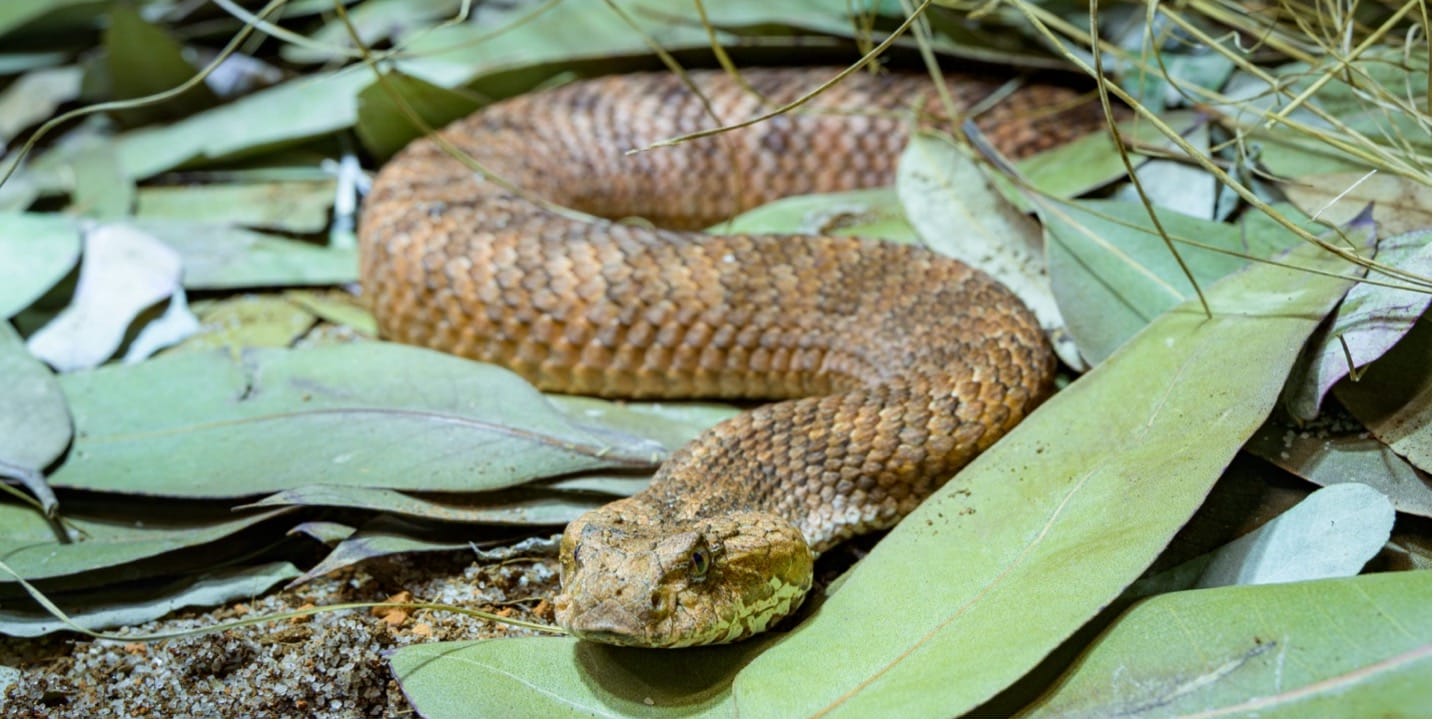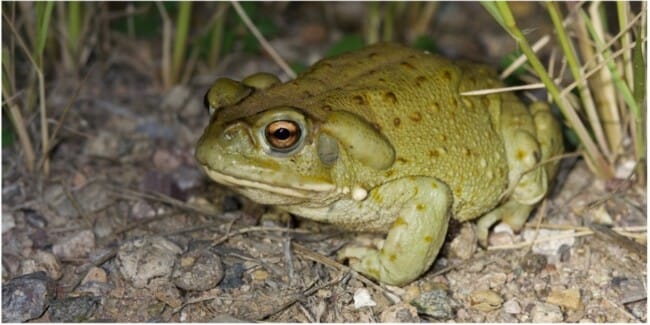
When people intentionally lick this toad, which toxin can they be exposed to?
- Bufodienolides
- Ciguatoxin
- Mescaline
- Psilocybin
[Image by Spencer B. via iNaturalist]
1. Bufodienolides
Background
Toads of the Bufo genus, such as the Sonoran Desert Toad or the Colorado River Toad, secrete from their modified parotid glands several toxins, including bufodienolides and bufotenin. Bufodienolides are cardiac glycosides similar to digoxin, while bufotenine (5-hydroxy-N,N-dimethyltriptamine, or 5-OH-DMT) is a psychedelic tryptamine similar to serotonin. [2,3] It is believed that the secretions of this toad were ingested in Mesoamerica for many years due to its intense psychedelic effects, and Bufo toad venom has been employed in traditional Chinese medicine for centuries. Its reported effects include anesthetic, anti-inflammatory, anti-neoplastic, improved cardiac function, and enhancement of sexual function. [4,5] Human exposures occur from intentional or unintentional exposure to toad venom via smoking dried venom, using herbal or traditional medication, ingestion of toad meat or eggs, and licking toad skin. [2,3,5-10]
What are the toxins found in Bufo toads, and how do they work? [4-8]
- Bufodienolides are cardioactive steroids found in toad venom. They bind to and inhibit the Na+/K+-ATPase pump, the same mechanism of action as digoxin, resulting in potentially serious toxicity.
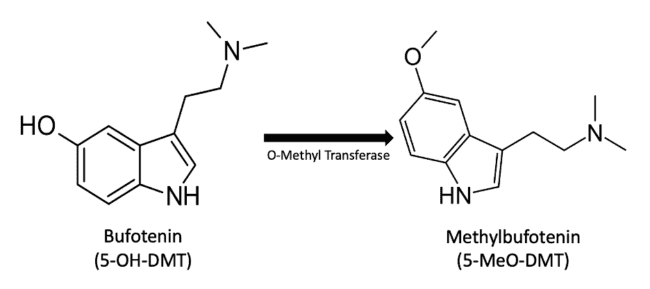
- Bufotenin and methylbufotenin (also known as 5-methoxy-N,N-dimethyltriptamine or 5-MeO-DMT), are serotoninergic psychedelic tryptamines which act on the 5-HT-1A and 5HT-2A receptors.
- Interestingly, the Incilius Alvarius, commonly known as the Colorado River Toad or the Sonoran Desert Toad, contains the enzyme O-methyltransferase, which converts bufotenine to methylbufotenin.
How do patients present after exposure to Bufo toad venom? [7-11]
- Findings related to bufodienolides are like those of digoxin poisoning and may be life-threatening
- GI symptoms (e.g., nausea, vomiting, abdominal pain)
- Pulmonary edema
- Arrythmias
- Bradycardia
- AV block
- Ventricular fibrillation
- Ventricular tachycardia
-
- Hyperkalemia
- Hypotension
- Cyanosis
- Seizures
- Cardiac arrest
- Median onset time of toxic effects is approximately 2 hours [2,3]
- Most deaths occur within 24 hours of ingestion
- Findings related to bufotenine/methylbufotenin are primarily psychedelic, including euphoria and dissociation, but some users also experience dysphoria and fear.
- Psychedelic effects are reported to last 5-15 minutes with residual effects for approximately one hour, although symptomatology may be prolonged in patients taking MAO inhibitors.
What diagnostic tests are useful for Bufo toad venom toxicity? [10,11]
- EKG and cardiac telemetry are indicated for the risk of arrhythmia
- Hyperkalemia can be seen due to the cardiac glycoside effects of the venom
- Digoxin levels may be detectable, but do not reflect the degree of toxicity
How do you treat Bufo toad venom toxicity? [9-13]
- Supportive care, such as IV fluids and antiemetics
- Caution is advised with the use of ondansetron in the setting of significant bradycardia, due to arrhythmia risk
- Consider activated charcoal with recent ingestion
- Evaluation for hyperkalemia
- Hyperkalemia may represent cellular shifting rather than true hyperkalemia, and potassium-lowering interventions should be considered with caution as hypokalemia may result and increased risk for arrhythmia
- Use caution with calcium administration, as with digoxin poisoning
- Treat arrhythmias using ACLS protocols
- Digoxin-specific antibody fragments have been used with successful recovery in some case reports and would be dosed empirically – more details on the treatment of natural cardiac glycoside poisoning can be found here: ACMT Toxicology Visual Pearl: Pretty (and Deadly) in Purple
Bedside Pearls
- A thorough history is key to diagnosing Bufo toad venom toxicity
- The venom contains substances with cardiac glycoside effects and substances with psychedelic effects
- Life-threatening manifestations of cardiac glycoside poisoning, such as bradycardia, arrhythmia, and hyperkalemia, may occur
- Hyperkalemia should be treated cautiously
- Treatment is supportive
- Digoxin-specific antibody fragments have been used with success in case reports

The American College of Medical Toxicology hosts this Toxicology Visual Pearls series. The post was peer reviewed on behalf of ACMT by Drs. Howard A Greller, Louise Kao, and Mark Neavyn.
References
- Spencer B. Incilius alvarius [photograph]. iNaturalist. https://www.inaturalist.org/taxa/65828-Incilius-alvarius. Used with permission.
- Liu Y, Zhang J, Wang B, Zheng F, Yan J. Epidemiological patterns and therapeutic approaches of toad toxin poisoning in a retrospective case study.Sci Rep. 2025;15(1):5586. doi:10.1038/s41598-025-89809-0. PMID: 39955382.
- Trakulsrichai S, Chumvanichaya K, Sriapha C, Tongpoo A, Wananukul W. Toad poisoning: clinical characteristics and outcomes.Ther Clin Risk Manag. 2020;16:1235–1241.PMID: 33363378.
- Shen HW, Jiang XL, Winter JC, Yu AM. Psychedelic 5-methoxy-N,N-dimethyltryptamine: metabolism, pharmacokinetics, drug interactions, and pharmacological actions.Curr Drug Metab. 2010;11(8):659-666. PMID: 20942780.
- Weil AT, Davis W. Bufo alvarius: a potent hallucinogen of animal origin.J Ethnopharmacol. 1994;41(1-2):1-8. PMID: 8170151.
- Incilius alvarius basic info. ICEERS.https://www.iceers.org/incilius-alvarius-basic-info/. Accessed January 2026.
- Orsolini L, Ciccarese M, Papanti D, et al. Psychedelic fauna for psychonaut hunters: a mini-review.Front Psychiatry. 2018;9:153. PMID: 29910745.
- Jimoh A, Muhammed U, Yunusa A, Adamu A, Aluefua O, Hudu S, Okwor C. Psychoactive faunas: new unconventional substances of abuse.Int J Innov Res Sci Eng Technol. 2022;7:1550–1561.
- Gambassi F, Lanzi C, Ricci Z, et al. Life-threatening pediatric poisoning due to ingestion ofBufo bufo toad eggs: a case report. Toxicon. 2022;217:13–16. PMID: 35839868.
- Kuo HY, Hsu CW, Chen JH, Wu YL, Shen YS. Life-threatening episode after ingestion of toad eggs: a case report with literature review.Emerg Med J. 2007;24(3):215–216. PMID: 17351232.
- Chi HT, Hung DZ, Hu WH, Yang DY. Prognostic implications of hyperkalemia in toad toxin intoxication.Hum Exp Toxicol. 1998;17(6):343–346. PMID: 9688359.
- Brubacher JR, Ravikumar PR, Bania T, Heller MB, Hoffman RS. Treatment of toad venom poisoning with digoxin-specific Fab fragments.Chest. 1996;110(5):1282–1288. PMID: 8915235.

Ann-Jeannette Geib, MD
Department of Emergency Medicine
Carolinas Medical Center, Charlotte, NC
Latest posts by Ann-Jeannette Geib, MD (see all)
- ACMT Toxicology Visual Pearl – Who Toad You to Lick It? - June 2, 2026
- ACMT Toxicology Visual Pearl – Sauté Gone Sour - May 19, 2026
- ACMT Toxicology Visual Pearl: Skin Lesions - July 17, 2024

Kendrick Lim, DO
Carolinas Medical Center
Latest posts by Kendrick Lim, DO (see all)
- ACMT Toxicology Visual Pearl – Who Toad You to Lick It? - June 2, 2026