

About Lauren VonHoltz, MD MPH

Assistant Professor of Clinical Pediatrics
Pediatric Emergency Medicine
Attending, Children's Hospital of Philadelphia

PERC-Peds Rule Could Change How Children Are Evaluated for Pulmonary Embolism: A PECARN Study

Pediatric emergency clinician evaluating a child at bedside, no imaging equipment in frame

Article reviewed: Ellison AM, Kuppermann N, Shihabuddin BS, et al. PERC-Peds rule for bedside exclusion of pulmonary embolism without radiation in children in the USA (BEEPER): a multicentre, prospective, observational, diagnostic accuracy study. Lancet Respir Med. Published online July 2026
DOI: 10.1016/S2213-2600(26)00086-X

Pulmonary embolism (PE) in children is uncommon, but delayed or missed diagnosis can have serious consequences. Despite this, there is relatively little evidence to guide clinician evaluation of suspected pediatric PE. There are no validated pediatric PE rule-out strategies and adult diagnostic pathways have not been prospectively tested in children.

PECARN sought to change that with their recently published study – BEEPER: Bedside Exclusion of Pulmonary Embolism without Radiation in Children [1]. The investigators developed a rule that safely excluded PE in low-risk children.

Study Objective

The goal of BEEPER was to prospectively evaluate whether the Pulmonary Embolism Rule-out Criteria adapted for children (PERC-Peds) could safely exclude pulmonary embolism in children without the need for laboratory testing or imaging.

What is PERC-Peds?

PERC-Peds was adapted from the adult Pulmonary Embolism Rule-out Criteria (PERC), a well-established adult clinical decision rule used to exclude PE in low-risk patients without additional testing [2]. Using retrospective pediatric data, investigators modified the adult PERC rule to create the pediatric version. A child was considered PERC-Peds negative only if ALL of the following were true:

  • Clinician gestalt pretest probability <15%
  • No prior PE or proximal DVT
  • No surgery requiring intubation within 30 days
  • No current estrogen use
  • No hemoptysis
  • Heart rate always:
    • <100 beats/min if older than 12 years
    • <120 beats/min if 12 years or younger
  • Oxygen saturation consistently >94%
  • No suspected DVT

Study Design

A Large, Prospective, Multicenter PECARN Study

BEEPER was a multicenter, prospective observational diagnostic accuracy study conducted across 21 emergency departments within PECARN (the Pediatric Emergency Care Applied Research Network).

Inclusion Criteria:

  • 4–17 years old, AND
  • had suspected PE or proximal DVT prompting clinicians to:
    • order diagnostic testing, OR
    • strongly consider PE in the differential diagnosis

Eligible diagnostic testing included:

  • D-dimer
  • CT pulmonary angiography (CTPA)
  • V/Q scan
  • MRI angiography
  • Other pulmonary vascular imaging

All testing decisions remained entirely at clinician discretion.

Outcome Definition

The outcome was venous thromboembolism (VTE), including:

  • image-confirmed pulmonary embolism, OR
  • proximal DVT (above knee or elbow)

Results

Enrollment

  • 4,039 children enrolled, 3,988 had analyzable data

Prevalence of Disease

Overall:

  • 254 children (6.3%) had PE and/or proximal DVT

Breakdown:

  • Isolated proximal DVT: 76
  • Both PE and proximal DVT: 56
  • Isolated PE: 122

Performance of PERC-Peds

The PERC-Peds rule demonstrated extremely high diagnostic sensitivity.

Diagnostic Accuracy

  • Sensitivity: 99.6% (95% CI 97.8–99.9%)
  • Specificity: 19.6% (95% CI 18.4–21.0%)
  • False negative rate: 0.1% (95% CI 0–0.75%)
  • Negative predictive value: 99.9%

There was only ONE false negative. These findings suggest that PERC-Peds can safely exclude PE in a subset of low-risk children without additional laboratory testing or imaging.

D-Dimer Findings

BEEPER also provided the first large prospective evaluation of D-dimer performance in children undergoing PE evaluation. Clinicians ordered D-dimer testing in approximately 75–79% of enrolled children. Using a standardized threshold of 500 ng/mL:

  • Sensitivity: 88.8%
  • Specificity: 61.9%
  • False negative rate: 1.2–1.4%

These data support the use of D-dimer as part of a sequential diagnostic strategy in pediatric PE evaluation for those children who fail PERC-Peds.

PERC-Peds + D-Dimer Sequential Strategy

One of the most clinically important findings was the potential value of combining:

  • PERC-Peds
  • followed by D-dimer if PERC-Peds failed

This sequential strategy would have:

  • safely excluded PE in 54.7% of enrolled children,
  • excluded PE in 69% of children who had D-dimer ordered,
  • maintained an acceptable false negative rate of 1.0% (95% CI 0.6–1.5%),
  • estimated reduction in CT pulmonary angiography use by approximately 18.5%.

Putting PERC-Peds in Context

The PERC-Peds rule performed well compared to the regularly utilized adult PERC rule. Adult PERC studies [2] typically show sensitivities around 95% with false negative rates below 2%, while in BEEPER, the sensitivity approached 100% with an exceptionally low false negative rate. Just as importantly, this is the first prospective study to support a bedside rule-out strategy for PE in children: offering a potential pathway to safely reduce unnecessary CT scans and radiation exposure in low-risk patients. BEEPER also lays the groundwork for a more standardized pediatric PE evaluation approach, where clinicians could use PERC-Peds first, followed by D-dimer testing when needed, reserving imaging for children at higher risk.

What’s Next?

While BEEPER represents a major step forward in pediatric PE diagnosis, the study also highlights important limitations and unanswered questions. PERC-Peds demonstrated high sensitivity, but relatively low specificity: meaning many children will still fail the rule, and indiscriminate use could potentially increase testing. Importantly, BEEPER was an observational diagnostic study, meaning it did not evaluate outcomes from the implementation of a clinical decision rule.

BEEPER provides the foundation for a new era of pediatric PE evaluation research. Future studies will likely focus on implementation science: understanding whether use of PERC-Peds changes clinician behavior, safely reduces imaging, and can be integrated into real-world emergency department workflows. Investigators also envision future diagnostic algorithms that combine PERC-Peds with D-dimer testing to reserve imaging for children at highest risk, potentially reducing unnecessary radiation exposure in a meaningful number of patients. Additional work can evaluate performance across different clinical settings, refine the gestalt component of the rule, and explore integration into electronic health record decision support tools. Taken together, BEEPER fills one of the most important evidence gaps in pediatric emergency medicine and represents the first major step toward safer, more standardized, and evidence-based pediatric PE evaluation.

References

  1. Ellison AM, Kuppermann N, Shihabuddin BS, et al. PERC-Peds rule for bedside exclusion of pulmonary embolism without radiation in children in the USA (BEEPER): a multicentre, prospective, observational, diagnostic accuracy study. Lancet Respir Med. Published online July 2026. doi:10.1016/S2213-2600(26)00086-X.
  2. Kline JA, Courtney DM, Kabrhel C, et al. Prospective multicenter evaluation of the pulmonary embolism rule-out criteria. J Thromb Haemost. 2008;6(5):772-780. doi:10.1111/j.1538-7836.2008.02944.x. PMID: 18318689.
By |2026-07-20T21:50:18-07:00Jul 21, 2026|Pediatrics, Pulmonary, Radiology|

PRoMPT BOLUS: A Landmark PECARN Trial Defining Fluid Choice in Pediatric Sepsis

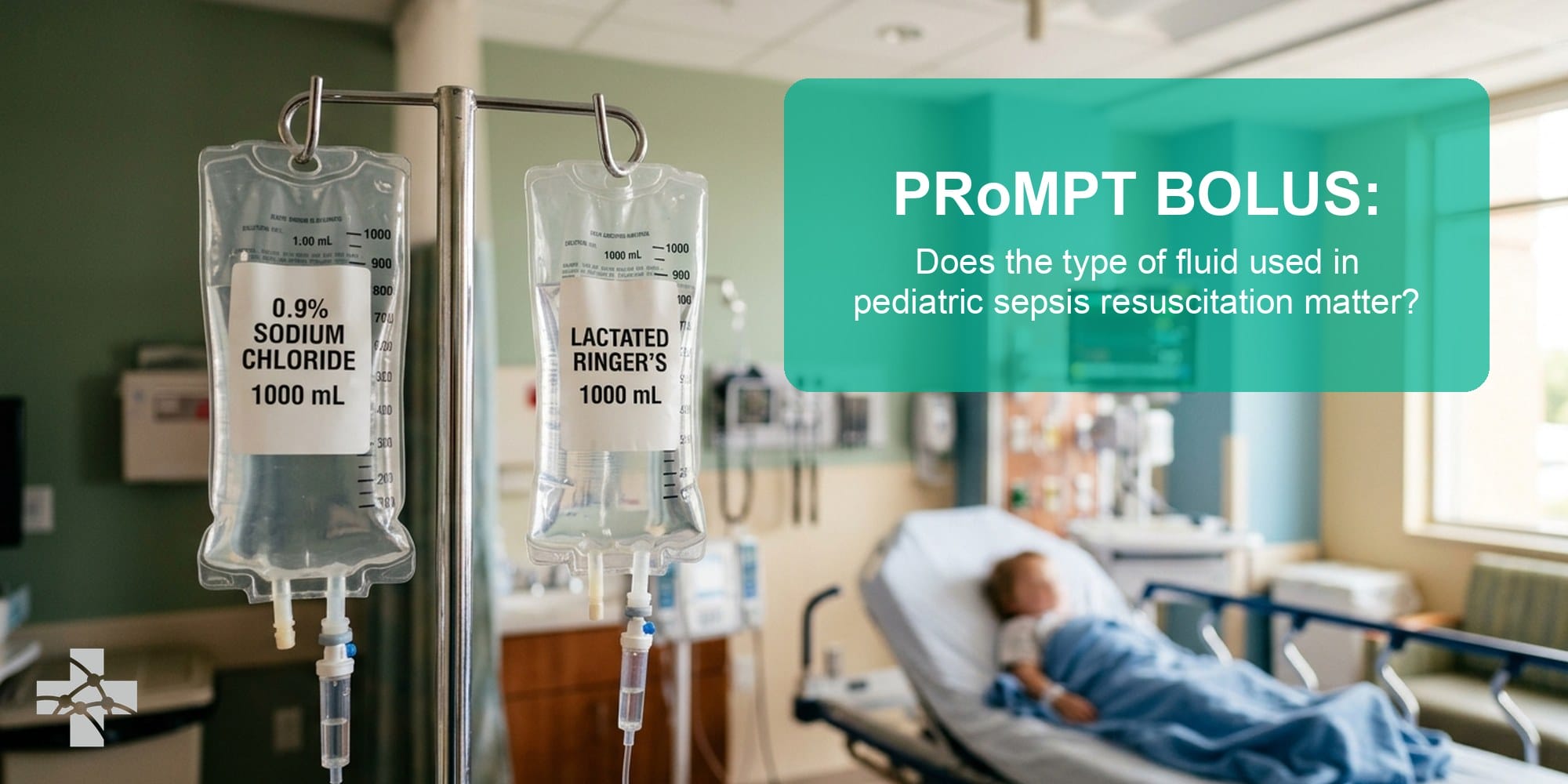
Two IV fluid bags labeled 0.9% sodium chloride and lactated Ringer's hanging side by side in a pediatric emergency department

Article reviewed: Balamuth F, Weiss SL, Long E, et al; PRoMPT BOLUS Investigators of the PECARN, PERC, and PREDICT Networks. Balanced Fluid or 0.9% Saline in Children Treated for Septic Shock. N Engl J Med. Published online April 24, 2026
DOI: 10.1056/NEJMoa2601969  |  PubMed: PMID 42028918

For years, clinicians and researchers have debated a fundamental question in pediatric emergency care: does the type of fluid used in pediatric sepsis resuscitation matter?

The PRoMPT BOLUS trial was designed to answer this question. Conducted across 47 international sites in 5 countries and enrolling more than 9,000 children, this large, pragmatic randomized trial compared 0.9% saline with balanced crystalloids in children treated for suspected septic shock.

The results have just been released. Across a wide range of clinically meaningful outcomes (including kidney injury, mortality, and recovery), there was no difference between fluid types.

Background

Sepsis remains a major global health concern, affecting approximately 50 million people each year, with children accounting for nearly half of these cases. Early fluid resuscitation is a cornerstone of treatment, making the choice of fluid a critical and historically debated decision.

Two primary types of crystalloid fluids are used in practice:

  • 0.9% saline, which contains a higher-than-physiologic chloride concentration
  • Balanced fluids (such as lactated Ringer’s, Hartmann’s solution and PlasmaLyte), which more closely resemble plasma electrolyte composition

Prior research raised concerns that saline could contribute to metabolic acidosis and kidney injury, while balanced fluids were associated with improved outcomes in some adult and smaller pediatric studies. However, the pediatric literature remained inconsistent, with observational studies reaching conflicting conclusions. As a result, guidelines offered only weak recommendations favoring balanced fluids and called for more definitive trials.

PRoMPT BOLUS was designed to fill this gap.

Study Design

This trial used a pragmatic, randomized design (NS vs. balanced fluids), intentionally embedded into routine clinical care. Pragmatic trials evaluate clinical interventions within typical practice, rather than highly controlled clinical settings. By incorporating fluid randomization without modifying additional aspects of clinical practice, this approach allowed investigators to study fluid choice in real-world conditions across diverse healthcare systems. PRoMPT BOLUS was a collaborative effort across multiple networks including PECARN (Pediatric Emergency Care Applied Research Network), PERC (Pediatric Emergency Research Canada), and PREDICT (Paediatric Research in Emergency Departments International Collaborative).

Children ages 2 months to <18 years were eligible if clinicians suspected sepsis and were planning to treat with more than one fluid bolus for abnormal perfusion consistent with septic shock. They were randomized to receive either balanced fluids or 0.9% saline, with clinicians otherwise managing care as they normally would.

The primary outcome was MAKE30 (Major Adverse Kidney Events within 30 days), a composite that includes mortality, need for renal replacement therapy, or persistent kidney dysfunction at hospital discharge or 30 days, whichever came first.

This pragmatic approach was critical to the study’s success. It allowed for:

  • High enrollment across multiple international sites
  • Enrollment at the beginning of sepsis resuscitation so that most early fluid was as randomized
  • Strong generalizability to everyday clinical practice
  • Minimal disruption to clinical workflows

Results

Primary Outcome

The primary outcome, MAKE30, occurred at nearly identical rates in both groups:

  • Balanced fluids: 3.4%
  • Saline: 3.0%

This difference was neither statistically nor clinically significant. There were also no differences in any of the individual MAKE30 components between treatment groups.

Secondary and Safety Outcomes

Similarly, there were no meaningful differences in:

  • Mortality
  • Hospital length of stay
  • Hospital-free days (median of 23 days in both groups)
  • Safety events such as thrombosis or cerebral edema

Together, these findings strongly support the conclusion that both fluids are equally safe and effective.

Biochemical Differences

Although there were measurable and statistically significant biochemical differences between groups (such as higher rates of hyperchloremia and hypernatremia with saline and hyperlactatemia with balanced fluids), these changes did not translate into clinically meaningful outcomes.

Subgroup Analyses

Subgroup analyses across patient characteristics, illness severity, and total fluid volume showed no differences in outcomes. While there was a non-significant trend suggesting potential benefit of balanced fluids in the most severely ill patients, the study was not powered to confirm this finding.

Major Findings

The results of PRoMPT BOLUS can be distilled into several key conclusions:

  • Both 0.9% saline and balanced fluids are safe and effective for treatment of children with suspected septic shock
  • Fluid type does not influence major clinical outcomes, including mortality or kidney injury
  • Biochemical differences exist between fluid choices, but did not translate to differences in clinical outcomes

Importantly, while the study cannot fully exclude a benefit of balanced fluids in the sickest patients, it provides strong evidence that for children presenting to the ED with suspected sepsis, either fluid is an appropriate choice.

Clinical Implications

These findings have immediate and meaningful implications for clinical practice.

First, they simplify decision-making. Clinicians can focus on timely recognition and treatment of children with suspected sepsis, and engage in fluid resuscitation with fluids that make sense for the clinical scenario.

Second, the results support flexibility in care. Fluid choice can now be guided by:

  • Availability
  • Medication compatibility
  • Patient-specific factors (e.g., electrolyte abnormalities, underlying conditions)

Limitations

While the study is robust, several limitations should be considered.

The overall incidence of MAKE30 was lower than expected (~3% vs. an anticipated ~6%), which may reflect a less severely ill population than initially projected. This could limit the ability to detect small differences between groups.

Additionally, although subgroup analyses suggested a possible benefit of balanced fluids in more severely ill patients, the study was not powered to draw definitive conclusions in this population.

Bottom Line

The PRoMPT BOLUS trial provides the strongest evidence to date addressing fluid choice in children presenting to the ED with suspected sepsis. Both 0.9% saline and balanced crystalloids are safe and effective for resuscitation in children with suspected septic shock.

References

  1. Balamuth F, Weiss SL, Long E, et al; PRoMPT BOLUS Investigators of the PECARN, PERC, and PREDICT Networks. Balanced Fluid or 0.9% Saline in Children Treated for Septic Shock. N Engl J Med. Published online April 24, 2026. doi:10.1056/NEJMoa2601969
By |2026-05-04T21:19:59-07:00May 7, 2026|Critical Care/ Resus, Pediatrics|
Go to Top