When Research Meets Social Media Expertise: Lessons from the PECARN-ALiEM Partnership
From Pipe Dream to Proven Strategy: How a 4-year partnership between PECARN and ALiEM created a replicable framework for evidence-based research dissemination
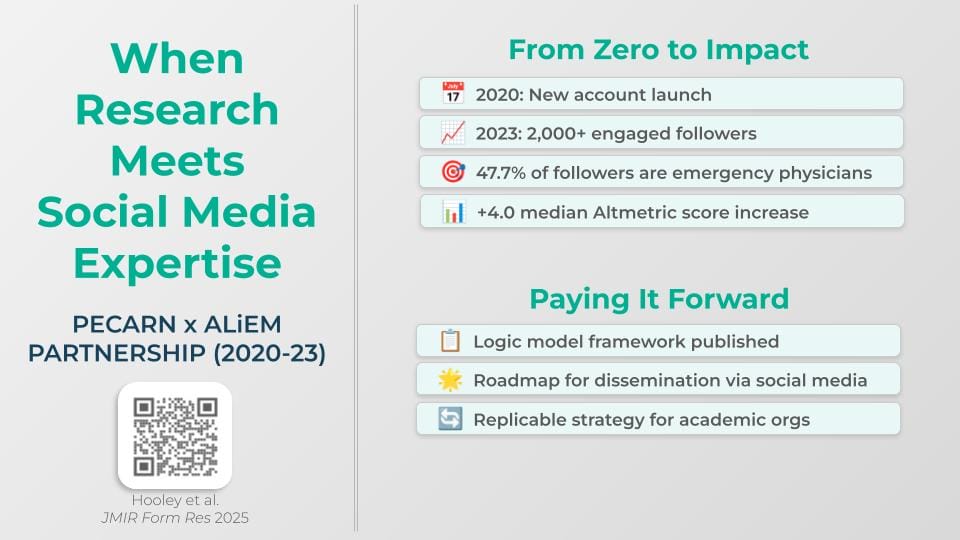
Sometimes the best collaborations begin with simple questions. Following Dr. Nathan Kuppermann’s grand rounds presentation in 2018, I had the opportunity to discuss an idea with him as PECARN’s Steering Committee Chair: might there be untapped potential in using social media platforms like Twitter to amplify PECARN’s research impact? Five years later, that initial conversation has grown into a reality with a systematic approach and measurable outcomes.
Social media is not just about fads and marketing. In fact, it represents the foreseeable future for information dissemination, even in scientific research, because it meets learners and providers where they already are. Rather than hoping clinicians would stumble upon publications in traditional journals, we should actively bring the research to the platforms they frequently check.
Why Organizational Social Media Requires Strategic Planning
Organizational social media for research dissemination can’t just “do social media.” This endeavor requires fundamentally different approaches than personal academic accounts. While individual faculty might share insights casually or build personal brands, research organizations need systematic frameworks that ensure consistency, maintain academic rigor, and deliver measurable impact.
The critical distinction: institutional social media isn’t about intuition or viral content—it demands rigorous planning, dedicated resources, and iterative optimization based on analytics. Just as we wouldn’t launch a research study without proper methodology and oversight, we shouldn’t approach organizational research dissemination without strategic frameworks and quality control systems.
The Partnership Model: When Research Meets Social Media Expertise
Our approach began with recognizing a fundamental truth: most research organizations lack the specialized expertise needed for effective social media presence. Rather than building these capabilities from scratch, PECARN partnered with ALiEM, leveraging our existing social media infrastructure and experience. What started as an experimental collaboration became a four-year case study, which we recently published in JMIR Formative Research [1]. We share our processes, outcomes, and lessons learned to provide a replicable framework and roadmap for other research organizations considering similar initiatives on Twitter/X (or alternative social media platforms).
The Foundation: Building Sustainable Infrastructure
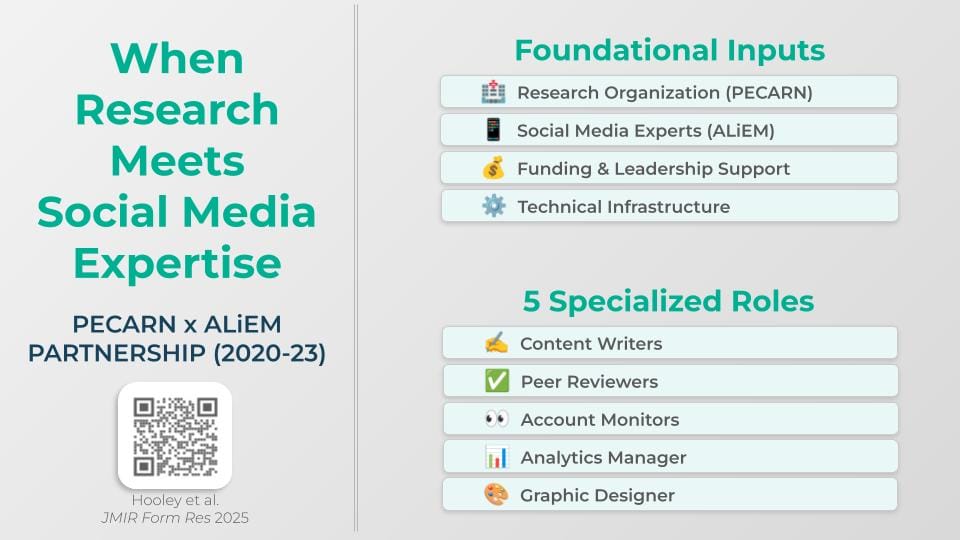
Organizational Inputs:
- Research Organization (PECARN) – content expertise and credibility
- Social Media Experts (ALiEM) – Twitter/X platform knowledge and audience understanding
- Funding & Leadership Support – executive champions and resource allocation
- Technical Infrastructure – analytics tools, scheduling platforms, communication systems
The 5-Person Dream Team:
- Content Writers (2): Physician-researchers who understand both clinical context and platform constraints
- Peer Reviewers (2): Quality control experts ensuring academic rigor
- Account Monitors (2): Daily engagement specialists building community
- Analytics Manager (1): Data scientist tracking performance and optimization
- Graphic Designer (1): Visual content specialist (added after 2 years based on data)
We created 2-person teams for key roles to ensure sustainability and backup coverage. Faculty have competing priorities, and redundancy ensures consistent output despite scheduling challenges.
What the Numbers Taught Us
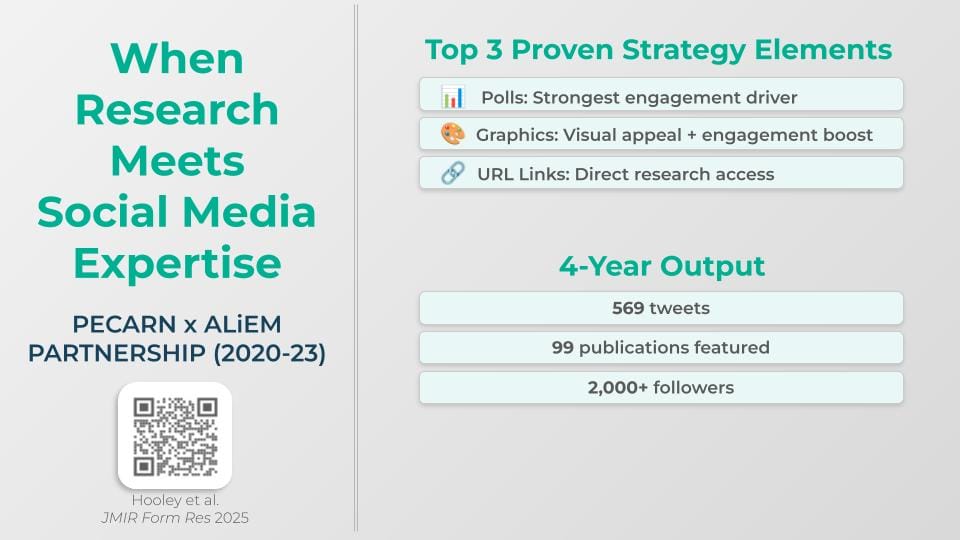
The key to our success wasn’t guesswork—it was rigorous analytics tracking and iterative evidence-based improvement. Over the 4 years (2020-23), 569 tweets were published, 99 PECARN journal publications were featured, and we grew an audience of over 2,000 followers.
Tweet-Level Analytics: The Strategy Elements That Actually Work
Through multiple linear regression analysis, we identified 3 characteristics with statistically significant impact on both impressions and engagement:
- Polls (β = 0.278): Our most impactful discovery was that interactive polls became our strongest engagement driver. we used polls to introduce clinical scenarios related to featured research, allowing audiences to test their knowledge before revealing study findings.
- Graphics (β = 0.195): Professional graphics significantly boosted engagement, leading us to add a dedicated graphic designer to the team after 2 years. This wasn’t cosmetic—it was a data-driven personnel decision.
- URL Links (β = 0.173): Links to full articles didn’t just drive traffic; they contributed to increased Altmetric Attention Scores, providing measurable academic impact beyond social media metrics.
Surprisingly, emojis showed a negative correlation with engagement in our academic audience. We hypothesize that these emojis may have not resonated with our academic and healthcare professions audience— a reminder that strategies must be tailored to the desired audience.
Lessons Learned for Building Research Dissemination Architecture
1. Analytics Are Non-Negotiable
Don’t guess about what works. Track impressions, engagement, click-through rates, and downstream academic metrics. What gets measured gets optimized.
2. Quality Control Maintains Credibility
Our peer review process for each tweet provided academic rigor for accuracy and quality, treating social media content with the same methodological care we apply to research publications. This approach strengthened PECARN’s digital credibility and built trustworthiness with our professional audience who expect evidence-based content even in 280 characters.
3. Team Redundancy Ensures Sustainability
Faculty have complex schedules. Build systems that work despite individual availability challenges.
4. Visual Content Isn’t Optional
Professional graphics aren’t “nice to have”—they’re proven engagement drivers in the era of information overload. They are worth the investment.
New Academic Role: Research Dissemination Architect
What began as grassroots FOAM (Free Open Access Medical education) with individual bloggers and social media educators has evolved into something more substantial: the emergence of the “Research Dissemination Architect” as a legitimate, potentially funded position within academic institutions and research organizations.
This represents a fundamental shift in how we think about knowledge translation careers. We’re no longer talking about faculty “doing social media on the side”—we’re talking about dedicated professional positions with specific expertise, measurable outcomes, and institutional recognition. Our recent publication in JMIR Formative Research documents our journey in this evolution. The ALiEM-PECARN partnership wasn’t just about Twitter success; it was about demonstrating that research dissemination can be a systematic, professional discipline worthy of institutional investment and academic recognition.
Conclusion
The PECARN-ALiEM partnership demonstrates that academic rigor and social media success aren’t mutually exclusive—they’re synergistic when approached systematically. Through this collaboration, we’ve contributed to establishing systematic approaches to research dissemination as a pathway toward accelerated knowledge translation.
Research Dissemination Architects represent an emerging career pathway that bridges traditional academic expertise with digital communication skills. As medical education continues evolving toward digital-first approaches, faculty who develop competency in evidence-based social media are positioning themselves at the forefront of this evolution. The framework we’ve developed offers one approach to professional research dissemination. As more organizations experiment with similar roles, we’ll undoubtedly see diverse models emerge, each contributing to our collective understanding of effective academic digital scholarship.
We hope our experience can inform others exploring this space. Whether you adapt our specific approach or develop entirely different methods, the opportunity to advance how research reaches its intended audiences has never been greater.
Reference
- Hooley GC, Magana JN, Woods JM, et al. Research Dissemination Strategies in Pediatric Emergency Care Using a Professional Twitter (X) Account: A Mixed Methods Developmental Study of a Logic Model Framework. JMIR Form Res. 2025;9:e59481. Published 2025 Jun 24. doi:10.2196/59481. PMID 40554778