


Lytics for sub-massive PE: Ready for primetime?
 There was recently a great study published in the American Journal of Cardiology (2012) by Sharifi et al1, questioning whether we should be considering tPA in patients other than those patients with massive pulmonary embolism (PE)? You know the big “Saddle Embolus” we all fear? Well it turns out this is only about 5% of all PEs.
Should we be considering tPA in patients with sub-massive PEs?
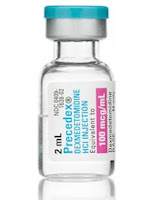 Sometimes a question is posed on Twitter that generates a great discussion from colleagues ’round the globe. Such was the case for dexmedetomidine. Although benzodiazepines remain the standard of treatment for ethanol withdrawal, particularly seizures and delirium tremens, what’s all the hype about dexmedetomidine?

 There has been a lot of discussion on the ideal intravenous fluids (IVF) for resuscitation in the Emergency Department and ICU. This was highlighted by the landmark study in JAMA on ICU patients who received chloride-rich versus chloride-restricted IVFs. This got me to thinking, what exactly comprises the common IVFs that we order? We so often take for granted what’s in 1 liter of normal saline. As it turns out, normal saline is not really “normal”. Dr. Scott Weingart has a
  Bottom Line