Tricks of the Trade: Finding the wandering contact lens

ContactLensContact lens wearers are familiar with the phenomenon of the wandering lens. What should you do if you can’t visualize the contact lens of a patient, who presents with a “lost contact lens” in the eye? You have the patient look in all directions and you evert the eyelid, but still no contact lens can be found. The patient swears that it’s there because of the painful foreign-body sensation.

(more…)

By |2021-06-01T09:35:32-07:00Jan 5, 2011|Ophthalmology, Tricks of the Trade|

Trick of the Trade: Self-Reflection


Selfreflection

After a shift, we often review the day’s case with our learners. We sometimes ask them to self-reflect.

I often used Demian’s ‘Plus/Delta’ approach and ask ‘What did you like /what would you change?’

This approach works well mostly. But, when the answer is ‘I don’t think I would change anything’, it is hard to target teaching and feedback to the learner’s need.

(more…)

By |2016-11-11T19:00:17-08:00Dec 8, 2010|Medical Education, Tricks of the Trade|

Trick of the Trade: Laryngospasm notch maneuver


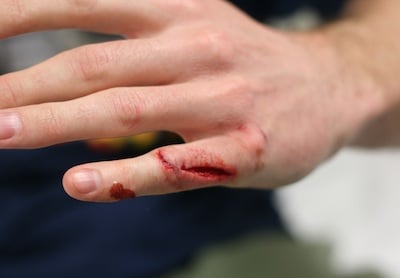
 smLacerationLipKetamine1What is the incidence of laryngospasm in pediatric patients receiving ketamine for procedural sedation in the ED?

Answer = 0.3%

A child with laryngospasm can be a scary thing to manage. There’s no way to predict whether a child is going to get it.

You can try the usual maneuvers including a jaw-thrust, positive pressure ventilation to try to open the vocal cords, and suctioning. If these don’t work, you might consider giving the patient a paralytic, such as succinylcholine, and performing an endotracheal intubation for worsening hypoxia. Before that, what non-invasive maneuver can you try first?


(more…)

By |2016-11-11T19:00:18-08:00Dec 1, 2010|Pediatrics, Tricks of the Trade|

Trick of the Trade: Toe paronychia splinting

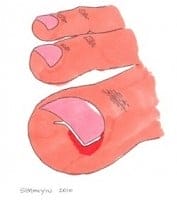
EPSON MFP imageIngrown toenails, or paronychias, are usually exquisitely painful and a bit gnarly when they present to you in the Emergency Department. Dr. Stella Yiu described toenail splinting techniques using steristrips or dental floss. The purpose of splinting is to prevent the toenail from growing back into the lateral nail fold.

This assumes a relatively mild-to-moderate case. Often simple elevation of the nail out of the lateral nail fold (under digital block anesthesia) is all that is needed to treat a paronychia. Pus is often released with this maneuver.

What do you do for more severe cases when you have to excise the lateral edge of the nail?

There’s no toenail to slide the steristrip/ cotton/ dental floss material under.

(more…)

By |2019-01-28T23:16:45-08:00Nov 17, 2010|Tricks of the Trade|

Trick of the Trade: Ultrasound-guided supraclavicular central line

SupraclavicularPositionsmEmergency physicians are procedural experts in central venous access. The subclavian vein is the best site for such access, because it has been shown to have the lowest rate of iatrogenic infections and deep venous clots

Bedside ultrasonography has really revolutionized how we obtain vascular access over the past 10 years. Identifying the subclavian vein using ultrasonography, however, is still technically challenging. The vein is located just posterior to the clavicle, which often gets in the way of the linear transducer. 

By |2016-11-11T19:00:20-08:00Nov 10, 2010|Tricks of the Trade, Ultrasound|
Go to Top