Trick of the trade: I got ultrasound gel in my eye!
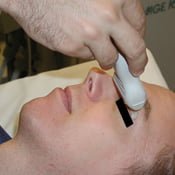
OcularUltrasoundProbeBedside ultrasonography is increasingly being used in the ED to examine the eye. For instance, it can be used to detect a retinal detachment, vitreous hemorrhage, and high intracranial pressure. The technique involves applying ultrasound gel on the patient’s closed eyelid. A generous amount of gel should be used to minimize the amount of direct pressure applied on the patient’s eye by the ultrasound probe.

Sometimes, however, no matter how careful you and the patient are, some gel accidentally contacts the eye itself.
(more…)

By |2019-01-28T23:23:16-08:00Sep 15, 2010|Tricks of the Trade, Ultrasound|

Trick of the Trade: "Pour some sugar on me" | Reducing a rectal prolapse


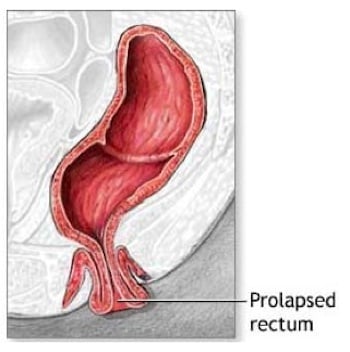
Rectal prolapse sugar for edema reductionRectal prolapses are typically caused by weakened rectal muscles, continued straining, stresses during childbirth, weakened ligaments, or neurological deficits.

How do you fix them? You can attempt manual reduction of the prolapse by using direct pressure. On the other extreme, corrective surgery can be performed from either an abdominal or perineal approach.

Trick of the Trade: Pour some sugar on it.

Def Leppard may have been right. Rectal prolapses often are associated with quite a bit of rectal mucosal edema. Sprinkle granulated sugar onto the area. Wait 15 minutes. The sugar reduces the edema by osmotically drawing out the fluid. The prolapse often reduces spontaneously or with gentle manual pressure.


References

  1. Ramanujam PS, Venkatesh KS. Management of acute incarcerated rectal prolapse. Dis Colon Rectum. Dec 1992;35(12):1154-6.
  2. Coburn WM III, Russell MA, Hofstetter WL. Sucrose as an aid to manual reduction of incarcerated rectal prolapse. Ann Emerg Med. Sep 1997;30(3):347-9.


By |2021-03-01T09:25:47-08:00Sep 1, 2010|Gastrointestinal, Tricks of the Trade|

Trick of the Trade: Increasing students responses to the differential diagnosis

DiagnosisAnyone who teaches medicine asks students to list their differential diagnosis when discussing a new clinical case. It’s also part of several models for education including the One-Minute Preceptor and SNAPPS.
For the most part, students are good at coming up with answers to the differential, but what do you do when they strike out? Or what if the answer is always the same, i.e. chest pain = myocardial infarction?

(more…)

Trick of the Trade: Modified HAT trick revisited

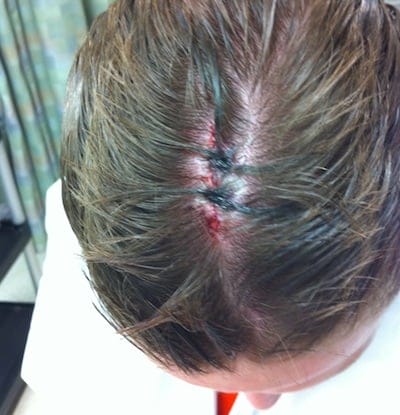
I finally tried the Modified HAT (Hair Apposition Technique) trick for the closure of scalp lacerations. I have used the traditional HAT trick multiple times but not the modified technique.

What’s the difference?

Instead of using your fingers, the modified approach involves the use of two instrument clamps to help twist and pull the hair strands taut. It turns out that this makes a huge difference, especially for short hairs. The clamps allow you to grab the hair strands so much more securely, before instilling a tissue adhesive at the twisting points.

The nice added benefit was that my chubby fingers were now out of the procedural field. This allowed my assistant to more easily see and reach the hair twisting points with the Dermabond applicator.

Check out the finished product of this 2.5 cm laceration on the scalp vertex.

Back Camera

Bottom line

The simple addition of two instrument clamps provides significantly superior control, stronger tensile strength, and better exposure when twisting hair strands together. Try it.

By |2019-11-20T18:11:20-08:00Aug 18, 2010|Tricks of the Trade|

Trick of the Trade: Prescribing opiates


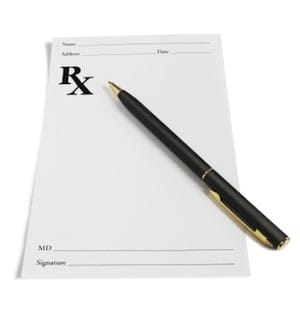
PrescriptionPadAs emergency physicians, we are experts in pain control. We frequently write opiate prescriptions for patients being discharged home. Unfortunately, an occasional patient tries to forge my prescription. At times, I get a call from pharmacy for prescriptions that were suspiciously written. For instance several years ago, I had someone try to forge 100 tablets of “Mophine”.

(more…)

By |2016-11-11T19:00:35-08:00Aug 4, 2010|Tox & Medications, Tricks of the Trade|
Go to Top