


Educational resources discussing lifestyle, public policy, and wellness relevant for all healthcare providers
Citing Audio and Video Publications on Your CV (AMA 10th edition)
Updated on 2-28-24 based on the AMA Manual of Style (11th edition, 2020)
Medical education is changing and so too are the types of publications with high impact. No longer do we live in a world where traditional journal publications are the only meaningful contribution to academia and to our specialty. The “non-traditional” publications include podcasts, educational videos, and blog posts. Just like journal articles, these can be done very well with thorough research, attention to detail, and even peer review. They can have broad reach, inspire change, and initiate conversation.
Curriculum Vitae Citation
Many people are uncertain how to cite this work on their curriculum vitae (CV). The structure of a CV will vary from one individual to the next, but let me share how I recommend citing audio and video publications.
First of all, cite them under the category of “Publications.” Personally, I have subcategories for “Print,” “Audio,” and “Video.” If you don’t consider them publications, then why would your administrators?
Below are suggested formats and examples for audio and video publications to credit your work. Let’s build a culture of academic merit with multimedia publications.
Audio Publication CV Reference
[box]Last Name First Initial. Your role. “Title of the segment.” Title of the Audio Publication. Date of release. URL[/box]
Example
McCue J. Contributor. “C3: Abdominal pain in the elderly.” Emergency Medicine Reviews and Perspectives. 2017 Jan 1. https://www.emrap.org/episode/c3elderly/introduction
Video Publication CV Reference
[box]Last Name First Initial. Your role. “Video title.” Title of Video Host or Channel. Date of release. URL[/box]
Example
Anaya A. Presenter. “Paracentesis.” Emergency Medicine Reviews and Perspectives. 2017 Jan 23. https://www.emrap.org/episode/paracentesis/paracentesis
 This is a call to action for residents who have the creativity and passion to make life better for all trainees. The 2017 Wellness Think Tank survey of more than 1,500 EM residents found that, on average, 15 out of every 16 residents are struggling with burnout. It’s time to change that! We are looking for motivated residents to be a part of a one-of-a-kind grassroots movement to create a better and more sustainable culture within Emergency Medicine. Apply to join the 2018 Wellness Think Tank today!
 Dr. Jennifer Stahl is an emergency and critical care physician from North Carolina. Despite juggling busy ED and ICU schedules, Dr. Stahl finds ways to stay active and spend time with her family and friends. From eating well, to practicing reflection and mindfulness, Dr. Stahl has more than a few tips on wellness. Here’s how she stays healthy in EM!
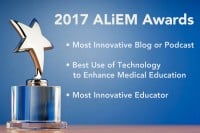 Congratulations to the winners of the 2017 ALiEM Awards! We reviewed some truly incredible submissions in all 3 categories – all were high caliber! Ultimately, we felt that the winners best represent the true spirit of medical education and digital innovation.