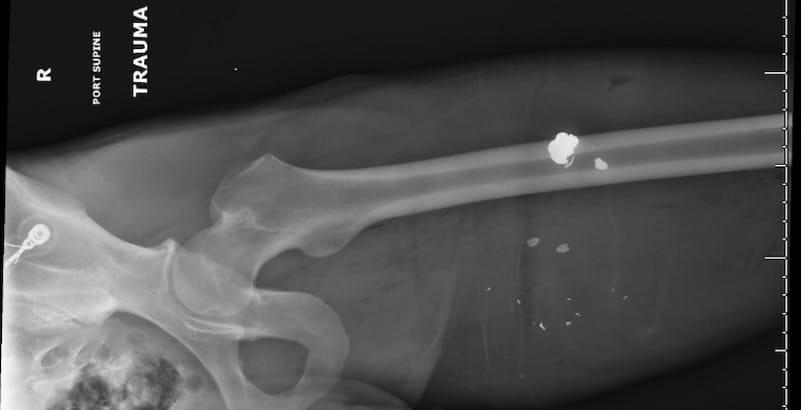
Which retained ballistic fragment(s) would be expected to result in elevated blood lead levels in a patient?

  1. Fragments in or near a joint space
  2. Fragments with an associated fracture
  3. Multiple fragments
  4. Soft tissue fragments
  5. All of the above

[Author’s own image]

5. All of the above

All patients with retained ballistic fragments are at risk for elevated blood lead levels (BLL) and clinical toxicity.  The presence of multiple fragments, an associated fracture, or fragments within a bodily fluid compartment, such as a joint space, conveys a higher risk. Still, soft tissue fragments have also been reported to result in elevated BLL and clinical toxicity.

Background

  • In 2020, there were nearly 100,000 nonfatal firearm injuries in the US [1].
  • Retained ballistic fragments are common, occurring in 75% of patients with a nonfatal gunshot wound, with soft tissue being the most common location [2].
  • Most patients still have at least one retained fragment present at discharge, as soft tissue fragments are typically not removed due to concern for causing more harm with removal [2].

Can retained ballistic fragments cause lead toxicity? What would be their symptoms?

  • There have been numerous case studies of clinical lead poisoning in patients with retained ballistic fragments [3-7].
  • Blood lead levels requiring immediate medical attention are 70 mcg/dL or higher in adults and 45 mcg/dL or higher in children [8,9].
  • CDC data from 2003-2012 show that retained ballistic fragments were associated with 4.9% of all BLL ≥ 80 mcg/dL [10].
  • Patients with elevated BLLs do not always present with clinical symptoms of lead poisoning.
    • Symptoms include abdominal discomfort, nausea, vomiting, constipation, cognitive dysfunction, irritability, anxiety, depression, headache, fatigue, and joint pain.  
    • Lead poisoning can also lead to hypertension, renal dysfunction, anemia, increased susceptibility to infection, and both male and female infertility [11].
  • A 2019 meta-analysis showed that patients with retained ballistic fragments have significantly higher BLLs than the rest of the population, with median levels above the CDC surveillance threshold [12].

Which patients with retained ballistic fragments are at risk for elevated BLLs? [12,13]

  • Ballistic fragments within a bodily fluid compartment, such as the joint, carry the highest risk for elevated BLLs and clinical toxicity.
  • Multiple ballistic fragments and the presence of a bony fracture are higher risk for elevated BLLs.
  • While soft tissue ballistic fragments were traditionally thought to be low risk, symptomatic lead toxicity has been reported with retained soft tissue fragments alone.

When should blood lead levels be checked in patients with retained ballistic fragments? [12,13]

  • Blood lead levels can peak at any time, depending on the location and the number of fragments involved.
  • Symptoms of lead toxicity can present years from the index injury, with a median time to symptom onset of 9 years.
  • While there are no universal testing guidelines, the two most recently published recommendations are as follows:
    • The Journal of Trauma and Acute Care Surgeons in 2019 recommended blood lead levels be drawn every 3 months for the first year after injury, and to attempt removal of retained fragments in anyone with a BLL > 5 mcg/dL if no potential for worsening the injury [12].
    • A 2021 meta-analysis published in Clinical Toxicology recommended that BLLs be drawn at index presentation, every 3 months for the first year, and then annually following that, in addition to any time someone becomes symptomatic [13].
  • Clinicians should retain a high index of suspicion for lead toxicity in those with known retained ballistic fragments.
  • Clinicians should also ask patients with elevated BLL of unknown origin about the possibility of retained metal fragments in the body.

Should retained ballistic fragments be removed? [12,13]

  • Current indications for ballistic fragment removal at index presentation include presence within a joint space, presence within a vascular lumen, or nerve impingement.
  • Consideration may be given to the removal of intra-abdominal or intra-spinal ballistic fragments, weighing risk/benefit carefully.
  • After index presentation, other indications for consideration of removal include persistent pain, infection, and fracture non-union.
  • Patients with rising BLLs and/or symptoms of clinical toxicity should have the ballistic fragment removed whenever possible.
  • Patients with symptomatic toxicity and elevated BLLs improve following ballistic fragment removal.
  • Some patients may be candidates for lead chelation, in conjunction with ballistic fragment removal, in a multidisciplinary approach.

Bedside Pearls

  • Patients with retained ballistic fragments are at risk for elevated blood lead levels regardless of the location.
  • The presence of multiple ballistic fragments or bony fracture are both associated with a higher risk of elevated BLLs, and ballistic fragments within a bodily fluid compartment confer the highest risk for clinical lead toxicity.
  • Because elevated BLLs and clinical toxicity can be delayed for years, clinicians must be alert for symptoms in patients with retained ballistic fragments.
  • Treatment includes ballistic fragment removal where possible, and in some cases, fragment removal in conjunction with chelation.

References

  1. Miller GF, Barnett SBL, Florence CS, McDavid Harrison K, Dahlberg LL, Mercy JA. Costs of Fatal and Nonfatal Firearm Injuries in the U.S., 2019 and 2020. Am J Prev Med. 2024;66(2):195-204. PMID: 38010238.
  2. Nee N, Inaba K, Schellenberg M, et al. Retained ballistic fragments after nonfatal gunshot wounds: epidemiology and outcomes. J Trauma Acute Care Surg. 2021;90(6):973-979. PMID: 33496545.
  3. Weiss D, Lee D, Feldman R, Smith KE. Severe lead toxicity attributed to ballistic fragments retained in soft tissue. BMJ Case Rep. 2017;2017:bcr2016217351. Published 2017 Mar 8. PMID: 28275014.
  4. Grasso IA, Blattner MR, Short T, Downs JW. Severe Systemic Lead Toxicity Resulting From Extra-Articular Retained Shrapnel Presenting as Jaundice and Hepatitis: A Case Report and Review of the Literature. Mil Med. 2017;182(3):e1843-e1848. PMID: 28290970.
  5. Aaronson DM, Awad AJ, Hedayat HS. Lead toxicity due to retained intracranial ballistic fragments: illustrative case. J Neurosurg Case Lessons. 2022;4(13):CASE21453. Published 2022 Sep 26. PMID: 36164673.
  6. Towner JE, Pieters TA, Maurer PK. Lead Toxicity From Intradiscal Retained Ballistic Fragment: Management Considerations and Recommendations. World Neurosurg. 2020;141:377-382. PMID: 32442733.
  7. Begly JP, Lajam CM. Systemic Lead Toxicity Secondary to Retained Intraosseous Ballistic A Case Report and Review of Literature. Bull Hosp Jt Dis (2013). 2016;74(3):229-233. PMID: 27620547.
  8. Walter K. What Is Lead Poisoning? JAMA. 2023;329(12):1040. PMID: 36897599.
  9. Calello DP, Henretig FM. Lead. In: Nelson LS, Howland M, Lewin NA, Smith SW, Goldfrank LR, Hoffman RS. eds. Goldfrank’s Toxicologic Emergencies, 11e. McGraw-Hill Education; 2019. Accessed April 21, 2025. https://accesspharmacy-mhmedical-com.wake.idm.oclc.org/content.aspx?bookid=2569&sectionid=210261271.
  10. Weiss D, Tomasallo CD, Meiman JG, et al. Elevated Blood Lead Levels Associated with Retained Ballistic Fragments – United States, 2003-2012. MMWR Morb Mortal Wkly Rep. 2017;66(5):130-133. Published 2017 Feb 10. PMID: 28182606.
  11. Gidlow DA. Lead toxicity [published correction appears in Occup Med (Lond). 2015 Dec;65(9):770. doi: 10.1093/occmed/kqv170.]. Occup Med (Lond). 2015;65(5):348-356. PMID: 26187801.
  12. Apte A, Bradford K, Dente C, Smith RN. Lead toxicity from retained ballistic fragments: A systematic review and meta-analysis. J Trauma Acute Care Surg. 2019;87(3):707-716. PMID: 30939573.
  13. Kershner EK, Tobarran N, Chambers A, Wills BK, Cumpston KL. Retained ballistics and lead toxicity: a systematic review. Clin Toxicol (Phila). 2022 Oct;60(10):1176-1186. PMID: 36074021.

Madison Watts, MD

Madison Watts, MD

Emergency Medicine Resident
Atrium Health Carolinas Medical Center
Madison Watts, MD

Latest posts by Madison Watts, MD (see all)

Anna Dulaney, PharmD, DABAT

Anna Dulaney, PharmD, DABAT

Clinical Toxicologist
Division of Medical Toxicology
Department of Emergency Medicine
Atrium Health’s Carolinas Medical Center
Anna Dulaney, PharmD, DABAT

Latest posts by Anna Dulaney, PharmD, DABAT (see all)