

About Melissa Smith, MD

Assistant Professor
APD
UT Southwestern Medical Center

SAEM Clinical Images Series: This Rash Came Out of No Where
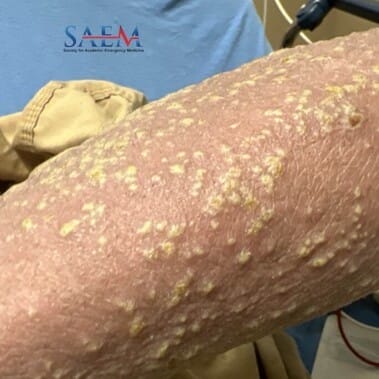
crusting

A 26-year-old male with a past medical history of eczema presented to the Emergency Department with a rash for two days. The patient stated he first noticed a rash on his right arm that rapidly spread to his face, chest, and left arm. He reported having similar rashes before but never to this extent. The patient stated he was given Bactrim and amoxicillin about one month ago for another rash, though he was unsure of the diagnosis. He denied any known allergies or exposures to new foods or hygiene products. He had no chest pain, SOB, nausea, or diarrhea. He lives in a correctional facility and does not know of anyone with any rashes.
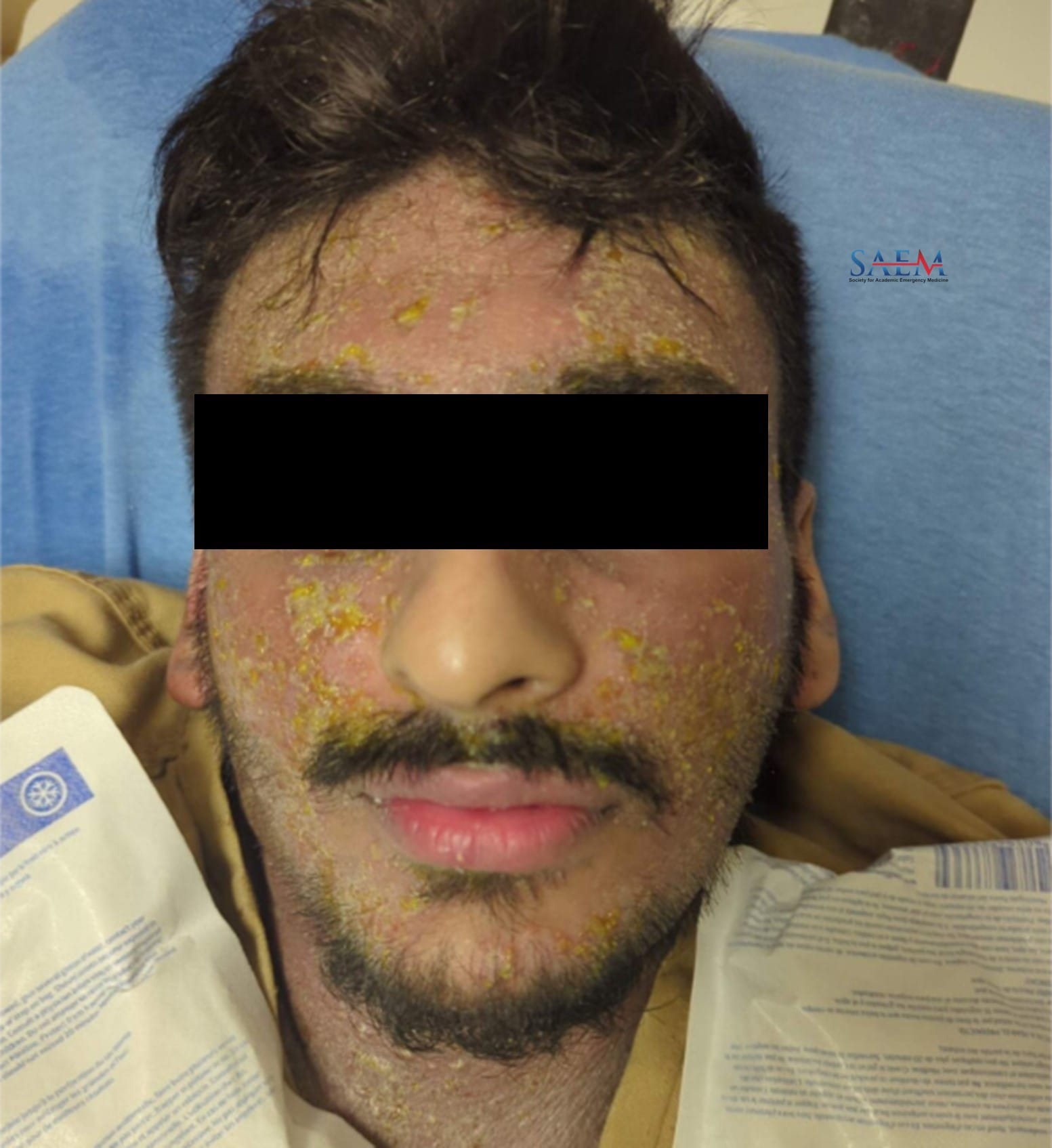
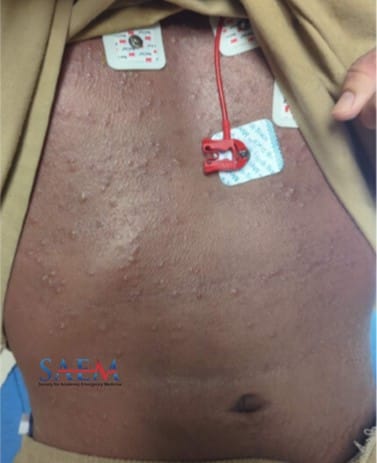
Vitals: Temp 102.7°F; BP 134/81; HR 137; RR 17; O2 100% on room air

Cardiac: Tachycardic, no murmurs

Lungs: CTABL

Skin: Pustular vesicles with scattered areas of confluency on face, upper extremities and torso. Yellow crusting on face, no mucosal involvement.

WBC: 17

Platelets: 261

Blood cultures: One of two positive

CMP and UA WNL

Non-bullous Impetigo

Impetigo is a rash that effects the epidermis. There are two main types, bullous and non-bullous. S. Aureus and S. Pyogenes are the most common causes of non-bullous impetigo with S. Aureus accounting for up to 80% of cases. Impetigo is highly contagious and patients often self-inoculate other areas of their skin after the initial lesion develops. As papules develop, they fill with pus and once ruptured a classically characterized honey-colored crust is left on the skin. It is more common in immunocompromised patients, diabetics, patients with poor hygiene, and those patients who spend time in crowded dwellings such as daycare or prison. Systemic antibiotics are recommended in all cases of bullous impetigo and in non-bullous impetigo if there are more than five lesions, signs of deeper tissue involvement, or systemic symptoms as was the case with this patient. Beta-lactamase-resistant antibiotics such as Keflex or Augmentin are often the first line and if the patient resides in an area with a high prevalence of MRSA, doxycycline or clindamycin are recommended. Once diagnosed, it is important to wash any clothing, bedding, or infected surfaces to prevent further household or community spread. In the case of this patient, he developed systemic symptoms ultimately becoming septic, and required admission with IV antibiotics. He made a full recovery.

Take-Home Points

  • Suspect in patients who are immunocompromised or have contact with crowded dwellings such as daycare or jail.
  • The classic skin finding is a honey-colored crust.
  • Patients with systemic symptoms or more than five lesions need systemic antibiotics.

  • Nardi NM, Schaefer TJ. Impetigo. [Updated 2023 Jul 31]. In: StatPearls [Internet]. Treasure Island (FL): StatPearls Publishing; 2023 Jan-. Available from: https:// www.ncbi.nlm.nih.gov/books/NBK430974/
  • Group A Strep Infection. (n.d.). Group a Strep Infection. https://www.cdc.gov/group-a-strep/?CDC_AAref_Val=https://www.cdc.gov/groupastrep/diseases-%2520hcp/impetigo.html

SAEM Clinical Images Series: Pediatric Genitourinary Bleeding

A 4-year-old female with no significant past medical history is brought to the Emergency Department by her grandmother for concern for two days of progressive vaginal bleeding. The grandmother first noted blood in the patient’s underwear the previous morning when she was helping the patient wipe and she noticed it again prior to arrival, this time saturating the patient’s underwear. There is no history of any recent falls or trauma, abdominal pain, pain to the vagina, dysuria, prior incidents of vaginal bleeding, or any noticeable behavioral changes per the grandmother. The patient lives at home with her mother but has been at her grandmother’s house for the past four days (the household consists of female cousins, grandmother, and grandfather). Of note, the patient’s father took her to a trampoline park with her younger sister two days ago.

Vitals: BP 95/68; HR 96; RR 24; 98% on room air; Temp 36.2°C; Wt 18.2 kg

General: Well-appearing 4-year-old female acting appropriately with grandmother and mother at the bedside.

Abdomen: Soft, nontender, nondistended.

Genitourinary: Normal appearing external genitalia without any skin tears/lacerations. Vaginal exam: Slow oozing bleed noted with round “doughnut” shaped tissue protruding at the vaginal opening.

Hemoglobin: 12.2 g/dL

Urinalysis (clean catch): Blood: Large; >200 RBCs, Ketones: 20, Nitrite: Negative, Leukocytes: Moderate, 19 WBCs

FSH/LH/Testosterone: Within normal limits

Urethral prolapse is a rare condition occurring in prepubertal female pediatric patients. It often presents to the emergency department with complaints of vaginal bleeding, difficulty urinating, or dysuria. The most common predisposing factors to this condition include obesity, cough, trauma, constipation, or a history of any activity that causes a sudden recurrent increase in pelvic pressure, such as a trip to the trampoline park as was the case in this patient [1]. On physical examination, urethral prolapse appears as an annular-like mucosal mass with a central dimple located between the labia majora on examination [1]. Initial treatment is medical management with topical estrogen cream in conjunction with Sitz baths and outpatient follow-up with pediatric urology or gynecology. However, persistence of the prolapse or necrosis of the distal urethra often warrants emergent pediatric urology consultation [2,3]. Recurrent cases or cases refractory to medical management will often require surgery. The patient in this case was treated with a 4-week estrogen cream taper. The patient followed up with pediatric gynecology without further complication or need for further intervention.

Child Abuse, Vaginal Trauma, Malignancies (ie: sarcoma botryoides), Infection, Vaginal foreign body, Urethral Prolapse, Precocious puberty, Hypothyroidism, and Exogenous hormone

Take-Home Points

  • Consider urethral prolapse in any prepubertal female who presents to the Emergency Department with a triage complaint of vaginal bleeding.
  • Treatment for urethral prolapse is typically conservative with topical estrogen cream and prompt follow up with pediatric urology or gynecology.
  • Always keep a broad differential for prepubertal pediatric patients with genitourinary and vaginal bleeding complaints
  • HHillyer S, Mooppan U, Kim H, Gulmi F. Diagnosis and treatment of urethral prolapse in children: experience with 34 cases. Urology. 2009 May;73(5):1008-11. doi: 10.1016/j.urology.2008.10.063. Epub 2009 Mar 13. PMID: 19285715.
  • Laufer M, Emans S. Overview of vulvovaginal conditions in the prepubertal child. Uptodate.com. https://www.uptodate.com/contents/overview-of-vulvovaginal-conditions-in-the-prepubertal-child. Published 2021. Accessed January 5, 2022.
  • Teach S. Evaluation of vulvovaginal bleeding in children and adolescents. Uptodate.com. https://www.uptodate.com/contents/evaluation-of-vulvovaginal-bleeding-in-children-and-adolescents#H11716993. Published 2021. Accessed January 5, 2022.

By |2023-11-12T14:19:13-08:00Nov 17, 2023|Ob/Gyn, Pediatrics, SAEM Clinical Images|

SAEM Clinical Images Series: My Eye Looks Different

cone

A 29 year-old-male with a past medical history of left eye enucleation secondary to a gunshot wound several years prior presents to the Emergency Department (ED) for blurry vision, redness, and concern for a deformity to his right eye. The patient states symptoms started 2-3 months ago and he initially thought symptoms were due to allergies and recalls rubbing his eye a lot. Over the past 3-4 days, he noticed an acute decline in his vision with what the patient describes as a “cloudy bump” appearing during that time. The patient normally does not wear contacts or corrective lenses but states his vision is very blurry and he is now having difficulty reading. He also reports photophobia and mild eye pain. Review of systems is negative for any fevers, headache, eye discharge, or any recent falls or trauma.

Vitals: BP 125/83; Pulse 70; Temp 97.6 F (36.4 C); Resp 17; SpO2 100%

Constitutional: No acute distress, lying in stretcher comfortably.

Head: No visible traumatic injuries. No peri-orbital edema or facial swelling.

Eyes:

  • OD: Edematous cone-shaped protrusion with central haziness. V-shaped deformity to lower lid margin noted on downward gaze. The patient reports no pain when performing extraocular movement testing which is intact and pupil is reactive to light. Visual fields intact. There is no fluorescein uptake upon Wood’s Lamp exam and IOP is 18. VisualAcuity OD 20/200.
  • OS: Eye prosthesis in place.

Nose: No foreign bodies.

Mouth/Throat: Oropharynx is clear and moist and mucous membranes are normal.

Neck: Normal range of motion.

Corneal hydrops secondary to keratoconus.

Keratoconus is a degenerative, multifactorial, non-inflammatory disorder of the cornea that causes bilateral thinning of the cornea and distorted vision. The corneal thinning leads to a structural weakness in the collagen fibers that causes the characteristic bulging, “cone-shaped” cornea. If the thinning is significant enough, a break in collagen fibers and Descemet’s membrane lead to sudden edema which appears as a corneal opacification. This complication is known as corneal hydrops and causes sudden eye pain and decreased visual acuity. Patients with keratoconus present in young adulthood with progressive blurry or distorted vision. Risk factors include connective tissue disorders and Down syndrome as well as a familial history of keratoconus. There is also a risk in patients with a history of eye rubbing as was the case with this patient. The initial treatment for keratoconus is corrective eyewear for refractive correction.

The clinical hallmark of keratoconus is the cone-like protrusion of the cornea. The bulging may eventually lead to “Munson’s sign”, a v-shaped indentation of the lower eyelid on downward gaze as the cornea bulges outward that is seen in advanced keratoconus.

Take-Home Points

  • Suspect keratoconus in patients with a history of constant eye rubbing, developmental delay (i.e. Down Syndrome), and in patients with connective tissue disorders.
  • Munson’s Sign is a v-shaped indentation of the lower eyelid on downward gaze as the cornea bulges outward.
  • Initial treatment of keratoconus is conservative management with prompt ophthalmology follow-up.

  • V. Mas Tur, C. MacGregor, R. Jayaswal, D. O’Brart, N. MaycockA review of keratoconus: Diagnosis, pathophysiology, and genetics Surv Ophthalmol, 62 (6) (2017), pp. 770-783
  • Gold J, Chauhan V, Rojanasthien S, Fitzgerald J. Munson’s Sign: An Obvious Finding to Explain Acute Vision Loss. Clin Pract Cases Emerg Med. 2019 Jul 8;3(3):312-313. doi: 10.5811/cpcem.2019.5.42793. PMID: 31403106; PMCID: PMC6682229.
  • Gialousakis, John P. “Management of Acute Corneal Hydrops in a Patient with Keratoconus: a Teaching Case Report.” The Journal of the Association of Schools and Colleges of Optometry, vol. 45, 2020.
  • Greenwald MF, Vislisel JM, Goins KM. Acute Corneal Hydrops. EyeRounds.org. August 3, 2016; Available from: http://EyeRounds.org/cases/241-acute-corneal-hydrops.htm
  • Stack L, Sheedy C, Bales B. Corneeal Hydrops: A Complication of Keratoconus. Visual Diagnosis Ophthalmology. Published 2015 Dec 11. Available from: https://www.emra.org/emresident/article/corneal-hydrops-a-complication-of-keratoconus/

By |2023-04-05T14:07:32-07:00Apr 17, 2023|HEENT, Ophthalmology, SAEM Clinical Images|

SAEM Clinical Images Series: Hey Doc, Can You Come Look at This Urine?

urine

A 4-year-old male with no significant past medical history presents as a transfer from an outside hospital for suspected inhalation burn secondary to a house fire. The patient was home with his father and sibling when the apartment caught fire from a suspected flame in the kitchen. The patient was evacuated from the building by fire rescue after an unknown period of time. He was intubated at the outside hospital due to concern for inhalation injury. It is unknown if the patient sustained any trauma prior to extraction.

Vitals: T 98.1°F; BP 120/64; P 126; RR 29; O2 Sat 100% on vent

General: Intubated and sedated.

HENT: Singed hair and soot noted to nares, soot in mouth and secretions.

Cardiovascular: Regular rate and rhythm.

Lungs: CTABL, no wheezing or stridor.

GU: Normal appearing genitalia, no blood at meatus or from rectum, dark red urine noted in foley bag.

Skin: 0% TBSA burns, no obvious signs of trauma.

CBC: WNL

ABG at outside hospital: pH 7.0, carboxyhemoglobin 10, methemoglobin 3, lactate 3.7

Repeat ABG after transfer: pH 7.22, carboxyhemoglobin 1.7, methemoglobin 3.7, lactate 2.1

Hydroxocobalamin should be given in any case of suspected cyanide toxicity. House fires are the most common cause of cyanide toxicity in industrialized nations. Cyanide toxicity can also occur due to occupational exposures, medications, foods, or intentional ingestion. Cyanide inhibits the electron transport chain thus blocking aerobic metabolism, leading to hypoxia. Patients can present with altered mental status, hemodynamic instability, and dysrhythmias. Labs will be significant for lactic acidosis. Hydroxocobalamin should be given as soon as cyanide toxicity is suspected. Hydroxocobalamin works by chelating cyanide and forming cyanocobalamin which is renally excreted. Hydroxocobalamin is relatively safe and non-toxic but can cause transient hypertension. It also can cause a reddish discoloration of the urine, skin, and mucous membranes that can last up to several days. This is not harmful to the patient but can cause interference in urinalysis results.

Take-Home Points

  • Hydroxocobalamin is the antidote for cyanide toxicity and should be given as soon as possible in suspected cases.
  • Hydroxocobalamin binds cyanide to form cyanocobalamin, which is excreted in the urine.
  • Hydroxocobalamin is relatively safe but can cause transient hypertension and a red urine discoloration that can interfere with urinalysis results.

  • Cescon DW, Juurlink DN. Discoloration of skin and urine after treatment with hydroxocobalamin for cyanide poisoning. CMAJ. 2009 Jan 20;180(2):251. doi: 10.1503/cmaj.080727. PMID: 19153403; PMCID: PMC2621289.
  • Wong SL, Pudek M, Li D. Wine-Colored Plasma and Urine from Hydroxocobalamin Treatment. J Gen Intern Med. 2017 Feb;32(2):225-226. doi: 10.1007/s11606-016-3782-3. Epub 2016 Jun 23. PMID: 27338592; PMCID: PMC5264665.
  • Desai, S. & Su, Mark K. (2021). Cyanide Poisoning. In: UpToDate, Post TW (Ed), UpToDate,Waltham, MA. (Accessed on January 04, 2022.)
  • Lexicomp. (n.d.). Hydroxocobalamin (vitamin B12a supplement and cyanide antidote): Druginformation. UpToDate. Retrieved January 8, 2022,from https://www.uptodate.com/contents/hydroxocobalamin-vitamin-b12a-supplement-and-cyanide-antidote-drug-information

By |2023-02-11T20:46:19-08:00Feb 13, 2023|SAEM Clinical Images, Tox & Medications|

SAEM Clinical Image Series: I Have a Stomachache

stomachache

An 18-year-old male with no significant past medical history presents with diffuse abdominal pain and multiple episodes of non-bloody, non-bilious vomiting for three days. The patient was seen yesterday at another facility and states he was diagnosed with gastritis and discharged with Zofran, which provided no relief. He denies fever, diarrhea, or urinary symptoms and states his last bowel movement was two days ago and was consistent with his usual bowel movements.

Vitals: T 97.7ºF; HR 138; BP 122/98; RR 18; O2 sat 99% on RA

General: Thin male, appears uncomfortable

Abdominal: Mild distention with diffuse tenderness to palpation; no guarding or rebound tenderness

White blood cell (WBC) count: 13k

Complete metabolic panel (CMP): Mild hypokalemia; otherwise unremarkable

Lactate: 4.9

Urinalysis (UA): Mild ketonuria; no hematuria; no evidence of infection

Superior Mesenteric Artery (SMA) syndrome also known as Wilke’s or Cast Syndrome is a condition where the third section of the duodenum gets compressed between the superior mesenteric artery and the aorta leading to a proximal obstruction in the duodenum and stomach. The most common etiology of SMA syndrome is the loss of the mesenteric fat pad surrounding the SMA. This leads to an acute angulation between the SMA and the aorta, thus compressing the duodenum and causing a partial or complete obstruction. While the condition is rare, predisposing factors include sudden weight loss and chronic illnesses such as malabsorption syndromes, AIDS, and malignancy.

Treatment in the acute stage is conservative management including gastric decompression, IV fluids, correction of electrolyte abnormalities, and nutritional support, which may include temporary gastro-jejunostomy (GJ) tube placement. Severe refractory cases may require surgical intervention. This patient was admitted and treated conservatively, including a temporary GJ tube placement which was removed a few months later.

Take-Home Points

  • Consider SMA syndrome in patients with a history of sudden weight loss or chronic illness.
  • Look for very proximal obstruction on CT with significant gastric distension.
  • Acute management is conservative treatment.

  • Hamden, A. & Scovell, S. (2020). Superior Mesenteric Artery Syndrome. In K. Collins (Ed.), UpToDate. Retrieved January 4, 2021, from https://www.uptodate.com/contents/superior-mesenteric-artery-syndrome
  • Niknejad, M. & Ranschaert, E. (2018). Superior Mesenteric Artery Syndrome. Radiopedia.org. Retrieved January 4, 2021, from https://radiopaedia.org/articles/superior-mesenteric-artery-syndrome?lang=us
  • Karrer FM. (2017). Superior Mesenteric Artery Syndrome. Medscape Reference. Retrieved December 22, 2020, from http://emedicine.medscape.com/article/932220-overview Genetic and Rare Diseases Information Center. (2018). Superior Mesenteric Artery Syndrome. [Online]. Available at: https://rarediseases.info.nih.gov/diseases/7712/superior-mesenteric-artery-syndrome#:~:text=Superior%20mesenteric%20artery%20syndrome%20(SMAS,complete%20blockage%20of%20the%20duodenum


Go to Top