About Michelle Lin, MD

ALiEM Founder and CEO
Professor and Digital Innovation Lab Director
Department of Emergency Medicine
University of California, San Francisco

PV Card: Intimate partner violence

cycle_of_violence

In the Emergency Department, we too often under-estimate our patients’ likelihood for intimate partner violence (IPV). Unfortunately, there is no perfect screening test to detect this. So one must maintain a high index of suspicion. Once you detect it, what questions should you ask to ensure her/his safety and how do you optimize the resources available to her/him?

Created by Trevor Wilson (UCSF medical student) and Dr. Beth Kaplan (UCSF/SFGH), the following PV pocket card reviews how to screen, document, intervene, and provide resources for the patient. Learn the “SAFE” questions.1,2

PV Card: Intimate Partner Violence

Go to ALiEM (PV) Cards for more resources.

References

  1. Ashur M. Asking about domestic violence: SAFE questions. JAMA. 1993;269(18):2367. [PubMed]
  2. Moyer V, U.S. P. Screening for intimate partner violence and abuse of elderly and vulnerable adults: U.S. preventive services task force recommendation statement. Ann Intern Med. 2013;158(6):478-486. [PubMed]
By |2021-10-06T19:50:43-07:00Jul 31, 2013|ALiEM Cards, Trauma|

Critical Care Series by new ALiEM writer Dr. Todd Seigel

SEIGEL Photo squareWelcome a new superstar blogger, Dr. Todd Seigel (@ToddSeigelMD), to the ever-growing ALiEM team. I first met Todd at the recent Society of Academic Emergency Medicine meeting. At that time, he was an already established clinician-scholar-educator at Brown University. He had already graduated from residency and was returning to fellowship training to get his board-certification in Critical Care Medicine. I’m thrilled that he is now at my home institution (UCSF) doing this fellowship, where I couldn’t resist recruiting him to join our all-star cast of blog authors. Today is the first of hopefully a long series of critical care/resuscitation topics that are practically relevant for all practicing emergency physicians.

(more…)

By |2016-11-11T19:02:41-08:00Jul 30, 2013|Critical Care/ Resus|

Quick clinical tip: Elson’s test for the finger

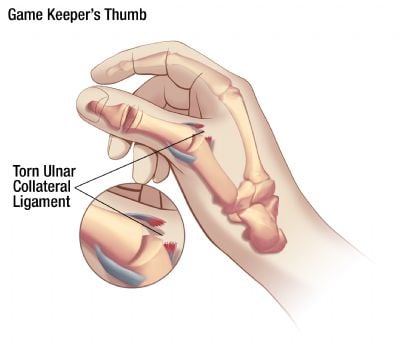
Extensor Tendon Laceration Finger 6 smInjuries to the hand are fraught with multiple, concurrent injuries. Many injuries may have chronic debilitating complications, if not detected early. One such example is a finger laceration with a concurrent extensor tendon injury, causing delayed boutonniere deformity formation and limited function. Review the anatomy of the extensor tendon. View the video on how to perform the Elson’s test to detect a central slip tendon injury.

(more…)

By |2020-12-27T19:00:43-08:00Jul 29, 2013|Orthopedic|

Patwari Academy: ECG Rate, Rhythm, Axis

Screen Shot 2013-07-20 at 9.26.07 AM

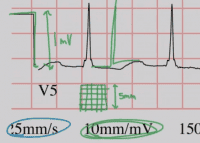
Dr. Rahul Patwari reviews the basics on how to determine an ECG’s rate, rhythm, and axis. It’s always nice to review these concepts. Do you remember how many seconds a traditional ECG typically spans on a single page? What’s the significance of the numbers: 300, 150, 100, 75, 60, 50? Spend a few minutes on these 2 refresher videos.
(more…)

By |2019-01-28T21:57:46-08:00Jul 21, 2013|ECG, Patwari Videos|

Trick of the Trade: Less traumatic nasopharyngoscopy


ViscousLidoNosesm
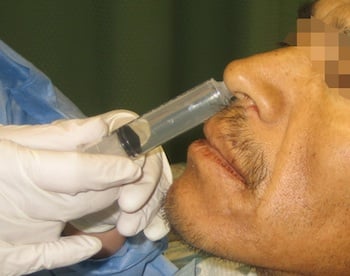
A fiberoptic nasopharyngoscope is a handy tool to check patients for suspected foreign bodies (e.g. fishbone stuck in throat) or laryngeal edema. Depending on the diameter of your fiberoptic cable, it may be fairly uncomfortable for the patient despite generous viscous lidocaine instillation through the nares and nebulized lidocaine. Alternatively or additionally, you can make your own lidocaine-oxymetazoline nasal atomizer which works well.  

What if the patient is STILL not tolerating the procedure well? 

(more…)

By |2016-11-11T19:02:31-08:00Jul 16, 2013|ENT, Tricks of the Trade|
Go to Top