Poll: How would manage a metacarpal fracture in the ED?

Metacarpal5fracture

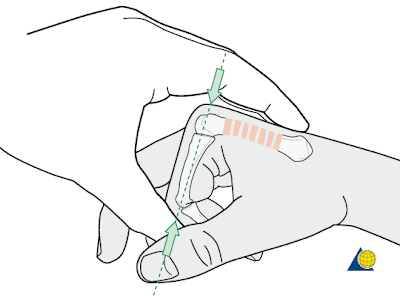
I am in the process of creating a PV card on metacarpal fractures, divided into anatomical areas (base, shaft, neck, head), and am realizing that the EM and orthopedic literature don’t quite agree. Actually they are quite vague on whether reductions should occur in the ED vs orthopedics clinic in the next few days.

  • Do you need to close-reduce all angulated fractures in the ED, which are outside of “acceptable” angulations?
  • What exactly are “acceptable” angulations? Some sources say that angulations of 10, 20, 30, and 40 degrees are acceptable for MC neck fractures and only 10, 10, 20, and 20 degrees are acceptable for MC shaft fractures. These numbers, though, vary from reference to reference.

(more…)

By |2016-11-11T18:43:07-08:00Dec 5, 2012|Orthopedic|

Patwari Academy videos: ACLS (parts 4-6)

Below are the next 3 video installments of Dr. Rahul Patwari’s digital whiteboard talks on ACLS. These videos cover:

  • Cardiac arrest (Vfib and Vtach)
  • Cardiac arrest (More of Vfib and Vtach)
  • Cardiac arrest (Asystole and PEA)

I love that each video is less than 15 minutes long. Also, even if you aren’t a medical student, these are great refreshers. For instance, don’t forget that atropine is no longer on the 2010 ACLS algorithm for asystole.

(more…)

By |2019-01-28T22:10:29-08:00Dec 2, 2012|Patwari Videos|

Losing faith in evidence-based medicine: Etomidate and sepsis

 
MagnifyingGlass3dIn an era where evidence-based medicine is the goal, it is vitally important for practitioners to understand how to prioritize and interpret the onslaught of data coming at us. 

This fact was driven home for me with a recent publication. Several weeks ago an article was published in Critical Care Medicine entitled “Etomidate is associated with mortality and adrenal insufficiency in sepsis: A meta-analysis.”

The point of this post is not to debate if etomidate should be used to intubate septic patients. Etomidate very well may kill people with sepsis. I just don’t know from the data currently available. Using this meta-analysis as an example, the goal is to point out two important areas where we could stand to sharpen our literature evaluation skills.

(more…)

PV card: PE Severity Index (PESI) score

pulmonary embolism PE PESI score

Do you send some of your low-risk patients with pulmonary embolism home?

This is a controversial issue which warrants a look at risk stratification tools. The primary one used is the validated Pulmonary Embolism Severity Index (PESI) score. In Lancet 2011, the authors looked at whether PESI class I and II (low risk) patients could be managed safely as outpatients. It turns out in their study, regardless of whether their PESI class I and II patients were treated as outpatients and inpatients, all fared equally well from a complications standpoint (recurrent clot, bleeding from anticoagulation).

I like the validated PESI scoring system to risk-stratify patients as low vs high risk for complications. I, however, do caution people to look closely at the exclusion criteria for this study before applying this to all ED patients.

The exclusion filter was so strict that they likely have captured a very narrow and unrealistic scope of patients to be widely applicable. It makes sense from a research standpoint to have these criteria to achieve internal validity but the question is external validity. Two exclusion criteria that struck me as awfully strict were: (1) needing parenteral opioids or (2) active alcohol or drug abuse.

Bottom line

For me, this study alone seems not have enough external validity to decide about the decision to treat PE patients as inpatient vs outpatient. Although I think that ultimately some can be managed as outpatients, I’d like to see more studies.

PV Card: PESI Score for Pulmonary Embolism


See other ALiEM (PV) Cards.

By |2021-10-08T09:35:48-07:00Nov 17, 2012|ALiEM Cards, Cardiovascular, Pulmonary|
Go to Top