Article review: Neuro exam documentation

Medicolegal woes often can be tracked back to poor documentation by the physician.

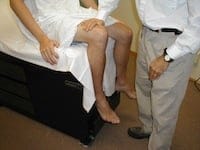
This article is a retrospective chart review of 384 EM resident charts, focusing on the documentation of the neurologic exam. Charts were selected if their chief complaints were neurologic or psychiatric in nature. A non-validated measurement tool for evaluating a neurologic exam was created based on discussions with attending emergency physicians. I have to agree with the chosen criteria. Documentation in each of the following criterion receives 1 point for a maximum score of 8.

(more…)

Trick of the Trade: Subclavian line gone north

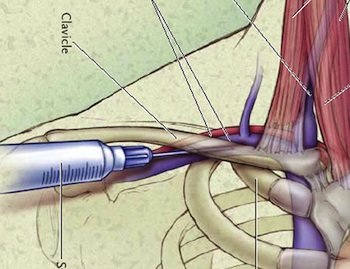
SubclavianNEJManatIn patients requiring central venous access, which vein do you prefer? In descending order, I prefer subclavians, internal jugulars (IJ), and then femorals.

There is increasing evidence that subclavian central venous lines are superior to femoral lines (JAMA 2001) with respect to iatrogenic infection and thrombosis rates. In 9% of subclavian lines, however, the line tip ends up in the ipsilateral IJ, instead of the superior vena cava (SVC) – see chest xray below. These lines are unusable in the long term because of the risk of cathether thrombosis in this low-flow area. The line must must be rewired.

(more…)

By |2016-11-11T19:01:49-08:00Dec 2, 2009|Tricks of the Trade|

Trick of the Trade: The defensive arts against pimping

laughingThanks to Dr. Rob Roger’s podcast on EM-RAP Educator’s Edition series, I learned of one of the funniest publications EVER in a medical journal. It was published on April 1, 2009 in JAMA. The article focuses on teaching medical students the essential skill set– how to survive “pimping”.

Pimping traditionally occurs when an attending physician poses a difficult question to a learner in a public forum, such as board rounds or in the operating room. As a student or resident, you know that this will happen during your training, and you should be prepared. If you think of pimping as a form of battle, you will need a good defense, and you should mix it up to be successful.

(more…)

By |2026-06-16T16:03:40-07:00Nov 18, 2009|Medical Education, Tricks of the Trade|

A radiology pearl: A subtle orthopedic diagnosis

A man recently presents with knee pain after pivoting and torquing his knee while falling. He complains of concurrent mild ankle pain. He presents with this tib-fib xray. Realizing that a proximal fibular fracture can present concurrently with a medial malleolus fracture or deltoid ligament rupture, we obtained xrays of the ankle. We were looking for a Maisonneuve fracture.

Do you see an ankle injury in these four images?

(more…)

By |2016-11-11T19:01:52-08:00Nov 13, 2009|Orthopedic, Radiology|

Trick of the Trade: Easy ocular application of fluoroscein

Fluorescein-1Gently instilling a fluorescein drop into a patient’s eye requires that the patient keep his/her eye still. What do you do for a patient who can’t quite stay still enough, such as an infant? This is an innovative trick of the trade, written by Dr. Sam Ko (Loma Linda EM resident) and Kimberly Chan (Loma Linda medical student).

(more…)

By |2016-11-11T19:01:53-08:00Nov 4, 2009|Ophthalmology, Tricks of the Trade|
Go to Top