SplintER Series: A Jammed Finger

boutonniere deformity boutonniere deformity

A 50-year-old male presents to the emergency department with a new inability to extend his 5th digit of the left hand. He states he was playing a game of pick-up basketball last week when he jammed the finger while attempting to catch a pass from a teammate. An AP and lateral radiograph of the digit is obtained (Image 1 courtesy of Dr Alborz Jahangiri, Radiopaedia.org). What is your diagnosis? What causes this injury? What exam maneuver can help diagnose the underlying injury before the deformity is evident? What is the treatment/management of this injury? What are the surgical indications?


(more…)

Unlocking the MIC-KEY: Understanding and Troubleshooting Low-Profile Gastrostomy Tubes

You are working an overnight clinical shift at your community emergency department when a worried mother brings in her 15-year-old child with cerebral palsy due to their gastric tube “coming out.” As you begin to obtain a history of the patient’s gastric tube (when it was placed, where it was placed, why is it in place, etc.) you realize you will be the one replacing it tonight, and frankly you haven’t done this before. The following post serves as a refresher on the use, placement, and complications of gastrostomy tubes.

(more…)

By |2020-08-23T17:00:00-07:00Aug 24, 2020|Emergency Medicine, Gastrointestinal|

SplintER Series: Hip Pain Following an MVC

A 48-year-old female presents to the emergency department after a high-speed motor vehicle collision (MVC). She is complaining of left hip pain. Her radiographs are shown (Image 1 courtesy of Dr Ayaz Hidayatov, Radiopaedia.org, rID: 52760). What is your diagnosis? What is the likely mechanism of injury? What physical exam findings are expected? What is your management in the emergency department and when should you consult orthopedics?

(more…)

SAEM Clinical Image Series: The Cocaine Gut

pneumoperitoneum

A sixty-five-year-old male with a medical history of gastroesophageal reflux disease (GERD), hypertension, alcohol dependence, homelessness, and cocaine abuse presents to the emergency department with abdominal pain for three days. The patient describes his abdominal pain as knife-like, 9/10, located diffusely throughout his abdomen, with associated anorexia and nausea. He reports that he had one episode of coffee ground emesis this morning which provoked him to come to the ED. He reports frequent cocaine use with his last use three days ago. He endorses subjective fevers, chills, and no bowel movement for two days. He has had no sick contacts.

(more…)

SAEM Clinical Image Series: Severe Cutaneous Lesions in an Immunocompromised Host

cutaneous lesions

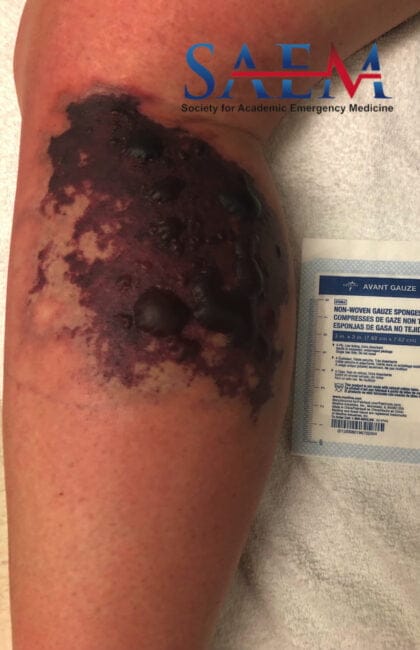
A thirty-one-year-old female presented to the emergency department with the complaint of a painful rash for 2 days. She has a history of HIV with a known CD4 count < 200 cells/µL. She states that the rash began two days ago and progressed to the current size. She describes the rash as burning and has never experienced these symptoms before. She has tried topical corticosteroids which did not alleviate the pain.

(more…)

SplintER Series: Elbow Injury

A 70-year-old female presents with left elbow pain and deformity after falling on an outstretched hand. You obtain shoulder x-rays and see the above images. What is the most likely diagnosis, likely mechanism of injury, expected physical exam findings, and management plan?  (Image 1: AP and lateral views of the left elbow. Author’s own images)

(more…)

SAEM Clinical Image Series: Found Down with Altered Mental Status

non-contrast head CT

A forty-nine-year-old male with a history of polysubstance abuse, including methamphetamine and intravenous (IV) drug use, rectal cancer, and human immunodeficiency virus (HIV) was brought into the emergency department by emergency medical services (EMS) after he was found down at the bottom of a flight of stairs by his roommate. In the emergency room, he was found to have a Glasgow Coma Scale (GCS) score of 7 and was intubated for airway protection. Non-contrast head CT was performed. Per the roommate, the patient had been “not himself,” exhibiting strange behavior and weight loss. History and review of systems (ROS) were otherwise unobtainable due to the acuity of illness.

(more…)

Go to Top