Paucis Verbis: Outpatient treatment for diverticulitis

The classic prior teaching for the treatment of diverticulitis includes:

  • Hospital admission
  • Bowel rest (NPO)
  • IV fluids
  • Broad spectrum IV antibiotics

Do ALL patients need to be admitted? There is some early literature suggesting that there is a small sub-population who fare well with outpatient treatment.

This article from Annals of EM in the “Best Available Evidence” series summarizes the existing literature well.

PV Card: Diverticulitis


Adapted from [1]
Go to ALiEM (PV) Cards for more resources.

Word of caution

This paper only provides guidelines, based on the limited evidence out there. Still use your common sense. For instance, I’d still admit patients who are elderly (>80 years old) or have evidence of any perforation on CT. If on the fence, admit the patient.

Still it’s nice to see that the treatment of uncomplicated diverticulitis on an outpatient basis has some supporting literature.

Reference

  1. Friend K, Mills AM. Is Outpatient Oral Antibiotic Therapy Safe and Effective for the Treatment of Acute Uncomplicated Diverticulitis? Annals of Emergency Medicine. 2011;57(6):600-602. doi: 10.1016/j.annemergmed.2010.11.008
By |2021-10-13T08:49:38-07:00May 27, 2011|ALiEM Cards, Gastrointestinal|

Paucis Verbis: International Registry on Aortic Dissection (IRAD)

What do these 3 people have in common?

  • Lucille Ball (comedienne)
  • Jonathan Larson (wrote the musical “Rent”)
  • John Ritter (comedian)

They all died from an aortic dissection. We commonly consider this diagnosis for Emergency Department patients presenting with severe chest pain. There is an International Registry on Aortic Dissection which published a retrospective, descriptive study of 464 patients with dissections.

I find this list helpful, because it illustrates the fact that the classic signs and symptoms aren’t actually very common. Here are some scary examples:

  • A pulse deficit in the carotid, brachial, and femoral arteries is only present 15% of the time.
  • A tearing or ripping quality of pain is present in only 50% of patients.
  • Not all patients have a widened mediastinum or abnormal aortic contour (only 78.7%).

PV Card: Aortic Dissection


Adapted from [1]
Go to ALiEM (PV) Cards for more resources.

Reference

  1. Hagan PG, Nienaber CA, Isselbacher EM, et al. The International Registry of Acute Aortic Dissection (IRAD). JAMA. 2000;283(7):897. doi: 10.1001/jama.283.7.897
By |2021-10-13T08:51:53-07:00May 20, 2011|ALiEM Cards, Cardiovascular|

Paucis Verbis: Head CT clinical decision rules in trauma

HeadCTbleedThe ideal clinical decision tool has a sensitivity and specificity of 100%.

You need a high sensitivity to be sure that your negative result indeed predicts a true negative. That means if your clinical decision tool suggests that you don’t need to get a head CT, then your head CT would have been normal.

On the flip side, this realistically means there is a low-moderate specificity. That means a clinical decision tool with at least 1 positive criterion does not always mean that there will be an abnormal finding on head CT.

There are 3 major clinical decision rules that I’ve heard tossed around in the literature:

  • Canadian CT Head Rules (CCHR)
  • New Orleans Criteria (NOC)
  • National Emergency X-Radiography Utilization Study (NEXUS)-II

There is no perfect tool.

Take a look at these decision rules and their inclusion criteria.

  • The CCHR included patients with GCS 13-15. The NOC initially enrolled only patients with a GCS of 15.
  • All factor in age (≥65 years for CCHR and NEXUS-II; ≥60 years for NOC).
  • Interestingly only the CCHR, for better or worse, take into account mechanism of injury. I’m not sure I would obtain a head CT on a pedestrian with a graze wound on the foot from a slow-moving vehicle.

Which do you use? I use a combination of all 3 and my clinical gestalt.

PV Card: Head CT in Trauma – Clinical Decision Tools


Go to ALiEM (PV) Cards for more resources.

By |2021-10-15T10:59:57-07:00May 13, 2011|ALiEM Cards, Radiology, Trauma|

Videos: The EM Eye Exam

Thanks to Dr. David Duong and Dr. Najm Haqu (UCSF) for letting me cross-post their amazing instructional video on the “EM Eye Exam”. These videos were made for the purpose of teaching senior medical students on their UCSF-SFGH EM clerkship. I thought it’d be great to share these tutorials, since the eye exam is typically a daunting task for many medical students (and residents).

(more…)

By |2019-01-28T22:49:24-08:00May 12, 2011|Ophthalmology|

Tricks of the Trade: Ultrasound workshop setup

 
Ultrasound

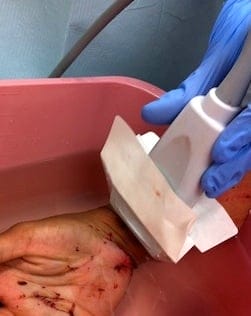
Have you ever been to an ultrasound workshop where each small group of attendees huddles around the small ultrasound display? Personally I think the 3 people closest to the display really see the images well. This tends to exclude the other participants.

Last week, I hosted (my first!) ultrasound workshop for the UCSF Alumni CME Conference where I showed peri-retired UCSF alumni from various specialties about the future of bedside ultrasonography. I equated it to the 21st century stethoscope. Thanks to my star team of ultrasonographers: Dr. Asaravala, Flores, Miss, Lenaghan, and Wilson.

(more…)

By |2016-11-11T18:54:22-08:00May 11, 2011|Tricks of the Trade, Ultrasound|

Paucis Verbis: Brugada syndrome

Brugada Syndrome

You always hear about it when working up syncope and sudden cardiac arrest in young patients, but it’s so easy to forget what it looks like on ECG. We so rarely see it… or DO we?!

This Paucis Verbis card on Brugada Syndrome is to help emblazon these ECG tracings in our mind, so that we don’t miss the subtle findings which place a patient at risk for sudden cardiac death. Pay special attention to Type 1, which is most specific for Brugada Syndrome.

PV Card: Brugada Syndrome

* Update 8/2/18: Only Type 1 and Type 2 are recognized for Brugada syndrome. The type 3 pattern is likely a normal variant.

<
Adapted from [1]
Go to ALiEM (PV) Cards for more resources.

Reference

  1. Antzelevitch C. Brugada Syndrome: Report of the Second Consensus Conference: Endorsed by the Heart Rhythm Society and the European Heart Rhythm Association. Circulation. 2005;111(5):659-670. doi:10.1161/01.cir.0000152479.54298.51
By |2021-10-15T11:04:55-07:00May 6, 2011|ALiEM Cards, Cardiovascular, ECG|
Go to Top