


Trick of the Trade: Identifying Team Members in Protected Code Blues
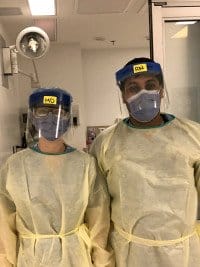 Your team in the Emergency Department (ED) receives a call from your local Emergency Medical Services (EMS) crew informing you that they are transporting a patient with high suspicion of COVID-19 in severe respiratory distress. As you assemble your team in preparation for a Protected Code Blue (PCB), your staff (including physicians, nurses, respiratory therapists, etc.) begins donning full Personal Protective Equipment (PPE). PPE includes donning a gown, gloves, face mask, goggles and/or a face shield.
With several team members assembled in the resuscitation bay in full PPE, it can be challenging to identify specific individual members of the team and their role.
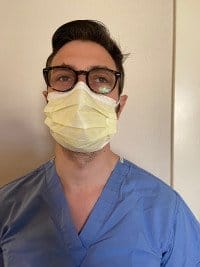 A 35-year-old male working as a healthcare worker presents for evaluation of ear discomfort. The skin behind his ears has been red and irritated since having to wear a surgical face mask with the majority of his patient interactions [1]. He has tried to minimize wearing his mask in the appropriate circumstances, using lotions and emollients, but still has a significant amount of discomfort [2].
 Patients who are tracheostomy and ventilator dependent are at increased risk for complications the longer they remain in this condition. One common complication is tracheomalacia. Progressive tracheomalacia can lead to air leaks around the tracheostomy cannula balloon. Initially, this can be managed by placing a longer tracheostomy cannula deeper into the trachea, however, these are often unavailable in the emergency department [1]. A second line strategy is to temporarily over-inflate the balloon, however, with chronic overinflation, eventually both the trachea and the neck stoma become too large, leading to an inability to maintain appropriate positive pressure (PEEP) and tidal volume necessary to ventilate the patient [2].
