Trick of the Trade: Tibial Intraosseous Line Stabilization in an Agitated Patient
 With the advent of commercial intraosseous (IO) needles for vascular access, administering IV medications for patients in extremis has been made much easier. Securing the IO needle to the patient’s tibia, femur, or humerus, however, is a different story. After successful patient resuscitation, these needles often tenuously secured through creative uses of sterile gauze, trimmed paper cups, bag valve masks, and/or just tape. Stabilization of tibial IO lines can be difficult in a sedated, intubated patient. This can be even more difficult in an agitated, moving patient.
 In cardiac arrest care it is well accepted that time to defibrillation is closely correlated with survival and outcome.
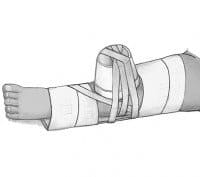 So much attention is appropriately focused on the anatomy and technique for intraosseous needle placement. In contrast, very little attention is paid to securing the needle. Often this involves a make-shift setup which involves gauze, wraps, and/or tape. This becomes especially important in the prehospital setting where these can be easily dislodged. The following trick stems from a