


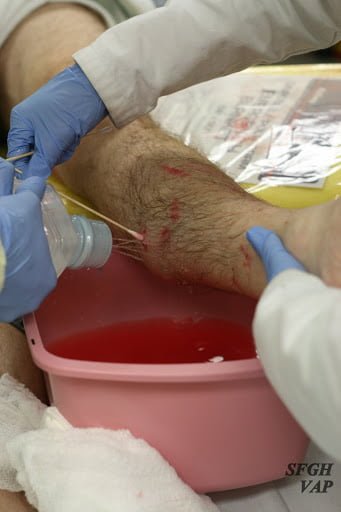
Trick of the Trade: The key to pollution is dilution
Wound care mantra: “The key to pollution is dilution.” High-pressure irrigation best reduces the patient’s risk for a wound infection. Open fractures are unique in the ED in that they require quick, high-volume irrigation before going to the operating room for more definitive wash-out. Often times a 30 mL syringe and 18-gauge angiocatheter is too cumbersome and slow for high-volume, high-pressure irrigation. [+]
Must-know toxicology website for emergency physicians
With recent discussion about the potential closing of California Poison Control Centers due to budget cuts, I suddenly became shockingly aware of how much Emergency Departments depend on these centers for assistance. They are always so knowledgeable and helpful in managing various ingestions and poisonings. [+]
Trick of the Trade: Peritonsillar abscess needle aspiration
How do you drain a peritonsillar abscess? When evaluating a patient with a sore throat and “hot potato voice,” peritonsillar abscess (PTA) is at the top of the differential diagnosis list. As with all abscesses, the definitive treatment involves drainage of pus. This can be done either by incision and drainage or, more commonly, by needle aspiration. [+]
Trick of the Trade: Hair apposition technique (HAT trick)
Scalp lacerations over hair-bearing areas require wound closure, usually with staples. An alternative technique is the Hair Apposition Technique, also known as the HAT trick [1, 2]. This technique provides a more cost-effective, faster, and less painful approach to scalp laceration repair. Imagine the scalp hairs as suture ties already embedded in the skin. [+]
Trick of the Trade: Reverse sugar tong splint
Distal radius fractures traditionally require a sugar tong splint to prevent the patient from ranging the wrist and elbow. The sugar tong splint essentially sandwiches the forearm with a splint, folded at the elbow. At this elbow fold, however, the splint often uncomfortably and inconveniently buckles and wrinkles when a wrap is applied. [+]
Trick of the Trade: Toxic sock syndrome
The olfactory nerve of an emergency physician is exposed to a broad range of smells in the Emergency Department. I’ve learned that the stinky-feet problem is a commonality amongst ED’s around the world! I call it the “toxic sock syndrome”. There are two remedies which I’ve been told of: Nebulized oil of wintergreen Placing a open canister of coffee grounds next to the feet (I’ve never understood this. I would imagine it would smell like stinky feet in a cafe. Plus, what a waste of coffee!) [+]
Trick of the Trade: Needle thoracostomy
On a shift last week, we had a patient present with a spontaneous pneumothorax. Not only that, but it was a tension pneumothorax. Although the patient was hemodynamically stable, he was very uncomfortable and really short of breath. To give us more time to prepare for the chest tube, it was decided to perform a needle thoracostomy. [+]
Sneak Peak "Trick of the Trade": Digital nerve block
The digital nerve block is common performed in the Emergency Department to provide anesthesia prior to wound closure. The digital nerves are typically accessed by injecting in the webspace on either side of the finger. Have you had patients start to get sweaty and anxious merely at the sight of your drawing up lidocaine in the syringe? Despite your reassurance that the 18-gauge needle that you used was just to move the lidocaine into the syringe and that you’ll be using a small needle for the procedure, they don’t look very reassured. Trust is key to having the procedure go [+]
Article review: CT irradiation exposure and risk
I’m still working on my 2009 ACEP Scientific Assembly handout for the LLSA exam test prep session (which were actually due yesterday!). Even though the conference isn’t until mid-October, the handouts are always due a few months earlier. And every year, it sneaks up on me! One of the articles I’m reviewing is about the risks of CT irradiation, published in the New England Journal of Medicine in 2007. [+]
Article review: Propofol (2007 ACEP Guideline)
Given all the recent brouhaha around propofol and Michael Jackson, I thought I would review the 2007 Annals of EM Clinical Practice Advisory paper on the use of propofol in the Emergency Department for procedural sedation. This is one of the 2009 Lifelong Learning Self-Assessment (LLSA) articles. Each year EM-board certified physicians are tested on 20 pre-selected LLSA articles to maintain eligibility for re-certification. [+]

Director of Growth, Strategic Alliance Initiative, Center for Innovation and Digital Health
Massachusetts General Hospital;
Chief Scientific Officer, Conductscience.com
Latest posts by Shuhan He, MD (see all)
- The Discharge Severity Index: Early Research on ED Readmission Risk Assessment - August 14, 2025
- Suboxone and the Emergency Physician: Get Waivered Training - August 12, 2022
- A Tale of Two Epidemics: COVID-19 and the Opioid Crisis - April 23, 2020