


Paucis Verbis card: Supratherapeutic INR
What do you do in these cases? A man on coumadin for atrial fibrillation arrives because he has increased bruising on his skin. He is otherwise asymptomatic. He was told to come to the ED because of a lab result showing INR = 6. A woman on coumadin for atrial fibrillation arrives because of melena and hematemesis. She looks extremely sheet-white pale. Her vital signs are surprising normal. Stat labs show a hematocrit of 15 and an INR value that the lab is “unable to calculate” because it is so high. Updated on 6/1/13: Old PV card revised to reflect [+]
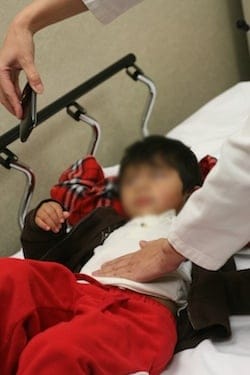
Trick of the Trade: Pediatric Distractors
Remember back in the day when we made simple toys for pediatric patients to focus on during the physical exam? Remember the inflated medical glove +/- a face drawn on it? I just encountered a FREE iPhone application (Eye Handbook), which has a lot of useful features. I currently only use the Pediatric Fixation animations. They can be found under the “Testing” section. Kids (and often adults too!) become mesmerized and distracted by the cartoon animations. [+]
Paucis Verbis card: TIA prognosis
Here is another installment of the Paucis Verbis (In a Few Words) e-card series on the topic of Transient Ischemic Attacks (TIA) from EM Clinics of North America. I use this card a lot specifically for the ABCD2 risk-stratification score. PV Card: Transient Ischemic Attacks Adapted from [1] Go to ALiEM (PV) Cards for more resources. Reference Ross M, Nahab F. Management of transient ischemia attacks in the twenty-first century. Emerg Med Clin North Am. 2009;27(1):51-69, viii. [PubMed]
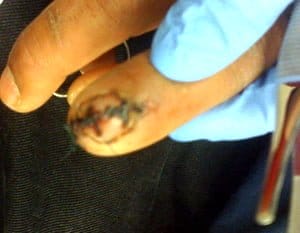
Trick of the Trade: Finger nailbed laceration repair
Over the years, I have been frustrated by how inelegant finger nailbed closure is. Nailbed lacerations are often sustained by a major crush injury, resulting in a stellate and irregular laceration pattern. This typically also requires the crushed fingernail to be removed. Cosmesis is never ideal because pieces of the nailbed are often missing, as seen in the photo above. Occasionally, nailbed lacerations are caused by a cutting rather than a crush mechanism. In these cases, I use a different technique. I leave the fingernail on. In fact, I use the fingernail to help reapproximate the nailbed edges. [+]
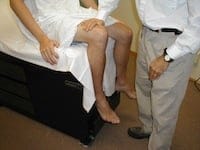
Trick of the Trade: Hip flexion strength testing
Testing lower extremity strength is a crucial part of the examination in patients with low back pain. In Emergency Departments, however, some patients provide a suboptimal effort because of general fatigue or malingering. How can you differentiate whether asymmetric hip flexion weakness is from suboptimal effort or true weakness? [+]
Paucis Verbis Card: CNS Infections
PV Card: CNS Infections Here is another installment of the Paucis Verbis (In a Few Words) e-card series on the topic of CNS infections from EM Clinics of North America 2009. Adapted from [1] Go to ALiEM (PV) Cards for more resources. Reference Somand D, Meurer W. Central nervous system infections. Emerg Med Clin North Am. 2009;27(1):89-100, ix. [PubMed]

Paucis Verbis Project: A peripheral brain e-card series
A few days I wrote about my "peripheral brain" note cards that I carry with me on each ED shift. These cards contain brief summaries of updated guidelines, evidence based literature, and clinical pearls. I constantly get requests for a copy of them, but they are fairly outdated now that I'm out of residency. So starting today, I'm going to start periodically posting new note cards in Word and PDF format that can be printed on any 4x6 inch index card. These will be posted every Friday. Feel free to download, edit, change font or font size, and use. You [+]
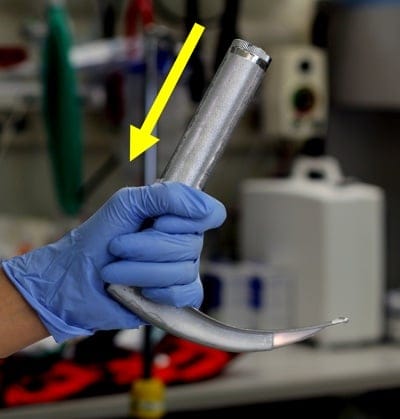
Trick of the Trade: Laryngoscope lifting strength
You are about to endotracheally intubate a patient. As you struggle to elevate the laryngoscope more anteriorly, has your left hand ever trembled while trying to see the vocal cords? Before you say, “I think the cords are too anterior, hand me the [insert your favorite backup airway adjunct]”, let’s focus on some basics. How can you gain significantly more laryngoscope lift strength? You can do more left arm bicep/tricep exercises, or… [+]

Tricks of the Trade: Diagnosing retinal detachment with ultrasound
In a sneak peek of my ACEP News’ Tricks of the Trade column, Dr. Patrick Lenaghan, Dr. Ralph Wang, and I will discuss how bedside ultrasonography can significantly improve your ocular exam. Here is a classic example. A patient presents with acute onset right eye pain and blurry vision. She possibly has a field cut in her vision. Her pupils are a teeny 2 mm in size in the brightly-lit Emergency Department. You are having a hard time getting a good fundoscopic exam to comfortably rule-out a retinal detachment. [+]
Article review: Neuro exam documentation
Medicolegal woes often can be tracked back to poor documentation by the physician. This article is a retrospective chart review of 384 EM resident charts, focusing on the documentation of the neurologic exam. Charts were selected if their chief complaints were neurologic or psychiatric in nature. A non-validated measurement tool for evaluating a neurologic exam was created based on discussions with attending emergency physicians. I have to agree with the chosen criteria. Documentation in each of the following criterion receives 1 point for a maximum score of 8. [+]

Director of Growth, Strategic Alliance Initiative, Center for Innovation and Digital Health
Massachusetts General Hospital;
Chief Scientific Officer, Conductscience.com
Latest posts by Shuhan He, MD (see all)
- The Discharge Severity Index: Early Research on ED Readmission Risk Assessment - August 14, 2025
- Suboxone and the Emergency Physician: Get Waivered Training - August 12, 2022
- A Tale of Two Epidemics: COVID-19 and the Opioid Crisis - April 23, 2020