


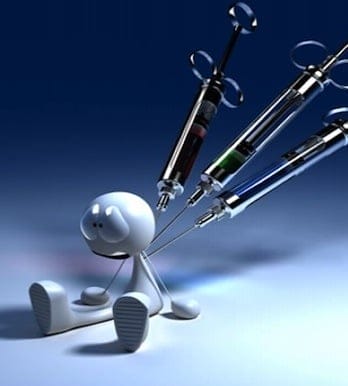
Tricks of the trade: Chemical sedation options
You walk into a room where a patient is screaming and thrashing about in his/her gurney from some stimulant abuse. PCP, cocaine, methamphetamine… or all of the above. When the number of people (police officers, security guards, nurses) is greater than the patient’s pupil size, you KNOW that you’ll need some chemical sedation. What intramuscular sedation regimen do you use? [+]

Paucis Verbis card: Hyperkalemia management
Hyperkalemia is a common presentation in the Emergency Department, especially in the setting of acute renal failure. In one shift, I had 4 patients with hyperkalemia! All had from some form of renal failure. This installment of the Paucis Verbis (In a Few Words) e-card series reviews the treatment options for hyperkalemia. PV Card: Hyperkalemia Adapted from [1] Go to ALiEM (PV) Cards for more resources. Reference Weisberg L. Management of severe hyperkalemia. Crit Care Med. 2008;36(12):3246-3251. [PubMed]
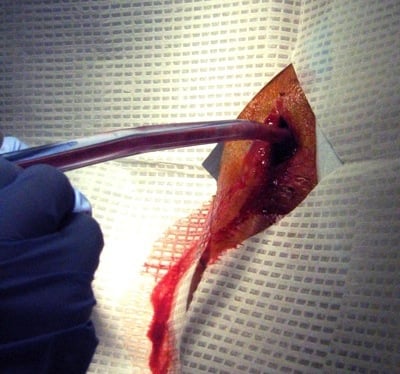
Trick of the Trade: Minimizing abscess odor
Building on my theme of combating odors in the Emergency Department (see Toxic Sock Syndrome), foul-smelling pus from large abscesses has got to be one of the most nauseating smells in the ED for me. Trick of the Trade Use a Yankauer to suction up pus [+]

Paucis Verbis card: Aneurysmal subarachnoid hemorrhage
Atraumatic subarachnoid bleeds are most commonly caused by ruptured intracranial aneurysms. This installment of the Paucis Verbis (In a Few Words) e-card series reviews the current management, knowledge, and challenges in aneurysmal subarachnoid hemorrhage (SAH). PV Card: Subarachnoid Hemorrhage Adapted from [1] Go to ALiEM (PV) Cards for more resources. Reference Edlow J, Malek A, Ogilvy C. Aneurysmal subarachnoid hemorrhage: update for emergency physicians. J Emerg Med. 2008;34(3):237-251. [PubMed]
Trick of the trade: Irrigation scalp wound photos
I mentioned from an earlier post about building a "head basin" for collecting irrigation fluid prior to wound closure. This basin prevents a deluge of fluid from soaking the gurney sheets and patient. I finally managed to capture this trick in action, while a student was irrigating an eyebrow laceration. Pearl When cutting out a semi-circular or rectangular hole in the basin, be sure that there remains a 2-4 inch lip at the bottom to ensure that fluid can collect in the basin.
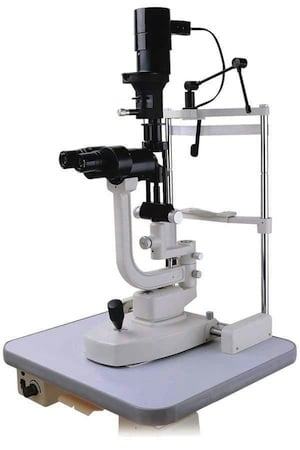
Great teaching video: Cell and flare
Using the slit lamp can be a challenge to learn, especially if you haven’t seen pathology before. In checking for anterior uveitis (i.e. iritis), you need to look for “cell and flare”. In theory, you know that you are looking for inflammatory cells and “flare”, which resembles a light beam being filtered through smoke. [+]
Paucis Verbis card: NIH Stroke Scale
Patients present with acute strokes to the Emergency Department. Time is of the essence to obtain a rapid neurologic exam, draw labs, get CT imaging, and consulting a neurologist especially if the patient presents within 3 hours of onset. To help the neurologist determine whether the patient should get thrombolytics, calculating a NIH Stroke Scale score is useful.w In this installment of the Paucis Verbis (In a Few Words) e-card series, here is the NIHSS scoresheet. Score 0 No stroke Score 1-4 Minor stroke Score 5-15 Moderate stroke Score 16-20 Moderate-severe stroke Score 21+ Severe stroke PV Card: NIH Stroke [+]
Trick of the trade: Spicing up your evidence-based lecture
Before I start creating a new talk, I ask myself 3 questions: Who will be in the audience? How can I make my talk more worthwhile to audience members, beyond their just reading the material/handout/articles on their own? Am I giving a talk before or after Dr. Amal Mattu? If so, just be resigned to being second-best. [+]
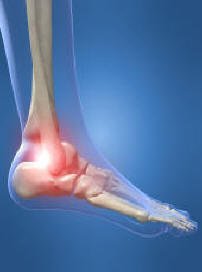
Paucis Verbis card: Ankle fractures
Ankle fractures are a common injury diagnosed in the Emergency Department. Being able to speak Ortho-ese (i.e. the language of orthopedists) is invaluable in consulting the orthopedist over the phone. One ankle fracture classification system that our orthopedists like to use is the Lauge-Hansen system. PV Card: Lauge-Hansen Classification of Ankle Fractures Go to ALiEM (PV) Cards for more resources.
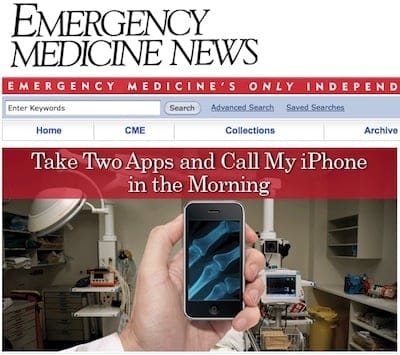
iPhone uses in the Emergency Department
Occasionally, I get a rare – “Hey congrats on the article!” comment from residents or students. It’s usually in reference to my ACEP News column that comes out every 3 months on Tricks of the Trade. However, I got about 3 shout-outs in the past 2 days. How odd. Then I saw one of our office staff who was reading EM News. “Hey cool!” she said. Totally confused, I realized that I was quoted on the front page of this week’s publication about iPhone applications in EM. Many months ago, I had done a brief telephone interview with the writer. [+]

Director of Growth, Strategic Alliance Initiative, Center for Innovation and Digital Health
Massachusetts General Hospital;
Chief Scientific Officer, Conductscience.com
Latest posts by Shuhan He, MD (see all)
- The Discharge Severity Index: Early Research on ED Readmission Risk Assessment - August 14, 2025
- Suboxone and the Emergency Physician: Get Waivered Training - August 12, 2022
- A Tale of Two Epidemics: COVID-19 and the Opioid Crisis - April 23, 2020