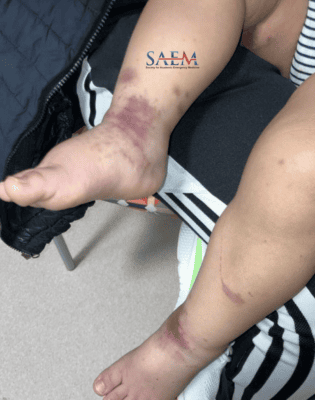
The patient is a 21-month-old male with no medical problems who is brought into the Emergency Department with concerns for bruising of the lower extremities and swelling of feet. His parents noticed the patient was walking differently 4 days ago and then noted bruising and edema of his feet bilaterally. They state there has been no known injury or trauma, and at least one of the parents has been with the child at all times. The bruising has spread and darkened to become widespread on both legs and today they noticed a few new spots on his arms and face. They report some possible subjective fevers and mild congestion, but there have been no other symptoms. There has been no recent weight loss and there is no history easy bleeding.
Vitals: HR 150, RR 28, Temp 98.1, O2sat 100% room air.
General: Awake, alert. Appears uncomfortable but in no acute distress.
Respiratory: Breath sounds normal. No increased work of breathing.
Cardiovascular: Mild regular tachycardia, no murmur.
Abdominal: Abdomen soft. There is no tenderness. No organomegaly.
Neurologic: At neurologic baseline. No focal deficits.
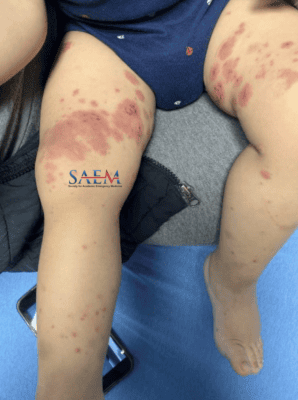
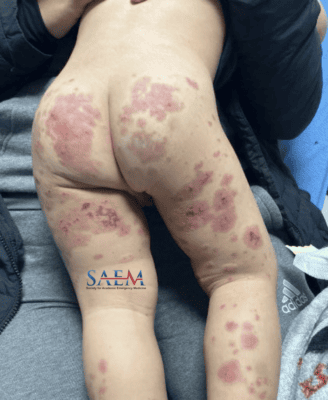
Skin: See images provided. Image 1 was on the first day of illness,
whereas Images 2 and 3 were taken on day four of the illness.
CBC: WBC 10.3, Hgb10.9, Plt 412,000
Creatinine normal at 0.25.
Urinalysis without blood or protein.
Acute Hemorrhagic Edema of Infancy (AHEI).
Acute Hemorrhagic Edema of Infancy (AHEI) is a small vessel vasculitis characterized by palpable purpuric skin lesions, edema, and fever. AHEI normally develops in children between the ages of 4 months to 2 years, as opposed to Henoch-Schönlein Purpura, which is more typical in children 2-10 years of age (peak age 4-6). Triggers can include infections, medications including penicillin, cephalosporins, and Trimethoprim- sulfamethoxazole, and immunizations. Clinical features are often preceded by a mild prodromal illness, followed by the rapid development of palpable purpura, ecchymosis, and petechia over 24-48 hours that is distributed mainly on the extremities and face, specifically the ears, eyelids and cheeks. The mucus membranes and the trunk are spared. Because AHEI is an immune-mediated vasculitis, internal organ involvement is possible, although rare, and can include nephritis, arthritis, and gastrointestinal tract problems. Diagnosis of AHEI is clinical, although other serious conditions must be considered in the differential such as non-accidental trauma, leukemia, and Kawasaki Disease. AHEI is a self-limited disease that resolves spontaneously over 1-3 weeks.
Take-Home Points
- AHEI is characterized by palpable purpuric skin lesions, edema and fever. It is distinguished from HSP clinically primarily by the age of onset, with HSP affecting children usually from age 2-10 years.
- Serious conditions such as non-accidental trauma, leukemia, and Kawasaki Disease should be considered and excluded.
- Cunha DF, Darcie AL, Benevides GN, Ferronato AE, Hein N, Lo DS, Yoshioka CR, Hirose M, Cardoso DM, Gilio AE. Acute Hemorrhagic Edema of Infancy: an unusual diagnosis for the general pediatrician. Autops Case Rep. 2015 Sep 30;5(3):37-41. doi: 10.4322/acr.2015.020. PMID: 26558246; PMCID: PMC4636105.
- Jindal SR, Kura MM. Acute hemorrhagic edema of infancy-a rare entity. Indian Dermatol Online J. 2013 Apr;4(2):106-8. doi: 10.4103/2229-5178.110630. PMID: 23741666; PMCID: PMC3673373.

Jamie Holland, MD
Medical College of Wisconsin
Latest posts by Jamie Holland, MD (see all)
- SAEM Clinical Images Series: A Mucous Membrane Mystery - February 20, 2026
- SAEM Clinical Images Series: Can I Snooze on This Bruise? - January 9, 2026
- SAEM Clinical Images Series: Alternative Block - February 28, 2025

Wendi Wendt, MD
Pediatric Emergency Medicine
Medical College of Wisconsin
Latest posts by Wendi Wendt, MD (see all)
- SAEM Clinical Images Series: A Mucous Membrane Mystery - February 20, 2026
- SAEM Clinical Images Series: Can I Snooze on This Bruise? - January 9, 2026
- SAEM Clinical Images Series: What is in my Child’s Mouth? - March 17, 2025