


SAEM 2010 (June 2-6, 2010)
The Society of Academic Emergency Medicine’s (SAEM) annual meeting starts this week. Instead of my regular posts, I thought I’d try using the Twitter widget to post real-time, first-hand accounts and photos from the conference. SAEM is a very dynamic and productive conference, where academicians in Emergency Medicine meet to pow-wow about the future of our specialty. [+]

Creating and delivering the stellar lecture
I recently re-read a book “Made to Stick” by Chip Heath and Dan Heath which discusses why some ideas stick and others are completely forgettable. The concepts discussed have helped me design lectures. Here’s something that I have incorporated into my talks: Memorable ideas share common attributes, which can be summarized by the acronym SUCCESs. [+]

Article review: Mentoring in EM
This article in the Canadian Journal of Emergency Medical Care reviews the EM literature on mentoring. The authors specifically do a great job summarizing practical tips. What is a mentor? It is a person who supports and guides a junior colleague (junior faculty member, residents, or medical student) in his/her professional development. [+]
Amazing video: Awake endotracheal intubation
Videos are priceless when trying to teach procedures. This amazing teaching video by Dr. Michael Bailin at Mass General demonstrates a novel way of anesthetizing the airway during an awake intubation. Inject 3 cc of lidocaine using a small butterfly needle through the cricothyroid membrane. This causes coughing, which spreads the lidocaine throughout the upper airway. Inject 5 cc of atomized lidocaine through the fiberoptic scope port to anesthetize the posterior oropharynx and vocal cords. Slide the endotracheal tube over the fiberoptic scope. [+]

Article review: Preparing for clinical clerkships during medical school
Do you remember the sheer terror you felt, when you first started your medical school clinical rotations? Your first two years were probably spent in classrooms and small-group labs discussing anatomy, pharmacology, pathology, etc. Then BAM! You are thrown into the deep end of the pool. You are now on a clinical team of medical professionals taking care of actual patients! [+]

What do you do with old posters?
In academia, it is common practice to make posters of your abstracts for national conferences. Once you are done presenting, what DO people do with the posters? I have several posters rolled up in my garage collected over the years. If the answer is nothing, why can’t we find a more creative way to display static (or even video) content during abstract sessions? Perhaps use a large LCD screen instead of posters taped to a backboard? [+]

Article review: The future of EM
As I was perusing through a recent Academic Medicine journal, I came across this interesting perspective piece on Emergency Medicine, written by national leaders in our specialty. This article essentially states that how the nation addresses ED crowding will define the future of EM. Currently, Emergency Departments are at a breaking point where overwhelming demands are commonly placed on under-resourced practices. [+]
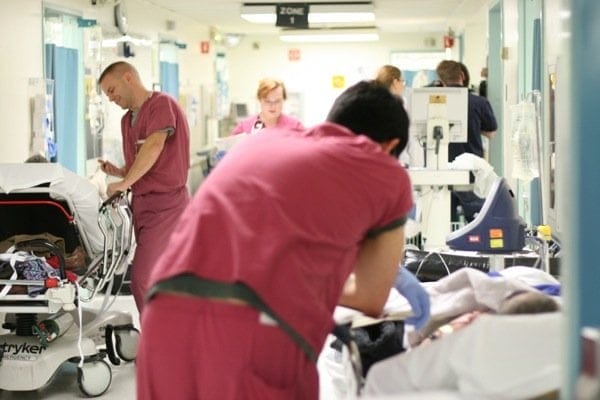
Work in progress: How can you balance ED crowding and education?
I’m working on writing a CORD consensus article on the impact of ED crowding on education and innovations towards maintaining educational excellence. We posited 2 scenarios of ED crowding: Overwhelming numbers of active ED patients Many ED boarders who are awaiting inpatient beds and who are taking up rooms which normally would have been used to see new patients What approaches do you know of which improve the ED educational experience for learners? We have thus far categorized innovations into 3 areas: [+]

Article review: The next 10 years in medical education
“Medical Education in the United States and Canada in 1910” was a landmark article, published by Abraham Flexner (shown in photo) in 1910. It’s commonly referred to as the Flexner Report. It revolutionized medical education in its call for higher quality and standardization. In summary the report advocated for the improvement of medical education and medical schools in 4 areas: [+]
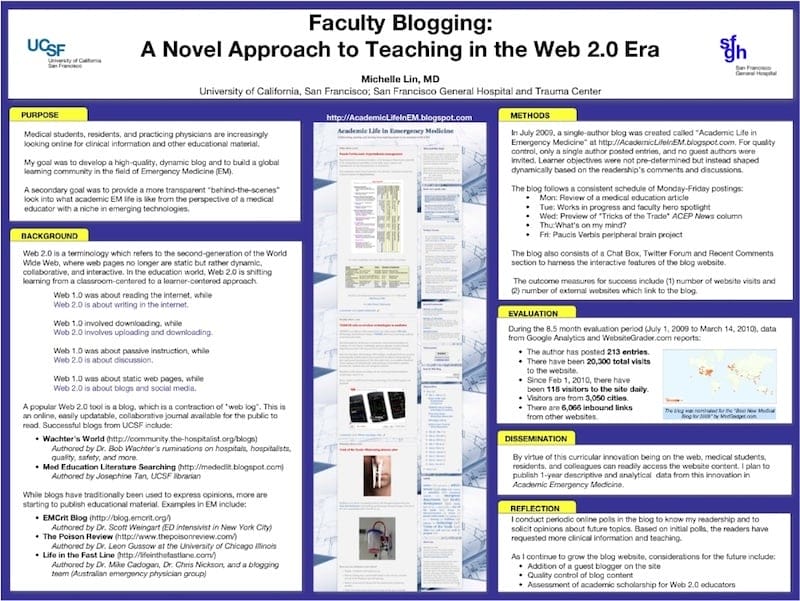
Work in progress: Poster on blogging
I need your help with a project! My poster on blogging was accepted to the annual UCSF Academy of Medical Educator’s Education Day. Feelings of joy and validation were quickly followed by terror and inadequacy. In order to get my poster costs reimbursed, I have to get feedback from my co-authors and incorporate that feedback into the poster. As you can see from the poster title on top, I have no co-authors! Since you are all my virtual co-authors, I thought I’d solicit for comments and suggestions. [+]
Director of Growth, Strategic Alliance Initiative, Center for Innovation and Digital Health
Massachusetts General Hospital;
Chief Scientific Officer, Conductscience.com
Latest posts by Shuhan He, MD (see all)
- The Discharge Severity Index: Early Research on ED Readmission Risk Assessment - August 14, 2025
- Suboxone and the Emergency Physician: Get Waivered Training - August 12, 2022
- A Tale of Two Epidemics: COVID-19 and the Opioid Crisis - April 23, 2020