



Residency interview season: Pitfalls
I often get asked by my advisees: “In my residency interview, what should I talk about or do to make myself more competitive?” To help you demystify the interview process, I wanted to share with you some insights. Overall, the interview day itself helps the program put a person and personality with your online ERAS application. Similarly, you quickly get a sense of the program’s personality. In EM, the residency interview day is generally pretty laid back. Not too many crazy questions. Programs just want to get to know you. Both you and the program should be asking each other– Is [+]
New kid on the block: Univ of Washington EM residency
How awesome would it be if there were EM residency programs at the University of Washington and UCSF-SF General Hospital?! This has been the question for decades. In 2006, I had the pleasure of seeing the UCSF-SFGH program become a reality. And now it’s the University of Washington’s turn. It is close to becoming a reality. It is really one of the last powerhouse institutions which does not have an EM residency program. The Univ of Washington EM residency’s Program Director is helmed by my superstar friend, Dr. Fiona Gallahue, and will be a 4-year program. The ACGME (accrediting organization) [+]

Article review: Inaccuracy in the SLOR
Residency interview season is quickly approaching! Unique to the field of EM, letters of recommendations from EM faculty are written on a standardized form. The Standardized Letter of Recommendation (SLOR), downloadable from the CORD website, documents information about the student’s performance in the EM clerkship, qualifications, and global assessment. At the end, the letter writer can provide free-text written comments. [+]
Opportunity for med students: SAEM meeting in Boston (Jun 1-5, 2011)
The Society for Academic Emergency Medicine (SAEM) holds its annual meeting at various U.S. metropolitan cities. This year, it is going to be at Boston in June 1-5, 2011. It is a terrific conference for medical students and residents interested in EM academia. To help coordinate the huge meeting, the SAEM Program Committee is looking for 15 enthusiastic medical students to serve as volunteers. [+]
Article review: EM in medical schools
Similar to JAMA, which publishes an annual publication focusing on Medical Education, the Academic Emergency Medicine (AEM) journal just published a AEM-CORD/CDEM supplement focusing on EM education. I was fortunate to be involved with one of the papers published in this supplement.This paper, written on behalf of the Clerkship Directors in EM (CDEM) and the Association of Academic Chairs of EM (AACEM), reviews the past, present, and future of EM in the U.S. medical school curriculum.EM faculty members are playing an increasingly important role in both the preclinical and clinical curriculum. Our specialty teaches skills and knowledge, crucial for all [+]

Practicing Judo in the ED: Secret to success
OK, you don’t actually practice Judo in the Emergency Department, but the principles in Judo are interestingly relevant in approaching our work in the ED. Thanks to Garr Reynolds of Presentation Zen fame for introducing me to the 7 rules of judo practice by the great Judo master Kyuzo Mifune. In his blog post, Garr specifically talks about how these rules are relevant in the realms of leadership and public speaking. These rules in fact are extremely relevant when you are a senior EM resident or an EM attending. These 7 simple rules really are the heart of maintaining respect, [+]
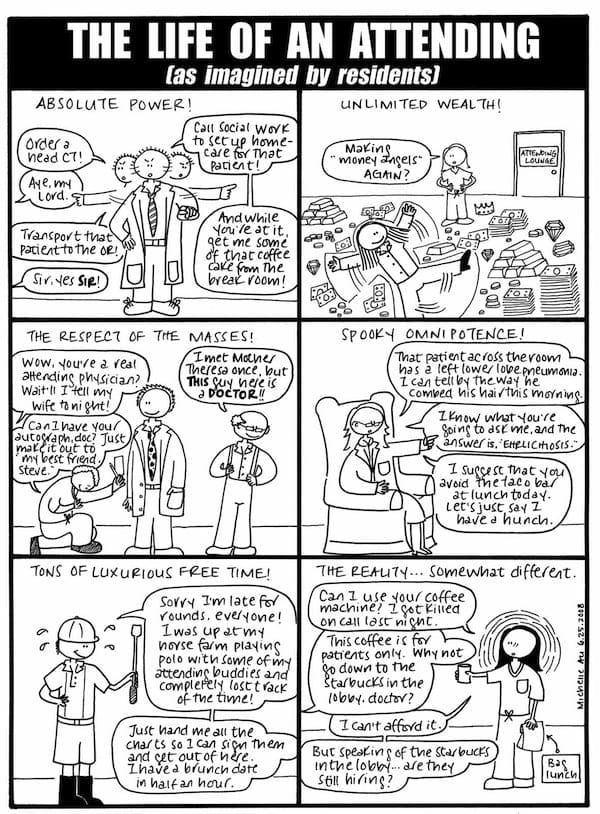
Life of an Attending: Is this or will this be you?
Thanks to one of our residents, Hangyul, I just recently learned about a hilarious comic strip series called Scutmonkey Comics in the blog The Underwear Drawer. It is side-splitting funny. [+]

Director of Growth, Strategic Alliance Initiative, Center for Innovation [+]
EMS officially recognized as an EM subspecialty
EMS was officially recognized as an EM subspecialty by the American Board of Medical Specialities on September 23, 2010! Residency programs have already implemented EMS Fellowship Training Programs to provide physicians with specialty training in prehospital care, medical direction, and research in the prehospital arena. The development of this new subspecialty was a collaborative effort between the National Association of EMS Physicians, the American College of Emergency Physicians, the Society of Academic Emergency Medicine, and the American Board of Emergency Medicine. The first certification exam is tentatively scheduled to be administered in 2013. Click here to see the announcement. [+]

Article review: Importance of first clinical clerkship
What was your first clinical clerkship rotation? Oddly, I started my third year with a sub-internship rotation on the Burn/Plastics service as my first rotation. Not sure how that happened… I managed my own patients like a 4th year student, did lots of wound care, and even got to harvest a few skin grafts. It was trial by fire.In a recent JAMA article, 3rd year medical students who started their clinical experiences in an Internal Medicine rotation overall did better on overall clerkship grades, when compared those who started their rotations on the Ob/Gyn, Psychiatry, or Family Medicine service. [+]
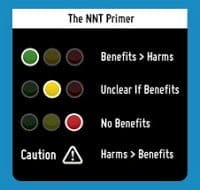
What’s on my mind: EBM Resource
Keeping up with the EM literature is difficult, particularly when we’re also trying to stay ahead of the curve in our own subspecialties (Healthcare Simulation and Medical Education in my case). Last week I was listening to Scott Weingart’s EMCRIT Podcast and at the very end of the show he mentioned a new EBM resource: TheNNT. [+]
Director of Growth, Strategic Alliance Initiative, Center for Innovation and Digital Health
Massachusetts General Hospital;
Chief Scientific Officer, Conductscience.com
Latest posts by Shuhan He, MD (see all)
- The Discharge Severity Index: Early Research on ED Readmission Risk Assessment - August 14, 2025
- Suboxone and the Emergency Physician: Get Waivered Training - August 12, 2022
- A Tale of Two Epidemics: COVID-19 and the Opioid Crisis - April 23, 2020