About Michelle Lin, MD

ALiEM Founder and CEO
Professor and Digital Innovation Lab Director
Department of Emergency Medicine
University of California, San Francisco

Paucis Verbis: Upper GI bleeding

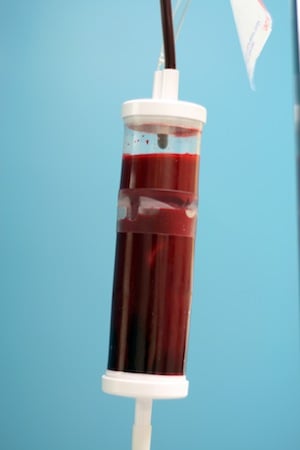
BloodTransfusionDripSM

Do you know what the Blatchford clinical prediction score is for upper GI bleeding? It can help you predict whether a patient with an upper GI bleed is severe and requires urgent intervention.

Hot off the presses, JAMA just came out with a great Clinical Rational Examination article on this topic. Thanks to Dr. Ryan Radecki (EMLitOfNote) for the heads up. The likelihood ratios and Blatchford risk stratification score are so useful that I’m breaking my PV rule to keep things down to the size of one index card. Note the absence of a NG lavage result to help you risk stratify for an upper GI bleed requiring urgent intervention using the Blanchard score.

Let’s say you have a patient with a Blanchard score of 0, as in the case of the JAMA example. Starting with a general 30% pretest probability that your upper GI bleed patient has a severe GI bleed, your post-test probability becomes <1% for a severe GI bleed.

PV Card: Upper GI Bleed


Adapted from [1, 2]
Go to ALiEM (PV) Cards for more resources.

References

  1. Kumar R, Mills A. Gastrointestinal bleeding. Emerg Med Clin North Am. 2011;29(2):239-52, viii. [PubMed]
  2. Srygley F, Gerardo C, Tran T, Fisher D. Does this patient have a severe upper gastrointestinal bleed? JAMA. 2012;307(10):1072-1079. [PubMed]
By |2021-10-10T18:50:55-07:00May 18, 2012|ALiEM Cards, Gastrointestinal|

KidsCareEverywhere-Vietnam study findings: SAEM 2012 meeting


KCElogo-bluedot.jpgI recently had the pleasure of presenting our KidsCareEverywhere-Vietnam team’s study findings at the national SAEM meeting in Chicago.

Bottom line

Despite knowing English as a second language, Vietnamese physicians were able to easily navigate an English-based, clinical decision support software (PEMSoft) after only a brief 80-minute training session, conducted by non-physicians. Their post-test exam scores improved by 84%!

 
By |2016-11-11T18:44:53-08:00May 16, 2012|Medical Education|

Trick of the Trade: Stabilizing mandibular relocations

MandibleBandage-1

Three weeks ago, I talked about more safely reducing mandibular dislocations. After successful completion of the procedure, how do you make sure that the patient doesn’t re-dislocate the mandible? You definitely should tell the patient to keep their jaw closed as much as possible for the next 24 hours and avoid opening the mouth widely (eg. yawning/laughing).

How do you immobilize the mandible? Especially for the chronic dislocators, presumably with more lax TMJ ligaments, you should think about immobilization. This can be done with a head bandage which goes under the chin. You can use kerlix rolls or an ACE wrap.

(more…)

By |2021-01-01T23:08:28-08:00May 15, 2012|ENT, Tricks of the Trade|

SAEM 2012 meeting and social media

SAEMlogoThose of us active in social media had quite an active meeting at the Society for Academic Emergency Medicine meeting in Chicago, IL this past week.

First off, Dr. David Marcus (@EMIMDoc) from Long Island Jewish Medical Center, NY gave many of us blogs a kind shout-out.

Also, many “iReporters” were on scene to live-tweet various events. Take a look at some of the posts below. Click on #SAEM12 hashtag to see the whole Twitter feed. I remember hearing that there were over 600 tweets!

By |2019-01-28T22:19:32-08:00May 13, 2012|Social Media & Tech|
Go to Top