About Michelle Lin, MD

ALiEM Founder and CEO
Professor and Digital Innovation Lab Director
Department of Emergency Medicine
University of California, San Francisco

Paucis Verbis: CHF likelihood ratios

senior with oxygen maskA 50 y/o man with a history of CHF and COPD is brought in by ambulance in severe respiratory distress. He is sitting upright with a RR 30 and O2 saturation of 79% on room air. Is this a CHF or COPD exacerbation? This is a common dilemma faced in the ED. Fortunately there are likelihood ratios to help you risk stratify using a Fagan nomogram.

Note that there are 3 tables:

  1. All-comer Emergency Department (ED) patients1
  2. ED patients WITH a known history of asthma or COPD2
  3. Summative LRs for BNP are provided in ED patients with or without a history of asthma/COPD1

See the blue font for the likelihood ratios ≥ 3.0.

PV Card: Does Your Dyspneic Patient Have CHF?


Adapted from [1, 2]
Go to ALiEM (PV) Cards for more resources.


References

  1. Wang C, FitzGerald J, Schulzer M, Mak E, Ayas N. Does this dyspneic patient in the emergency department have congestive heart failure? JAMA. 2005;294(15):1944-1956. [PubMed]
  2. McCullough P, Hollander J, Nowak R, et al. Uncovering heart failure in patients with a history of pulmonary disease: rationale for the early use of B-type natriuretic peptide in the emergency department. Acad Emerg Med. 2003;10(3):198-204. [PubMed]
By |2021-10-10T08:40:49-07:00Aug 24, 2012|ALiEM Cards, Cardiovascular|

Paucis Verbis: Does this adult patient need blood cultures?
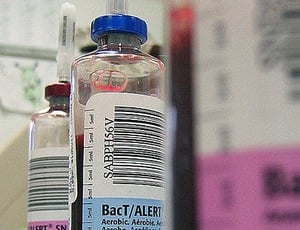
Blood Cultures Bottle

Do you order blood cultures for all your ED patients with a fever? Obviously no. What’s your decision making process on ordering this test? There are really no findings or tests with high specificity (rules-IN bacteremia), except interestingly “shaking chills”. Notice almost all the criteria listed below approach a likelihood ratio (LR) of 1.0. Two prediction rules do exist, however, to help you virtually rule-OUT bacteremia:

  • SIRS
  • Shapiro prediction rule

The list of LRs also will be helpful to show learners in the ED that an isolated serum WBC number is useless risk-stratifier.

Patient Case

A 55 y/o man with a PMH of hypertension presents with a community-acquired pneumonia on CXR, no fevers, no chills, no vomiting.

  • Temperature 37.8 C, BP 160/90, HR 100, RR 16, Sat 100% RA
  • Serum WBC 20K (no bands)
  • Platelets 300K
  • Creatinine 1.1 mg/dL

What is the patient’s pre-test and post-test probability for having bacteremia? Use these helpful stats from the Rational Clinical Examination series from JAMA.

PV Card: Blood Cultures for Suspected Bacteremia


Adapted from [1]
Go to ALiEM (PV) Cards for more resources.

Answer to patient case

  • Start with 7% pretest probability for bacteremia with a community acquired pneumonia.
  • Using the clinical prediction rules, the WBC 20K and HR 100 bpm are criteria for SIRS but do not fulfill the Shapiro prediction criteria. LR = 1.8 * 0.08 = 0.144. Post-test probability for bacteremia = 0.06%.
  • If the patient had instead a normal HR of 80 bpm, both the SIRS and Shapiro criteria would have been negative. LR = 0.09 * 0.08 = 0.0072. Post-test probability for bacteremia = << 0.1%.

This discussion doesn’t address WHETHER we should get blood cultures despite a risk for bacteremia in the setting of uncomplicated pneumonia receiving IV antibiotics or pyelonephritis with a pending urine culture.

References

  1. Coburn B, Morris A, Tomlinson G, Detsky A. Does this adult patient with suspected bacteremia require blood cultures? JAMA. 2012;308(5):502-511. [PubMed]
  2. Shapiro N, Wolfe R, Wright S, Moore R, Bates D. Who needs a blood culture? A prospectively derived and validated prediction rule. J Emerg Med. 2008;35(3):255-264. [PubMed]
By |2021-10-10T08:43:50-07:00Aug 17, 2012|ALiEM Cards, Infectious Disease|

Trick of the Trade: Incision and loop drainage of abscesses

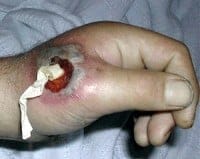
Abscess Packing Hand

Why are we still teaching the traditional incision and drainage approach to simple abscess drainage? They require frequent, painful packing changes to ensure persistent drainage of retained pus.

Trick of the Trade

Incision and loop drainage (I&LD) technique

As per usual, Dr. Rob Orman (ercast) beat me to this. He already reviewed the technique on his blog in 2010. This stems from a landmark article in the Journal of Pediatric Surgery, which involves creating a persistently draining fistula at two points by using a small vascular loop, tied into a non-tensile loop.

It makes sense to extrapolate and use this technique for both pediatric and adult patients with uncomplicated abscess, especially if the patients may not follow-up for packing changes as scheduled. The added benefit is that showering is encouraged to help encourage drainage without the risk of dislodging the secured loop.

Questions

Does anyone have experience with this that they would like to share? Particularly, what if you don’t have the skinny vascular loops in your Emergency Department?

What are the follow-up instructions?

Per the Tsoraides article1:

  • Take a bath/shower TWICE daily for the first 3 days.
  • Remove the loop in 7-10 days (when the drainage stops and the overlying cellulitis resolves)

Reference

  1. Tsoraides S, Pearl R, Stanfill A, Wallace L, Vegunta R. Incision and loop drainage: a minimally invasive technique for subcutaneous abscess management in children. J Pediatr Surg. 2010;45(3):606-609. [PubMed]
By |2021-01-02T13:55:50-08:00Aug 14, 2012|Tricks of the Trade|

Paucis Verbis: Overanticoagulation and supratherapeutic INR

I find it amazing that I know more non-emergency physicians virtually in the social media world rather than in person. Primarily through Twitter, I follow and am followed by medical educators from various specialties. If you haven’t joined Twitter yet, I think it might be time. There is a whole world of collaboration and conversation going on in this virtual community, which crosses specialties and geography.

Last week, Dr. Javier Benítez (@jvrbntz) was tweeting a Question of the Day, referencing a 2010 Paucis Verbis card on overanticoagulation, which was based on the 2008 American College of Chest Physicians (ACCP) guidelines. About 8 minutes after I retweeted his question, Dr. Roy Arnold (@cholerajoe), a pulmonary/critical care physician kindly informed me that the 2012 ACCP guidelines have been out since February.

So this PV card is replacing the 2010 card with revised recommendations. For more in-depth discussion, definitely take a look at Dr. Scott Weingart’s great podcast over at EMCrit. He helps to clarify holes which the 2012 ACCP guidelines don’t really address such as:

What if the patient is minorly bleeding with a high INR?

  • Oral vitamin K and 15 mL/kg FFP

What if you only have the 3-factor PCC (factors II, IX, X) and not the recommended 4-factor PCC (factors II, IX, X plus factor VII)?

  • If PCC is indicated, add recombinant factor VIIa or FFP to the 3-factor PCC to cover for factor VII.

PV Card: Overanticoagulation and Supratherapeutic INR


Adapted from [1]
Go to ALiEM (PV) Cards for more resources.

Reference

  1. Holbrook A, Schulman S, Witt D, et al. Evidence-based management of anticoagulant therapy: Antithrombotic Therapy and Prevention of Thrombosis, 9th ed: American College of Chest Physicians Evidence-Based Clinical Practice Guidelines. Chest. 2012;141(2 Suppl):e152S-84S. [PubMed]
By |2021-10-10T08:47:06-07:00Aug 10, 2012|ALiEM Cards, Heme-Oncology, Tox & Medications|

Welcome to the blog team: Bryan Hayes, PharmD

Bryan Hayes Circle SMHave you been reading the mind-blowing pearls on Twitter by Bryan Hayes, PharmD, DABAT? He is taking world of ED pharmacology and toxicology by storm on Twitter as @PharmERToxGuy. If have not been following him, you are missing out. I usually end up hitting “favorite” for all of his tweets to review again later. So for purely selfish reasons, I asked Bryan to see if he’d be willing to expand his 140 character gems on this blog. Much to my delight, he said yes!

(more…)

By |2019-09-10T14:03:54-07:00Aug 9, 2012|Life|
Go to Top