About Michelle Lin, MD

ALiEM Founder and CEO
Professor and Digital Innovation Lab Director
Department of Emergency Medicine
University of California, San Francisco

Paucis Verbis: Genital Ulcers

A few months ago, American Family Physician published a nice review article on the diagnosis and management of genital ulcers. How do you remember the classic appearances of the lesions? I often quickly check references to confirm my suspicions.

I find the two following tables helpful to remember. The table of differential diagnoses is from AFP. The article also reviews the confirmatory diagnostic testing and treatment protocols. The table of the clinical characteristics for the main infectious causes is from “The Practitioner’s Handbook for the Management of Sexually Transmitted Disease”.

Note: Although the primary lesion from Lymphogranuloma venereum (LGV) can have a variable appearance the tender, and often suppurative lymphadenopathy (buboes) are classic.

genital ulcers

PV Card: Genital Ulcers


Adapted from [1]
Go to ALiEM (PV) Cards for more resources.

Most recent 2010 CDC treatment guidelines

Reference

  1. Roett M, Mayor M, Uduhiri K. Diagnosis and management of genital ulcers. Am Fam Physician. 2012;85(3):254-262. [PubMed]
By |2021-10-10T18:59:28-07:00May 4, 2012|ALiEM Cards, Genitourinary|

Trick of the Trade: Seldinger chest tube technique using bougie
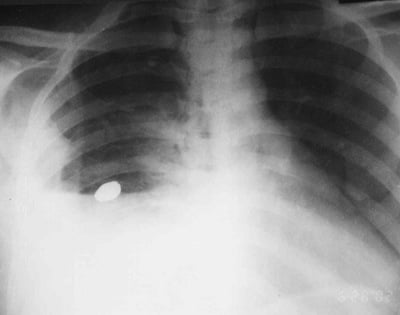
HemoPTXA 40 year-old man presents with a traumatic hemopneumothorax. He weighs 400 pounds.

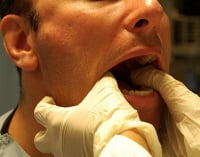
Chest tubes can sometimes be challenge, especially for those with extra redundant tissue to tunnel through before reaching the intrathoracic cavity. You want to avoid placing the chest tube mistakenly in the subcutaneous space. How can you ensure that your chest tube actually reaches the intrathoracic space?

(more…)

By |2019-01-28T22:18:57-08:00May 1, 2012|Social Media & Tech, Tricks of the Trade|

TED video: The happy secret to better work

If you have a few minutes, take a listen to this rather humorous and thought-provoking TED video about the “intersection of human potential, success, and happiness”. The speaker, Shawn Achor, is the CEO of Good Think Inc, a Cambridge-based consulting firm which researches positive outliers — people who are well above average, and author of “The Happiness Advantage”.

“If we study what is merely average, we will remain merely average.”

By |2019-01-28T22:19:41-08:00Apr 30, 2012|Medical Education|

Resuscitation 2012 conference

Resuscitation2012

What are you doing the rest of this week? Hop on a plane to Las Vegas and join me at the 2012 Resuscitation conference. It looks to be a great conference. I’ll be giving a 3-hour (!) discussion session on “Tips and Tricks in Emergency Medicine” on Friday. Inevitably when I given this talk, I always come away with great ideas from the audience. I’ll be sure to write them down and share on the blog.

By |2019-01-28T22:22:20-08:00Apr 26, 2012|Medical Education|

Trick of the Trade: Protecting your thumbs in mandible relocations

756148-821994-823775-1619710tn

Does anyone think that this is generally a bad idea when closed-reducing mandible dislocations? Yes, it’s easiest to apply downward pressure on the mandible by pushing down on the occlusal surfaces of the molar teeth. Sometimes, however, when the mandible relocates into place, the teeth clamp shut abruptly – placing your thumbs at risk. How can you prevent any injuries to yourself?

One way is to slide gauze into the mouth during your procedure. Start the video around the 1:30 mark for an exam.


Trick of the Trade: Mandible Relocations

Apply a protective roll of gauze over each thumb. Additionally, you can wear a second glove to cover the gauze. No, those are NOT just fat thumbs under the gloves.

ThumbWraps1

ThumbWraps2 Thanks to Dr. Liz Brown (UCSF-SFGH EM resident) for the trick!

 
By |2016-11-11T18:45:03-08:00Apr 24, 2012|ENT, Tricks of the Trade|

Paucis Verbis: Blunt Abdominal Injury, Likelihood Ratios

blunt abdominal injury

This month’s issue of JAMA addresses the question “Does this patient have a blunt intra-abdominal injury?” as part of the always-popular Rational Clinical Examination series.

The systematic review of the literature summarizes the accuracy of findings for your blunt trauma patient in diagnosing intra-abdominal injuries. Specifically, likelihood ratios (LR) are summarized. These LRs can be used to plot on the Bayes nomogram below. You draw a straight line connecting your pretest probability and the LR. This yields your posttest probability.


Bayes-1

The most predictive positive LR include: Abdominal rebound tenderness, a “seat belt sign”, ED hypotension, hematocrit < 30%, AST or ALT > 130, urine with > 25 RBCs, base deficit < -6 mEq/L, and a positive FAST ultrasound.

The trouble is that the absence of these findings aren’t as helpful in ruling-out injury, with negative LR’s very close to 1.0. The two exceptions are base deficit and FAST ultrasound with a negative LR of 0.12 and 0.26, respectively.


Adapted from [1]
Go to ALiEM (PV) Cards for more resources.

I find it interesting that there are studies on hepatic transaminase levels. Anyone else getting these in their trauma patients? I traditionally don’t. Many of our patients have a history of hepatitis C and underlying alcoholic hepatitis. If suspicious for blunt abdominal trauma, we just get the CT.

Reference

  1. Nishijima D, Simel D, Wisner D, Holmes J. Does this adult patient have a blunt intra-abdominal injury? JAMA. 2012;307(14):1517-1527. [PubMed]
By |2021-10-10T19:02:16-07:00Apr 20, 2012|ALiEM Cards, Gastrointestinal, Trauma|
Go to Top