Trick of the Trade: Ear Irrigation in the Emergency Department

Ear pediatricEar irrigation is an important tool for adult and pediatric patients in the Emergency Department (ED) with ENT complaints. Irrigation can be used to clear ear cerumen, visualize tough-to-see tympanic membranes, and remove foreign bodies. This may reduce the need for subspecialist care and improve the patient’s hearing and quality of life.1 Commercial electronic and mechanical devices are available for irrigation and have been studied. Moulton and Jones presented the improved efficacy of foreign body removal using an electric ear syringe in an (ED) population.2 In this trick of the trade, we present a low cost and effective way of  “ear-rigation” taught to us by one of our veteran nurses using easily available tools in the ED.

(more…)

Diagnose on Sight: Case of a red, swollen neck

Ludwig's AnginaCase: A 78 year-old female with a past medical history of asthma and hypothyroidism presents with a three day history of sore throat and a two day history of a “lump” along the right side of her neck. The “lump” has now progressed to involve both sides of her anterior neck and is accompanied with erythema, tenderness to palpation, and swelling. In addition, the patient has developed a hoarse voice and odynophagia. The patient’s primary care physician referred her to an ENT specialist, who then referred the patient to the ED for urgent imaging due to the concern for a deep space neck infection. Triage vitals are remarkable for a heart rate of 118 beats per minute. She is otherwise normotensive and afebrile. On physical exam, slight crepitation in noted on the floor of the patient’s mouth. Of note, the patient also informs you of her penicillin allergy. Which of the following is the biggest risk factor for this particular disease process? 

(more…)

By |2016-12-22T19:19:10-08:00Aug 17, 2016|Diagnose on Sight, ENT|

PV Card: Introduction to ED Charting and Coding

Editor’s Note (Jan 13, 2023): 

The new AMA CPT 2023 Documentation Guidelines have completely revamped how the billing and coding for Emergency Department charts is done. See the ACEP FAQ page on the 2023 Emergency Department Evaluation and Management (E/M) Guidelines.


ED charting and coding computer-charting-TEXT-canstockphoto17902161What makes a good chart? How do you write a good chart quickly? How about a good, efficient, billable chart? On average, residents and practicing physicians report they did not receive adequate training in charting and coding [1–3] and resident charts are more often down-coded due to documentation failures than those of attendings and PAs [4]. Thankfully, resident education in charting has improved over the past 15 years [5], and a little learning goes a long way to improve confidence [6] and competence [7].

In the spirit of #FOAMed, we would like to provide some pearls and pitfalls for EM documentation, starting with a PV card that addresses the basic elements of coding a chart. We hope it’s a handy on-shift reference.

What is a CPT code? What is an E/M level?

In order to uniformly bill for services provided, the American Medical Association (AMA) maintains a list of Current Procedure Terminology (CPT) codes. When you provide medical services to a patient, the chart is billed using a CPT code based on Evaluation & Management (E/M) levels 1-5 [8]. Most ED visits are billed as E/M levels 3-5. In order to objectively categorize a chart, Centers for Medicare & Medicaid Services (CMS) created a coding system to assign an E/M level.

What is the difference between a lower and higher E/M level chart?

Three essential elements determine the E/M level: history, physical exam, and medical decision making (MDM). Each of these components is evaluated by a set of guidelines and categorized by the documented elements of the history/physical exam and complexity of MDM. After evaluating each essential element separately, all three are considered in choosing an E/M level and CPT code that is billed. The complexity of your MDM should ultimately determine your E/M level, but under-charting in another area will limit you from billing an appropriately high E/M level.

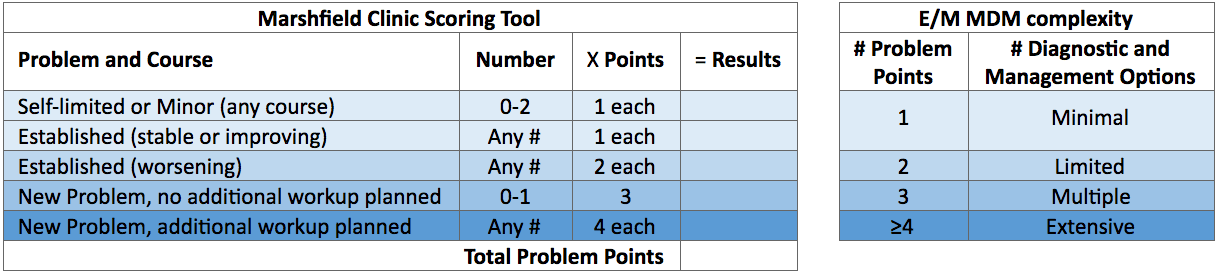
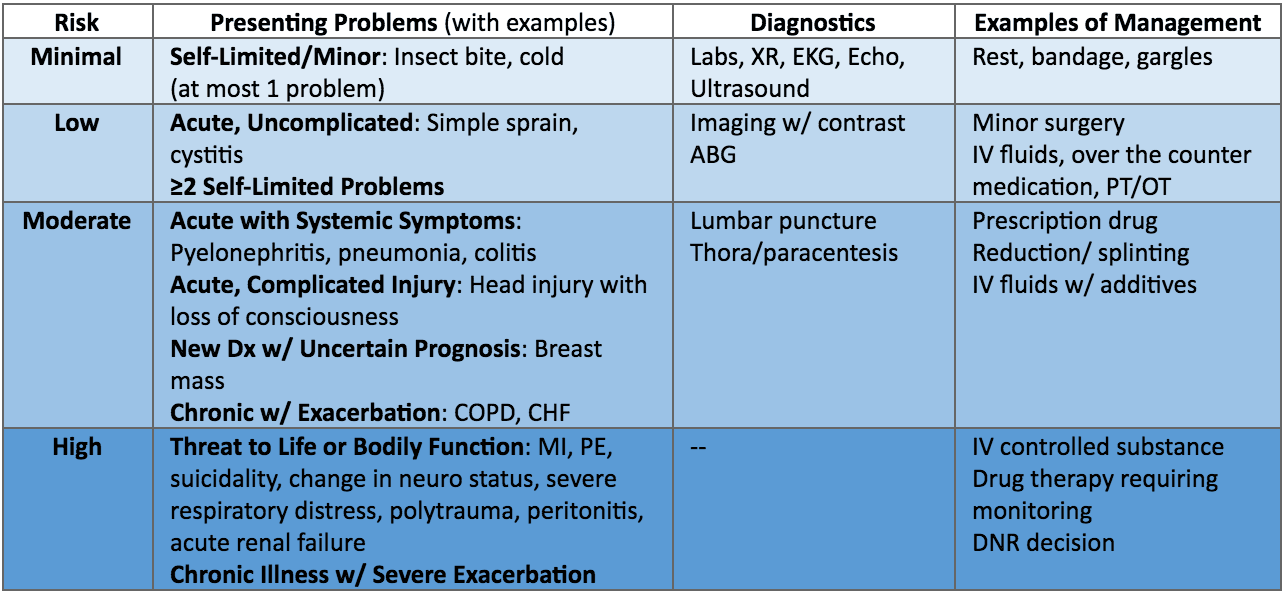
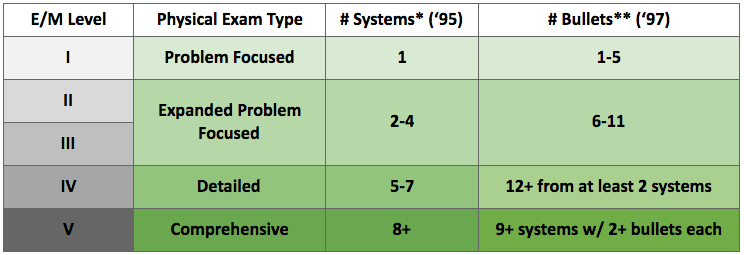
On your next shift, take a second to review your charts. Could one additional word in the history of present illness (HPI) bump a level 3 up to a level 4? Did you mention your chart biopsy, even if it was just skimming the most recent discharge summary or yesterday’s note? The following PV card outlines the minimum elements needed from all 3 areas required to code specific E/M levels, and shows that a single word or phrase may be the difference in clarifying a higher level of care provided.

Keep an eye out for our follow-up posts. We’ll focus on individual sections of the chart (history, physical examination, MDM), specific diagnoses and special situations that require extra care when documenting.

Happy charting!

References

  1. Howell J, Chisholm C, Clark A, Spillane L. Emergency medicine resident documentation: results of the 1999 american board of emergency medicine in-training examination survey. Acad Emerg Med. 2000;7(10):1135-1138. [PubMed]
  2. Pines J, Braithwaite S. Documentation and coding education in emergency medicine residency programs: a national survey of residents and program directors. Cal J Emerg Med. 2004;5(1):3-8. [PubMed]
  3. Dawson B, Carter K, Brewer K, Lawson L. Chart smart: a need for documentation and billing education among emergency medicine residents? West J Emerg Med. 2010;11(2):116-119. [PubMed]
  4. Ardolic B, Weizberg M, Cambria B, et al. 362: Documentation and Coding Skills: Is There Adequate training in Emergency Medicine Residency? Ann Emerg Med. 2006;48(4):108.
  5. Heiner J, Dunbar J, Harrison T, Kang C. 426: Current Emergency Medicine Residency Education of Documentation, Coding, and Reimbursement: Fitting the Bill? Ann Emerg Med. 2010;56(3):137-138.
  6. Takacs M, Stilley J. 169: Billing and Coding Shift for Emergency Medicine Residents: A Win-Win-Win Proposition. Ann Emerg Med. 2015;66(4):60.
  7. Carter K, Dawson B, Brewer K, Lawson L. RVU ready? Preparing emergency medicine resident physicians in documentation for an incentive-based work environment. Acad Emerg Med. 2009;16(5):423-428.
  8. Evaluation and Management Services Guidelines. Dept of Health & Human Services: Centers for Medicare & Medicaid Services. https://www.cms.gov/Outreach-and-Education/Medicare-Learning-Network-MLN/MLNProducts/Downloads/eval-mgmt-serv-guide-ICN006764.pdf. Published August 2015. Accessed July 24, 2016.
By |2023-01-13T18:42:49-08:00Aug 15, 2016|Administrative, ALiEM Cards|

Tips for Interpreting the CSF Opening Pressure

Lumbar Puncture positioning. Creative Commons License - Blausen staff

In Emergency Medicine, we are like Goldilocks when it comes to many things: We don’t like a patient’s PaO2 to be too high or too low. We don’t like the bed too high or too low when we intubate. We get concerned when we see a potassium that is too high or too low. The Goldilocks principle is also true of opening pressures on a lumbar puncture (LP). This post will discuss what the opening pressure means, and a differential diagnosis for when it is too high or too low and even when it is in the normal range.

(more…)
By |2019-04-26T19:09:38-07:00Aug 10, 2016|Neurology|

Trick of the Trade: Ocular ultrasound for the swollen traumatic eye

Eye swelling ocular ultrasound

You are caring for a patient with an incredibly swollen eye – like a scene out of almost any Rocky film. This patient is likely going to the CT scanner, but regardless of the finding (retrobulbar hematoma, orbital wall fracture, etc.) you still need to evaluate for extraocular muscle entrapment and loss of pupillary response. There’s only one problem: you can’t see the eye. The old standards like getting the patient to retract their lid using paperclips or a cotton swab may help, but sometimes there is just too much swelling, and those techniques are just not enough. Without brute force – and potentially causing more trauma – you likely won’t be able to examine this patient’s eye.

(more…)

Cardiotoxicity from Loperamide Overdose: The Toxicologist Mindset

Loperamide PillsThe Toxicologist Mindset series features real-life cases from the San Francisco Division of the California Poison Control System.

A 21-year-old man with history of opiate abuse was brought in by ambulance after 2 episodes of syncope and 1 episode of self-limited ventricular fibrillation. On initial presentation, the patient was found altered and unresponsive. His mental status improved after the administration of naloxone. On further history, the patient reported ingesting 50 -100 tablets of loperamide (2 mg) daily. A rhythm strip was obtained.


(more…)

By |2017-03-05T14:18:45-08:00Aug 8, 2016|Tox & Medications|
Go to Top