


 The Ultrasound for the Win! book, available now on
 PEM Pearls: Perfecting your pediatric lumbar puncture using ultrasound
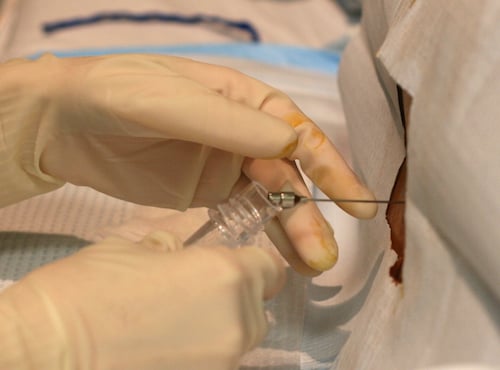 A lumbar puncture (LP) is a common procedure that every emergency physician must master. Pediatric LPs can be challenging for even the most experienced clinician due to small anatomy, difficulty with patient cooperation, and lack of frequency performed. A successful procedure is defined by obtaining cerebrospinal fluid and/or performing a non-traumatic lumbar puncture. There are multiple variables that lead to a successful pediatric lumbar puncture including provider experience, use of anesthesia, and patient positioning. Success rates for pediatric lumbar punctures are variable, with a large range from 34%-75%.1
AIR Series: Procedures Module (2016)
 Welcome to the Procedures Module! After carefully reviewing all relevant posts from the top 50 sites of the Social Media Index the ALiEM AIR Team is proud to present the highest quality procedure content. Below we have listed our selection of the 13 highest quality blog posts within the past 12 months (as of June 2016) related to procedure emergencies, curated and approved for residency training by the AIR Series Board. More specifically in this module, we identified 3 AIRs and 10 Honorable Mentions. We recommend programs give 4 hours (about 20 minutes per article) of III credit for this module.
ED Charting and Coding: History of Present Illness & Past Medical, Family, Social History
Editor’s Note (Jan 13, 2023):
The new AMA CPT 2023 Documentation Guidelines have been published and the prior history and physical elements are no longer incorporated into the billing and coding guidelines. See the ACEP FAQ page on the 2023 Emergency Department Evaluation and Management (E/M) Guidelines.
 Remember the “OPQRST” mnemonic? It stands for Onset, Provocation/Palliation, Quality, Region/Radiation, Severity, Timing. Not only can it guide your history taking, but charting these descriptors also ensures you can code at an appropriate level. The patient’s history is the first example of the balance between essential information and over-documentation. It should be comprehensive, yet be chief-complaint focused [1]. Below, we outline the components of a thorough and billable history.
History
The history includes 4 elements:
- Chief complaint (CC)
- History of present illness (HPI)
- Review of systems (ROS)
- Past medical, family, and social history (PFSH)
A chief complaint is required for all levels of charting. The remaining three elements (HPI, ROS, PFSH) determine the type of history for the chart, as separated into 4 levels [2,3]:
- Problem Focused
- Expanded Problem Focused
- Detailed
- Comprehensive
The lowest common history level met by all elements determines the highest billable Evaluation and Management (E/M) level.
Remember “4-2-1” rule: 4 descriptors for HPI, 2 sections of PFSH, and 1 item per system for ROS guarantees a Comprehensive history.
| E/M Level | History Type | HPI | ROS | PFSH |
|---|---|---|---|---|
| I | Problem Focused | 1-3 | 0 | 0 |
| II/III | Expanded Problem Focused | 1-3 | 1 | 0 |
| IV | Detailed | 4 | 2-9 | 1/3 |
| V | Comprehensive | 4 | 10+ | 2/3 |
Example:
If the HPI and ROS meet requirements for a Comprehensive History (E/M level 5) but the chart does not include any elements from the PFSH, this limits the history to Expanded Problem Focused. You can not bill higher than an E/M level 3.
Chief Complaint (CC)
Centers for Medicare & Medicaid Services definition:
“A concise statement describing the symptom, problem, condition, diagnosis, physician recommended return, or other factor that is the reason for the encounter, usually stated in the patient’s own words.”
A clearly stated CC may be documented in a physician’s note or a triage note [2].
History of Present Illness (HPI)
The HPI discusses details of the CC and provides a chronological story, usually with 3-4 of the following descriptors [1,2]:
- Location
- Quality
- Severity
- Duration
- Timing
- Context
- Modifying factors
- Associated signs/symptoms
A Brief HPI (E/M levels 1-3) requires 1-3 descriptors, while an Extended HPI (E/M levels 4-5) requires ≥4 descriptors [2,3]. Note that E/M level 4-5 charts can still be concise.
Example
The patient is a 34 y/o M presenting with chest pain (chief complaint) that is substernal (location), starting an hour prior to arrival (duration) while mowing the lawn (context), feels “like a pressure” (quality) that is intermittent (timing) and severe (severity), with associated nausea and diaphoresis (associated signs/symptoms).
This qualifies for Comprehensive, E/M Level 5 with 8 HPI descriptors.
Review of Systems (ROS)
Keep your eye out for our next post, where we will dive into the complexities of ROS.
Past Medical, Family, and Social History (PFSH)
Past Medical History (PMH) includes chronic diseases, past illnesses/injuries, and operations/treatments. Family History (FH) is a review of medical events including hereditary and non-hereditary disease. Social History (SH) is a review of pertinent age-appropriate current and past risks factors such as alcohol/tobacco/drug use, sexual history, employment, and education. You must document one specific item for a Detailed history (E/M level 4) and at least one item each in two areas for a Comprehensive history (E/M level 5) [2,3].
Example for Detailed History, E/M level 4
- PMH: Hypertension, hyperlipidemia, diabetes mellitus. [Detailed, E/M level 4]
Example for Comprehensive History, E/M level 5
- PMH:Hypertension, hyperlipidemia, diabetes mellitus
- SH: smokes cigarettes 1 ppd
A common misconception is that listing two past medical problems (e.g. hypertension, diabetes) are still all counted as two items. They are instead all under one item (PMH). You still need to list an item from either the SH or FH to be eligible for E/M level 5. Thus this would drop the coding from a potential E/M level 5 down to a level 4.
The PMFH recorded by ancillary staff (e.g. tobacco use recorded at triage as part of the SH) counts as long as it is included in your documentation with a statement of review and confirmation [1]. Example: “Past medical, family, and social histories reviewed and verified by me.”
Additional Tips
- CC, ROS, and PFSH may be recorded by ancillary staff or via patient questionnaire, but you must document that you have confirmed this information with the patient [2,3].
- What if a patient is unconscious, intubated, or refuses to give a history? If a patient’s condition or circumstance limits acquisition of any history component, add a qualifier describing the limitation, e.g. cannot obtain due to encephalopathy, dementia, intubation, etc. This qualifier applies to all elements of history: HPI, ROS, and PFSH [2,3]
- Did you play detective and obtain a history through other sources? Get credit! As an alternative to the extended HPI (E/M level 5 HPI), you can discuss the status of at least 3 chronic or inactive conditions [1,2]
Example: Patient sent from nursing home for altered mental status. He is nonverbal at baseline, but per nursing staff and transfer records, his (1) urinary retention has been stable with Foley in place, he (2) has not missed any seizure medications, and (3) the staff has been controlling his blood glucose well.
A statement describing how and what additional history was obtained will add to the complexity of data review in your medical decision making (MDM), which will be detailed in a later post). The statement “Additional history obtained by family/extended care facility staff” without elaboration will not count [2].
Work Smarter, Not Harder
The elements above describe the minimum data for each level. It is important to include additional data as appropriate and to avoid potential down-coding; however, be cognizant of wasting time or space recording historical information which neither contributes to your thought process nor billing. Some items are relevant to many aspects of care: diabetes in the family, bleeding and clotting diatheses, smoking history, and illicit drug use are both PFSH and risk factors. A patient’s living situation is relevant for disposition. Do not include “not relevant” or “non-contributory” history as it does not contribute to billable documentation.
See the PV Card on ED Charting and Coding
References
- Guth T, Morrissey T. Medical Documentation and ED Charting. CDEM Curriculum. 2015. Accessed 30, 2016.
- 1997 Documentation Guidelines for Evaluation and Management Services (PDF). Centers for Medicare & Medicaid Services. Accessed Aug 30, 2016.
- Evaluation and Management Services Guidelines (PDF). Department of Health & Human Services: Centers for Medicare & Medicaid Services. Accessed Aug 30, 2016.
Trick of the Trade: Simple finger traps using gauze roll
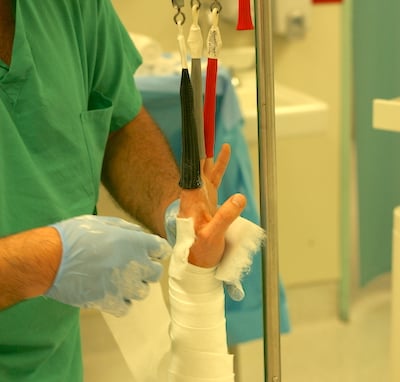 Closed reduction of fractures or dislocations in the hand and wrist can be difficulty to achieve. Gravity can serve as an assistant. Commercial finger traps are available, but can sometimes be hard to find in the Emergency Department. An earlier trick of the trade describes the use of a gauze role to build your own finger trap setup. The following describes a simpler way to build finger traps using a gauze roll.
Radiograph-Negative Lateral Ankle Injuries in Children: Occult Growth Plate Fracture or Sprain?
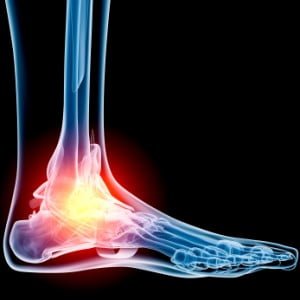 An 7-year-old girl presents to your Emergency Department (ED) with an ankle inversion injury from while performing gymnastics. Plain films of her ankle show no fracture. It has been a long-held presumption that skeletally immature children with fracture-negative radiographs should be immobilized with a cast given the concern for an occult Salter-Harris 1 fracture. “Children do not get sprains” is a common teaching point. But a recent 2016 JAMA Pediatrics article challenges that premise in a prospective cohort study of 135 pediatric patients.1 Can these injuries be managed more like a sprain, utilizing a removable ankle brace?
‘Treat and Release’ after Naloxone – What is the Risk of Death?
 Often in the prehospital setting, naloxone is administered by EMS (or possibly a bystander) to reverse respiratory and CNS depression from presumed opioid overdose. The patient then wakes up, and not uncommonly, refuses transport to the hospital. The question is: Is it safe to ‘treat and release?’ Or, rather, what is the risk of death associated with this practice.
Last updated: January 2, 2019