Acute Coronary Syndrome (ACS) in the Elderly

Screen Shot 2013-07-18 at 5.09.00 PMAcute coronary syndrome (ACS) is the number one cause of mortality in patients older than 65 years old. 1 To complicate this fact further, they also present atypically with weakness, nausea/vomiting, fatigue, and shortness of breath.  It has been shown that older adults who present to the emergency department (ED) with ACS and a chief complaint other than chest pain have worse outcomes:

(more…)

By |2019-09-10T13:36:48-07:00Jul 25, 2013|Cardiovascular, Geriatrics|

Supraventricular Tachycardia (SVT) With Aberrancy Versus Ventricular Tachycardia (VT)

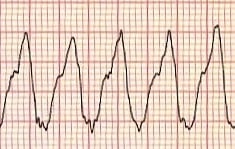
2011_04_22AwmEPRDifferentiating between SVT with aberrancy and VT can be very difficult. It is crucial to be able to make this distinction as therapeutic decisions are anchored to this differentiation. Brugada et al prospectively analyzed 384 patients with VT and 170 patients with SVT with aberrant conduction to see if it was possible to come up with a simple criteria to help differentiate between the two with high sensitivity and specificity.

(more…)

Patwari Academy: ECG Rate, Rhythm, Axis

Screen Shot 2013-07-20 at 9.26.07 AM

Dr. Rahul Patwari reviews the basics on how to determine an ECG’s rate, rhythm, and axis. It’s always nice to review these concepts. Do you remember how many seconds a traditional ECG typically spans on a single page? What’s the significance of the numbers: 300, 150, 100, 75, 60, 50? Spend a few minutes on these 2 refresher videos.
(more…)

By |2019-01-28T21:57:46-08:00Jul 21, 2013|ECG, Patwari Videos|

EKG Subtlety: Tall T-Wave in Lead V1

Balance

EKGs are a simple, cheap modality that can give an emergency physician quite a bit of information.  Sometimes, in a busy ER, this information can be very subtle and almost overlooked without a second thought. A perfect example of this is a New Tall T-wave in  lead V1 (NTTV1). This finding can be a normal variant, but can also be a precursor to badness.

(more…)

Trick of the Trade: Less traumatic nasopharyngoscopy


ViscousLidoNosesm
A fiberoptic nasopharyngoscope is a handy tool to check patients for suspected foreign bodies (e.g. fishbone stuck in throat) or laryngeal edema. Depending on the diameter of your fiberoptic cable, it may be fairly uncomfortable for the patient despite generous viscous lidocaine instillation through the nares and nebulized lidocaine. Alternatively or additionally, you can make your own lidocaine-oxymetazoline nasal atomizer which works well.  

What if the patient is STILL not tolerating the procedure well? 

(more…)

By |2016-11-11T19:02:31-08:00Jul 16, 2013|ENT, Tricks of the Trade|

Emergency Neurological Life Support (ENLS) course

Emergency Neurological Life Support (ENLS) is a new online course that I am taking. It is sponsored by the NeuroCritical Care Society, which focuses on the first few hours of care to neurological emergencies. It is a collaborative effort between emergency physicians and neurointensivists, both of which author each individual module. The course is co-chaired by Scott Weingart, MD of EMCrit fame and is geared towards anyone who treats neurological emergencies (physicians, nurses, PA/NP, EMS personnel). The course utilizes technology to deliver its content by podcast, video presentation of ENLS guidelines, online reading of published guidelines and an online quiz. Completion of all modules awards the participant a certificate of certification in ENLS as well as 15 hours of CME. (more…)

By |2017-03-05T14:18:34-08:00Jul 15, 2013|Neurology, Social Media & Tech|
Go to Top