


Paucis Verbis: Spinal epidural abscess
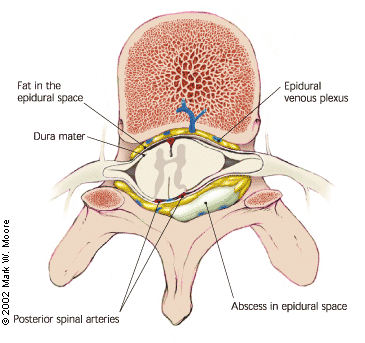 One of the most challenging diagnoses to make is that of a spinal epidural abscess (SEA), especially if you work in an Emergency Department which cares for many IV drug users and HIV patients. There’s never before been a published diagnostic guideline or algorithm which helps you with risk-stratification.
In the Journal of Neurosurgical Spine, a diagnostic guideline was prospectively evaluated on a small population (n=31) as compared to historical controls (n=55). They found that an ESR test had a sensitivity of 100% if a patient had at least 1 risk factor for SEA. A CRP test was much less helpful.
Not a practical algorithm
Unfortunately, they didn’t study the utilization rate of the MRI scanner with this guideline. Are they getting better results (fewer diagnostic delays and fewer cases of patients later in their clinical course) because they are just MRI-scanning more people? Almost everyone in my ED with back pain would fall into the Urgent/Emergent MRI box… I’m not a fan of this algorithm.
Regardless, this algorithm may help you in shaping your diagnostic decision and medical decision making documentation.
PV Card: Spinal Epidural Abscess
Adapted from [1]
Go to ALiEM (PV) Cards for more resources.
Reference
- Davis D, Salazar A, Chan T, Vilke G. Prospective evaluation of a clinical decision guideline to diagnose spinal epidural abscess in patients who present to the emergency department with spine pain. J Neurosurg Spine. 2011;14(6):765-770. [PubMed]
 I just finished taking the 2011 LLSA exam to remain eligible for recertification. The only good thing about this test is that it gives me interesting topics for my Paucis Verbis cards.
 Abscess drainage can be painful and time consuming in the ED. Can this article help?
 Does your Emergency Department have computerized spectrophotometric catheters to measure continuous central venous oxygen saturation (ScvO2) in early goal directed therapy (EGDT) for severe sepsis? That’s what was used in the original Rivers’ EGDT study.