SplintER Series: Stop! Hammer Time


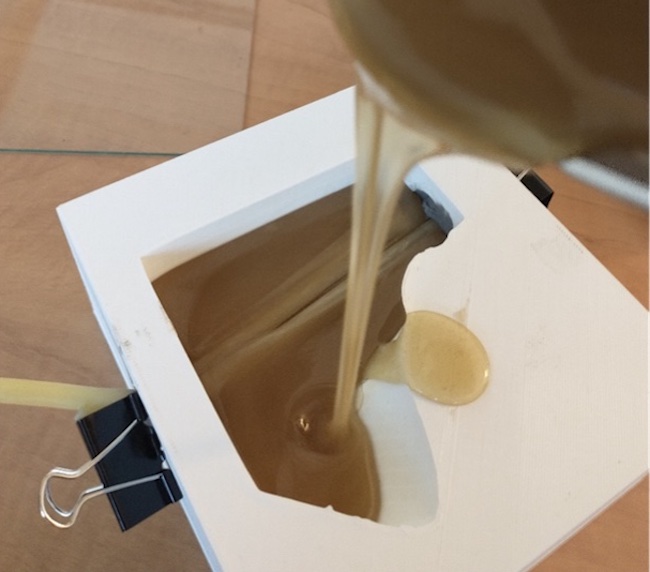
What is the correct antidote for a patient who is poisoned with the pictured substance?
(photo used with permission courtesy of Maureen Dallhoff, MD)
Ultrasound-guided IVs require hand-eye coordination and fine movements of probe in Goldilocks fashion. Apply too much pressure, and the vein in question is compressed. Slide a little to the right, and now it’s out of the window. Something that practitioners don’t think about is the tension from the cord. If left to its own devices, the cord will tug on the probe, making the probe harder to steer and handle, especially for those tiny veins.
Have the patient grasp the cord!
This makes them an active participant. Usually, if they are awake and good-humored, tell them “audience participation is required.” Doing so will give you enough slack to effectively visualize and troubleshoot the ultrasound-guided IV.
Tape the cord to the gurney side rail. Use a 2×2 gauze as a buffer between the tape and the rail so the tape doesn’t damage the cord itself.
Read other articles in the Tricks of the Trade series.

Read this tutorial on the use of point of care ultrasonography (POCUS) for pediatric appendicitis. Then test your skills on the ALiEMU course page to receive your PEM POCUS badge worth 2 hours of ALiEMU course credit.
Mason is an 8-year-old boy who comes to the emergency department for abdominal pain. The pain has been present for 12 hours, started near his belly button, and now has migrated to the lower right side. He describes it as constant and worsening. His parents are concerned because he had a fever to 101F since 2 hours prior to arrival and had 2 episodes of emesis. They deny diarrhea or bloody stool. They gave acetaminophen for fever 2 hours prior to arrival. He has not wanted to eat anything today.
| Vital Sign | Finding |
|---|---|
| Temperature | |
| Heart Rate | 120 bpm |
| Blood Pressure | 106/58 |
| Respiratory Rate | 18 |
| Oxygen Saturation (room air) | 100% |
The patient has a leukocytosis with a WBC 13.3 x 10⁹/L and an absolute neutrophils count (ANC) 10.3 x 10⁹/L but otherwise unremarkable labs. His final Pediatric Appendicitis Score (PAS) is 8. You decide to incorporate appendix POCUS to your evaluation. You place a linear, high-frequency transducer on the patient and visualize his appendix. You observe the following:
The patient receives IV morphine and is made NPO. The general surgeon on call is consulted and agrees with the plan for an appendectomy.
Which of the substances below causes crystalluria with hexagonal crystals that shimmer on macroscopic urine examination?