ACMT Toxicology Visual Pearl: Hypertension and Rash

Which toxic exposure can present with the pictured rash along with hypertension and tachycardia mimicking pheochromocytoma?
- Arsenic
- Lead
- Mercury
- Silver
- Thallium



Which toxic exposure can present with the pictured rash along with hypertension and tachycardia mimicking pheochromocytoma?

Direct-acting oral anticoagulants (DOACs), including apixaban, rivaroxaban, edoxaban, and dabigatran, are widely used for various indications and considered first-line therapy for prevention of acute ischemic stroke in patients with nonvalvular atrial fibrillation [1]. The management of acute ischemic stroke in patients on DOACs presents a difficult clinical scenario in the emergency department due to concern for increased risk of hemorrhage. IV thrombolytics (e.g., alteplase, tenecteplase), a mainstay in acute ischemic stroke management, are not recommended in current guidelines for patients whose last DOAC dose was within the last 48 hours [2, 3]. Therefore, patients with an acute ischemic stroke who are compliant with their DOACs are often excluded from guideline recommended therapy. Additionally, as covered in a previous ALiEM post, it is not recommended to reverse anticoagulation status in order to administer a thrombolytic.
The use of IV thrombolytics in patients on DOACs was evaluated by Kam et al in a 2022 study published in JAMA [4]. This retrospective analysis included 163,038 patients from the AHA/ASA Get With The Guidelines-Stroke registry with acute ischemic stroke who received IV alteplase within 4.5 hours of symptom onset. Of the total number of patients, only 2207 had documented use of a DOAC within the last 7 days, with 25 of these patients reporting DOAC use within 48 hours. Patients on warfarin or other anticoagulants were excluded. The primary outcome was symptomatic intracranial hemorrhage (ICH) within 36 hours of IV alteplase administration. After adjusting for clinical factors, the rate of symptomatic ICH was not significantly different between patients taking DOACs and those not on anticoagulation (3.7% vs. 3.2%, adjusted OR 0.88, 95% CI 0.70 to 1.10). However, when stratified based on time from last DOAC dose, patients who took their DOAC 0-48 hours prior had an 8% rate of symptomatic ICH compared to 3.2% among those not on DOACs. Furthermore, the rate of any alteplase complication was 12% vs. 6% in those taking DOACs within 48 hours vs. no DOAC.
Read other articles in the EM Pharm Pearls Series and find previous pearls on the PharmERToxguy site.
Jessica Mason, PharmD
PGY-2 Emergency Medicine Pharmacy Resident
Massachusetts General Hospital

A 35-year-old male presents after injuring his left shoulder while weight lifting two days ago. He describes sudden-onset pain with associated “pop” in his left anterior/medial shoulder and chest as he was bench pressing. On exam, he has ecchymosis over the medial aspect of his humeral shaft and left chest. He has decreased strength with resisted internal rotation of the shoulder. An MRI is obtained and shown above (Image 1: Case courtesy of Dr. Tim Luijkx, Radiopaedia.org, rID: 36975)

An acute aortic dissection (AAD) can be a life-threatening emergency which frequently requires rapid and precise control of the patient’s heart rate and blood pressure. The 2010 guidelines for management of patients with thoracic aortic disease suggest a heart rate goal of <60 bpm and a systolic blood pressure between 100-120 mmHg. In order to achieve this, a rapid-acting beta-blocker (i.e., esmolol) may be used in combination with an IV calcium channel blocker (i.e., nicardipine or clevidipine). These medications need to be monitored closely to avoid overshooting these goals and causing hemodynamic compromise. Ideally, an arterial line would be used to monitor the patient’s blood pressure, however this may not always be feasible so a traditional, noninvasive blood pressure cuff can be used. This may be complicated if the patient has the classic, but not universal, finding of unequal systolic blood pressure values between their left and right extremities. This raises the question, in a patient with an AAD and disparate blood pressures in each arm, which arm reading should be used for monitoring?
A 2018 study from Um et al. evaluated 111 patients with an AAD and compared them with 111 control patients. This study found that while a systolic blood pressure difference of >20 mmHg between sides was a positive predictor for an AAD, the presence of a pulse deficit had a higher diagnostic accuracy. For the purpose of this study, a pulse deficit was defined as “any recorded difference in volume/force or difference in obvious signs of malperfusion”. The cause of an unequal blood pressure or pulse deficit in the upper extremities in this population is typically due to dissection of the brachiocephalic or subclavian arteries. In order to properly achieve the desired blood pressure reduction in patients with divergent blood pressure values, the higher value should be used for titration of antihypertensives. This is due to the occurrence of pseudohypotension occurring in the limb with the dissected artery.
Read other articles in the EM Pharm Pearls Series and find previous pearls on the PharmERToxguy site.
A 13-year-old boy presented to the emergency department with complaints of a right eye injury. Five hours prior to arrival, he was struck directly in the right eye with a snowball resulting in immediate eye pain, localized swelling, some flashes of light in his vision and blurry vision. Prior to arrival, the patient had been seen at an optometry center where puff pressures of his eyes were obtained and the right eye was noted to have an increased intraocular pressure (IOP) of 46 mmHg compared to a pressure of 13 mmHg on the left. He continued to endorse photophobia and mild right eye pain.
Eye: Non-contributory The red flags include a history of vision loss and the presence of ocular hypertension with the hyphema. Ophthalmology was emergently consulted for the intraocular hypertension. By the time of evaluation by the specialist, the patient stated that his vision was less blurry and he did not see any spots in his vision. The photos demonstrate progression of the traumatic hyphema from grade IV, to grade II, and then grade I. The emergent conditions that must be addressed include open globe and intraocular hypertension. Ophthalmology IOP measurements were 14 mmHg bilaterally. Visual acuities were 20/40 on the right and 20/20 on the left. A dilated eye exam with the slit lamp could not fully assess the posterior eye structures due to haziness. A metal eye shield was applied to the patient’s right eye, and he was discharged with cyclopentolate and prednisolone acetate eye drops, and an ophthalmology follow-up appointment within 24 hours. The patient was instructed to be on bed rest with the head of the bed elevated and to avoid straining.

Take-Home Points
A 102-year-old female presents with intermittent epigastric abdominal pain for the last two days. Episodes have no relieving or exacerbating factors. The pain originates in the epigastrium and radiates diffusely to the abdomen and back, resolving on its own within minutes of onset. She has had one episode of nonbilious, non-bloody emesis. Her last bowel movement was two days prior and she hasn’t been able to pass gas. The pain is associated with mild shortness of breath which has been progressively worsening since the onset of symptoms. Her family was concerned and called EMS because the shortness of breath has worsened and the episodes of pain have been progressively worsening in intensity. The patient denies fever, chills, hematuria, urinary frequency, chest pain, headache, dizziness, syncope, recent traumatic events, and any other associated symptoms.
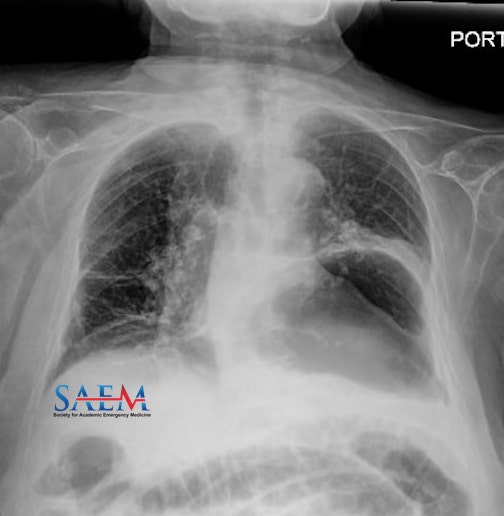
General: Well-appearing; no acute distress; awake, alert, and oriented to date, place, and person Cardiovascular: Regular rate and rhythm; S1/S2 present; 2+ systolic ejection murmur; capillary refill <2 seconds; 2+ pulses in all extremities Respiratory: Lungs clear to auscultation bilaterally with diminished breath sounds in the left lower lobe; no signs of respiratory distress; no accessory muscle use Abdomen: Soft; non-tender; non distended; no palpable masses; no guarding or rebound tenderness; no signs of peritonitis Extremities: Full range of motion of all extremities; nonambulatory at baseline Complete blood count (CBC): WBC 10.8 x 10^3/mcl; Hgb 12 g/dl; Hct 40.1%; Plt 375 x 10^3/mcl Basic metabolic panel (BMP): Na 139 mmol/L; K 3.7 mmol/L; Cl 97 mmol/L; CO2 31 mmol/L; Glucose 170 mg/dL; BUN 10 mg/dL; Cr 0.58 mg/dL; Ca 10.2 mmol/L Liver function test: AST 19 U/L; ALT 7 U/L; Alk Phos 144 U/L Lipase: 11 U/L Venous blood gas (VBG): pH 7.33; pCO2 61.1 mmHg; pO2 38 mmHg; BE -7 mmol/L Lactic acid: 1.56 mmol/L Small bowel obstruction (SBO) secondary to a spigellian hernia with an associated hiatal hernia. The CT demonstrates a spigellian hernia causing a small bowel obstruction. Spigellian hernias are hernias in the spigellian fascia which is located between the semilunar line and the lateral edge of the rectus abdominus muscle. These hernias constitute 0.12% of abdominal wall hernias, making them very rare and difficult to diagnose clinically. Spigellian hernias often go unnoticed until they are strangulated and require surgery. This patient not only had a rare spigellian hernia but also had a hiatal hernia causing the stomach to enter the pleural space. It’s possible that the bowel obstruction worsened the hiatal hernia with the backup of gastric contents and gas.
Take-Home Points

Welcome to the AIR ACS Module! After carefully reviewing all relevant posts from the top 50 sites of the Social Media Index, the ALiEM AIR Team is proud to present the highest quality online content related to ACS emergencies in the Emergency Department. 7 blog posts met our standard of online excellence and were curated and approved for residency training by the AIR Series Board. We identified 4 AIR and 3 Honorable Mentions. We recommend programs give 4 hours (about 30 minutes per article) of III credit for this module.
In an effort to truly emphasize the highest quality posts, we have 2 subsets of recommended resources. The AIR stamp of approval is awarded only to posts scoring above a strict scoring cut-off of ≥30 points (out of 35 total), based on our scoring instrument. The other subset is for “Honorable Mention” posts. These posts have been flagged by and agreed upon by AIR Board members as worthwhile, accurate, unbiased, and appropriately referenced despite an average score.
Interested in taking the ACS quiz for fun or asynchronous (Individualized Interactive Instruction) credit? Please go to the above link. You will need to create a free, 1-time login account.
| Site | Article | Author(s) | Date | Label |
|---|---|---|---|---|
| EM Cases | Reciprocal Change and Occlusion MI | Jesse McLaren, MD | 10 Aug 2021 | AIR |
| EM Cases | Wellen’s Syndrome, Re-occlusion, and MI | Jesse McLaren, MD | 13 Jul 2021 | AIR |
| EM Cases | HyperAcute T waves and Occlusion MI | Jesse McLaren, MD | 4 May 2021 | AIR |
| EM Cases | ST elevations mnemonic and Occlusion MI | Jesse McLaren, MD | 12 Jan 2021 | AIR |
| Rebel EM | The OMI/NOMI Paradigm | Salim Rezaie, MD and Tarlan Hedayati, MD | 3 Oct 2021 | HM |
| Dr. Smith’s ECG blog | Accuracy of OMI ECG findings versus STEMI criteria for diagnosis of acute OMI | Steve Smith, MD and Pendell Myers, MD | 12 Apr 2021 | HM |
| emDocs | Cocaine and ST elevation | Brannon Inman, MD and Lloyd Tannenbaum, MD | 10 Dec 2020 | HM |
(AIR = Approved Instructional Resource; HM = Honorable Mention)
If you have any questions or comments on the AIR series, or this AIR module, please contact us! More in-depth information regarding the Social Media Index.
Thank you to the Society of Academic Emergency Medicine (SAEM) and the Council of EM Residency Directors (CORD) for jointly sponsoring the AIR Series! We are thrilled to partner with both on shaping the future of medical education.


